
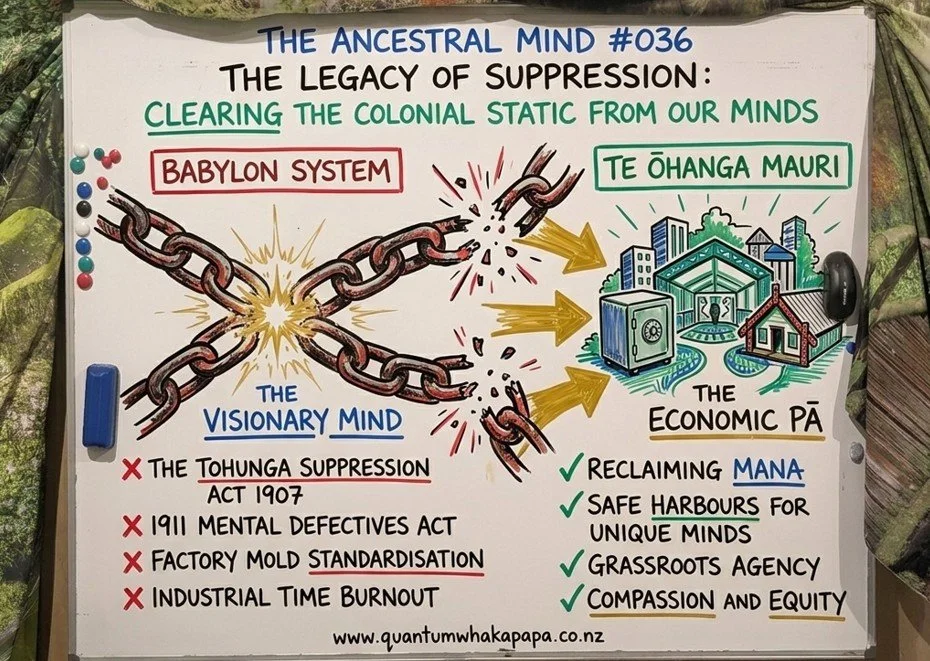
THE ANCESTRAL MIND #036 - THE LEGACY OF SUPPRESSION: CLEARING THE COLONIAL STATIC FROM OUR MINDS
The colonial machine
When we talk about the challenges facing our whānau in Taitokerau, we often look at lost land or broken promises. But there is another side to colonisation that we rarely discuss, the deliberate attempt to standardise the way our minds work. We can call this heavy, corporate setup "Babylon." It’s an outdated operating system that treats our world like a cold machine made of separate parts. It insists that every single person must be squeezed into the same mold to be considered useful. For people with unique minds that thrive on varying rhythms and deep connections, this machine has been completely hostile for over a century.
Silencing our seers
The historical proof of this hostility is very clear. In 1907, the colonial government passed a specific law called the Tohunga Suppression Act. This was a targeted strike against the unique leadership and traditional knowledge systems of the Māori world. What our ancestors recognised as a beautiful spiritual gift guided by Wairua Tapu, the colonial state re-labelled as madness, bad practice, or insanity. By outlawing the practices of our traditional experts, specifically the matakite, or seers, and traditional healers, the Crown effectively criminalised a highly visionary way of thinking. They cut at the roots of our leadership to ensure the community lost its guidance.
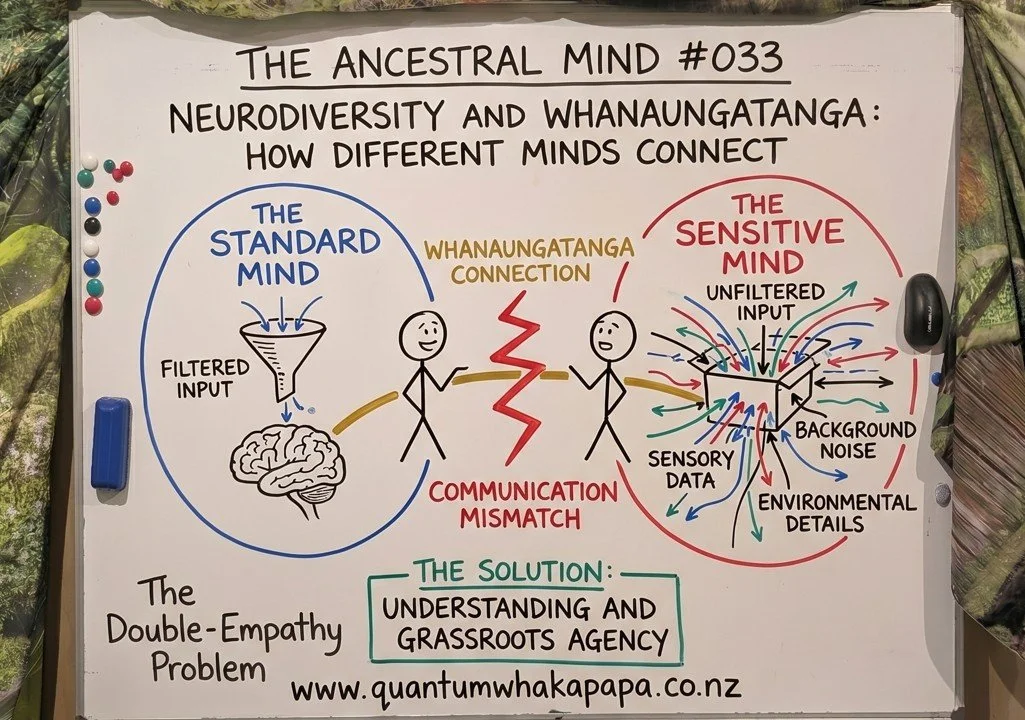
THE ANCESTRAL MIND #033 - NEURODIVERSITY AND WHANAUNGATANGA: THE “DOUBLE EMPATHY PROBLEM”
Redefining family ties
When we talk about whanaungatanga on our marae or around our kitchen tables in Taitokerau, we are talking about something much deeper than just social networking or ticking a bureaucratic box. It is the simple, down-to-earth truth that we are all permanently stitched together as one people. Our ancestors understood that no human being is an isolated island, and that what happens to one person directly affects the rest of the whānau. This deep bond means we share a collective life force that links us to each other, to our ancestors, and to the very land we walk on. For many of our neurodivergent whānau, this connection is not just a nice idea, it is something they feel in their bodies every single day.
Thin sensory filters
Many autistic or ADHD minds operate with very thin filters. A standard mind is excellent at shutting out background noise, like the hum of a fridge, a flickering fluorescent light, or people talking down the hall, to keep life simple and manageable. But a highly sensitive mind keeps the windows wide open, taking in every single sound, light, and change in the room all at once. When a young person walks into a busy shop or classroom and feels instantly exhausted, the modern system is quick to call it a behavioral breakdown or a disorder. In reality, their mind is simply trying to process every piece of information around them instead of blocking it out. It is a highly detailed way of seeing the world, but it takes an enormous amount of daily energy to manage.
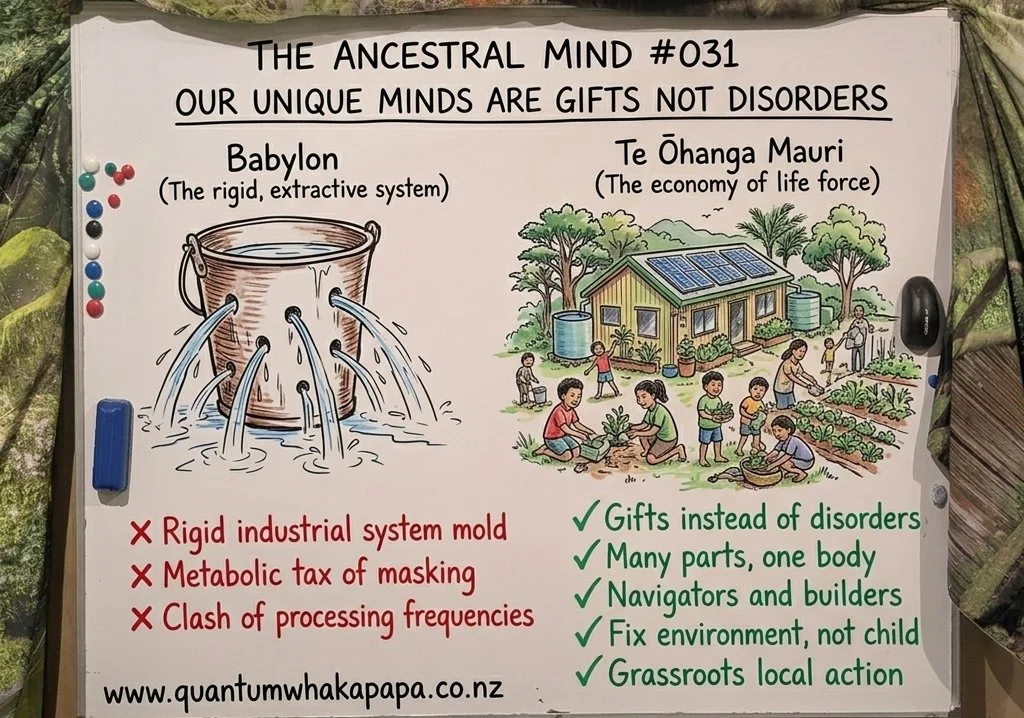
THE ANCESTRAL MIND #031 - OUR UNIQUE MINDS ARE GIFTS NOT DISORDERS
Real talk about labels
Let us be completely honest about what is happening to our kids here in Taitokerau. Every single week, parents across Taitokerau are completely exhausted and stressed out because their child has been sent home from school again or labeled as a major problem in the classroom. We are told by outside experts and official agencies that conditions like Takiwātanga, what people call Autism, or Aroreretini, known as ADHD, are behavioral disorders that need to be managed with medication or special clinics. But looking closely at our families, I see a much simpler truth. The problem is not with our children, it is with a rigid system that expects every single mind to work exactly the same way.
This post marks the start of a plain-spoken, ten-part series about our ancestral mind. Over the coming weeks, we are going to look at the hard realities of our community, from classrooms that feel like cages to the genuine need for practical skills on our land and in technology. I’m not interested in grand, wishy-washy academic theories. What we need is real, grassroots solutions that make sense to everyday people.
The industrial assembly line
The modern education and work system was built over a century ago to turn people into productive workers for factories. It relies entirely on standardisation, strict clock-time, and forcing children to sit perfectly still for hours on end. When a child with an active, fast-moving mind does not fit that narrow mold, the system protects itself by calling the child broken. It is a very lazy way of explaining human differences, and it is causing real harm to our whānau.