
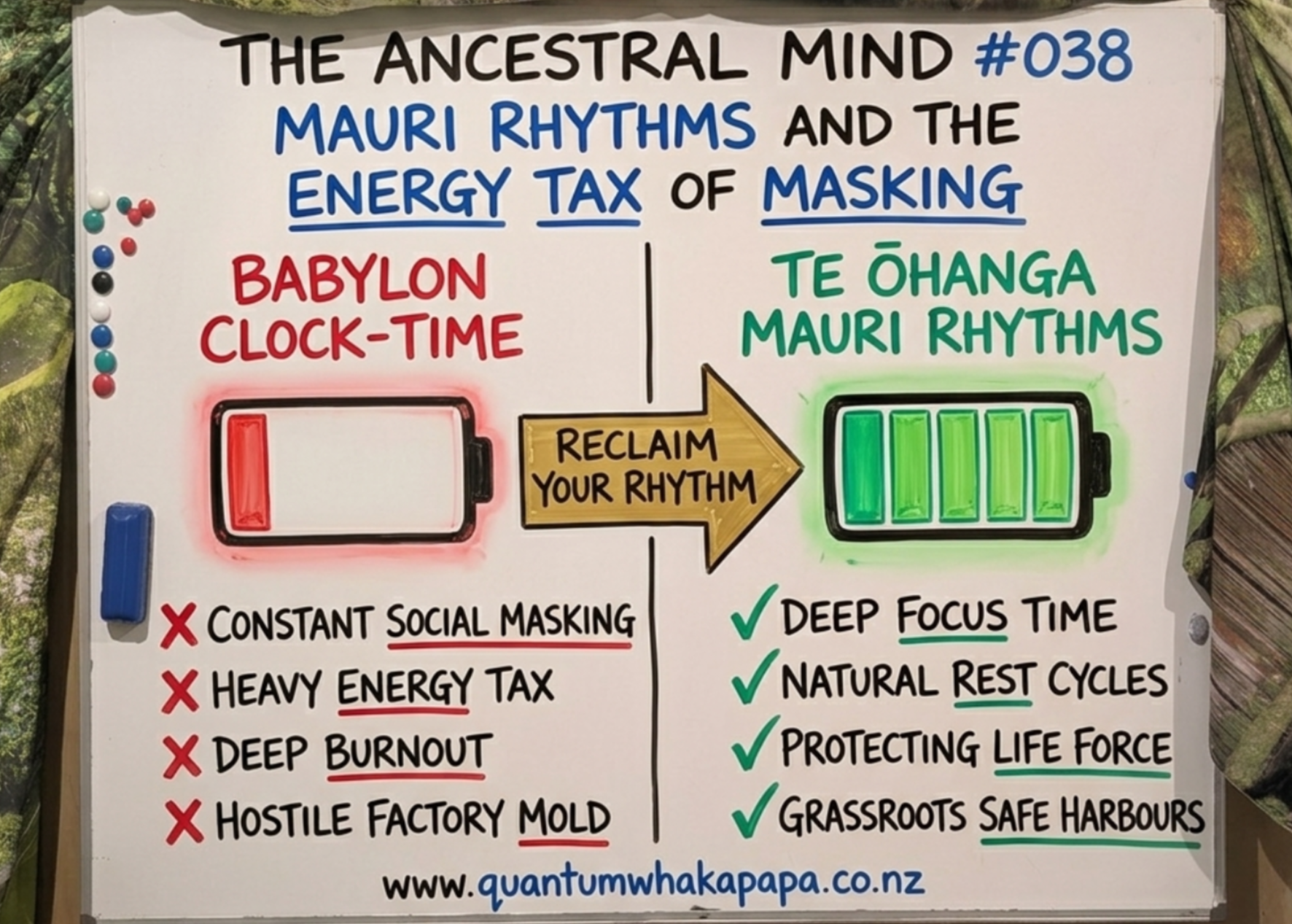
THE ANCESTRAL MIND #038 - MAURI RHYTHMS AND THE ENERGY TAX OF MASKING
Rhythms of the land
In Taitokerau, we understand that life has its own natural seasons. You cannot rush the growth of a kūmara, and you cannot force the tide to turn before its time. Yet, when it comes to our daily work and school lives, we are constantly forced into an industrial system that completely ignores these natural cycles. We are expected to show up, sit still, and perform at a constant, uniform rate from 9-to-5, regardless of how our minds are actually wired. For many in our neurodivergent community, this heavy pressure to live by a rigid corporate clock is a major source of exhaustion.
Clock-time versus natural rhythms
The modern system runs on a mechanical concept we can call factory clock-time. It treats every hour of the day as identical and expects every single worker to behave like a frictionless gear in a corporate machine. But many unique minds naturally operate on variable rhythms. Our focus is not linear; it is cyclical, shifting between periods of deep, intense focus and periods of quiet rest.
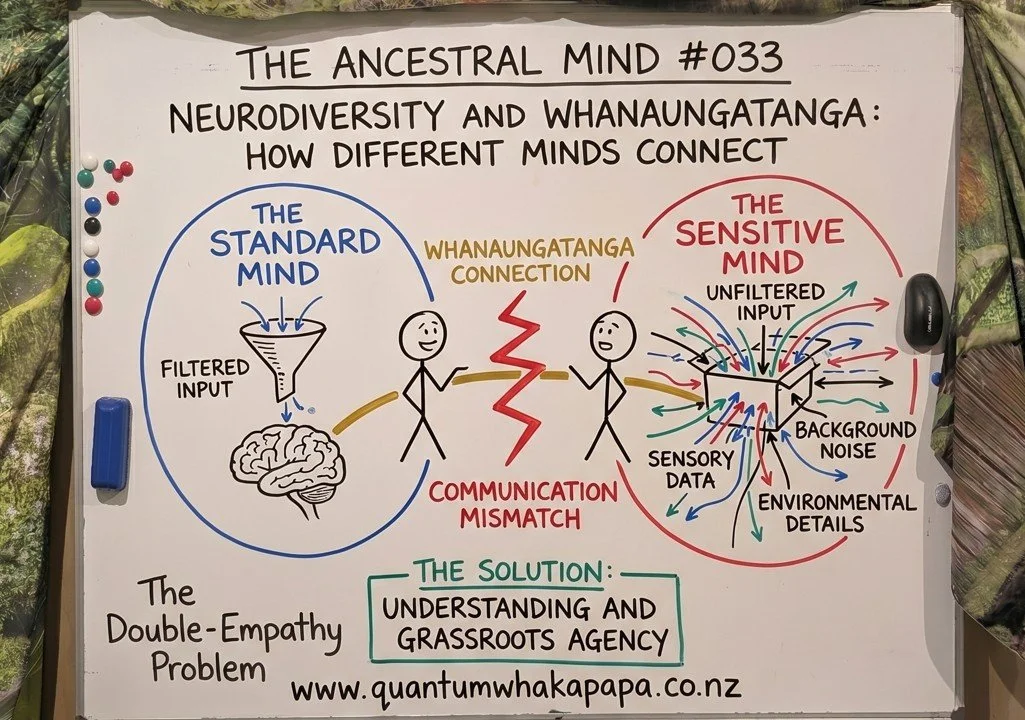
THE ANCESTRAL MIND #033 - NEURODIVERSITY AND WHANAUNGATANGA: THE “DOUBLE EMPATHY PROBLEM”
Redefining family ties
When we talk about whanaungatanga on our marae or around our kitchen tables in Taitokerau, we are talking about something much deeper than just social networking or ticking a bureaucratic box. It is the simple, down-to-earth truth that we are all permanently stitched together as one people. Our ancestors understood that no human being is an isolated island, and that what happens to one person directly affects the rest of the whānau. This deep bond means we share a collective life force that links us to each other, to our ancestors, and to the very land we walk on. For many of our neurodivergent whānau, this connection is not just a nice idea, it is something they feel in their bodies every single day.
Thin sensory filters
Many autistic or ADHD minds operate with very thin filters. A standard mind is excellent at shutting out background noise, like the hum of a fridge, a flickering fluorescent light, or people talking down the hall, to keep life simple and manageable. But a highly sensitive mind keeps the windows wide open, taking in every single sound, light, and change in the room all at once. When a young person walks into a busy shop or classroom and feels instantly exhausted, the modern system is quick to call it a behavioral breakdown or a disorder. In reality, their mind is simply trying to process every piece of information around them instead of blocking it out. It is a highly detailed way of seeing the world, but it takes an enormous amount of daily energy to manage.