
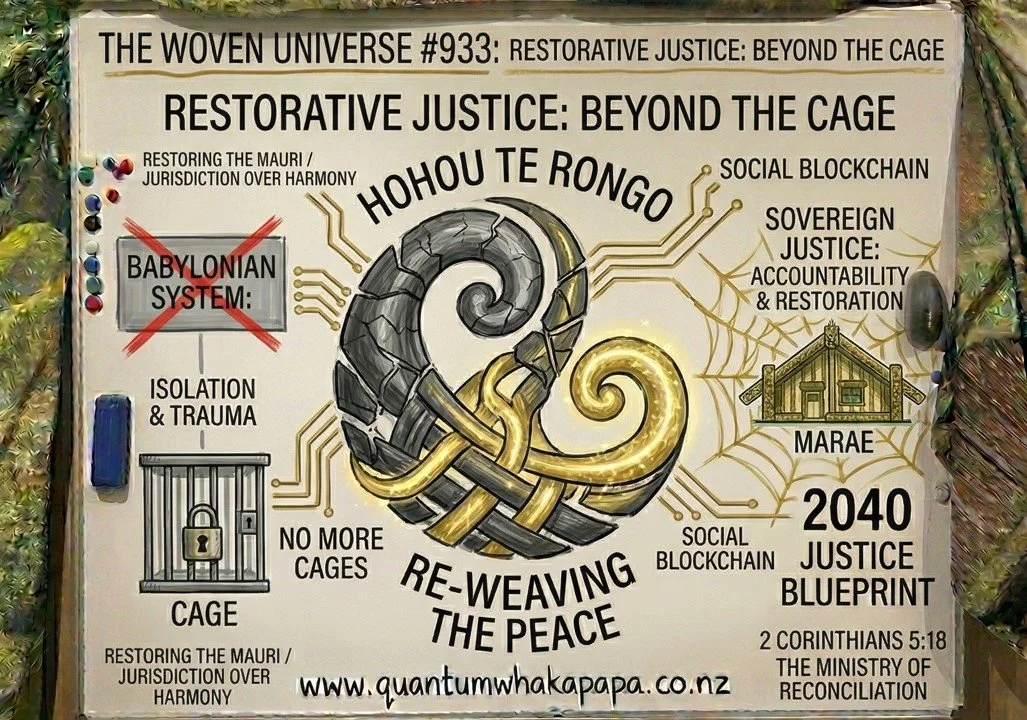
THE WOVEN UNIVERSE #933 - RESTORATIVE JUSTICE: MOVING BEYOND INCARCERATION
The Jurisdictional Shift in Justice
One of the most profound failures of the Babylonian administrative state is its approach to "correction." The current system operates on a low-frequency logic of punishment, isolation, and the removal of the individual from their social context. According to Research Report #256, sovereign hapū jurisdiction requires a total departure from this model. We are moving away from the "punitive" and toward the "restorative."
In our framework, a "ping" is a targeted spiritual signal used to verify a location, and the current justice system sends a signal of trauma that echoes through generations. Restorative justice, or Hohou te Rongo, sends a signal of equilibrium. It recognises that "crime" is often a system error or a breach in the social blockchain that must be repaired, not just punished.
From Punishment to Restoration (Hohou te Rongo)
Under hapū jurisdiction, the goal of social regulation is the maintenance of Mauri and the restoration of Tapu.
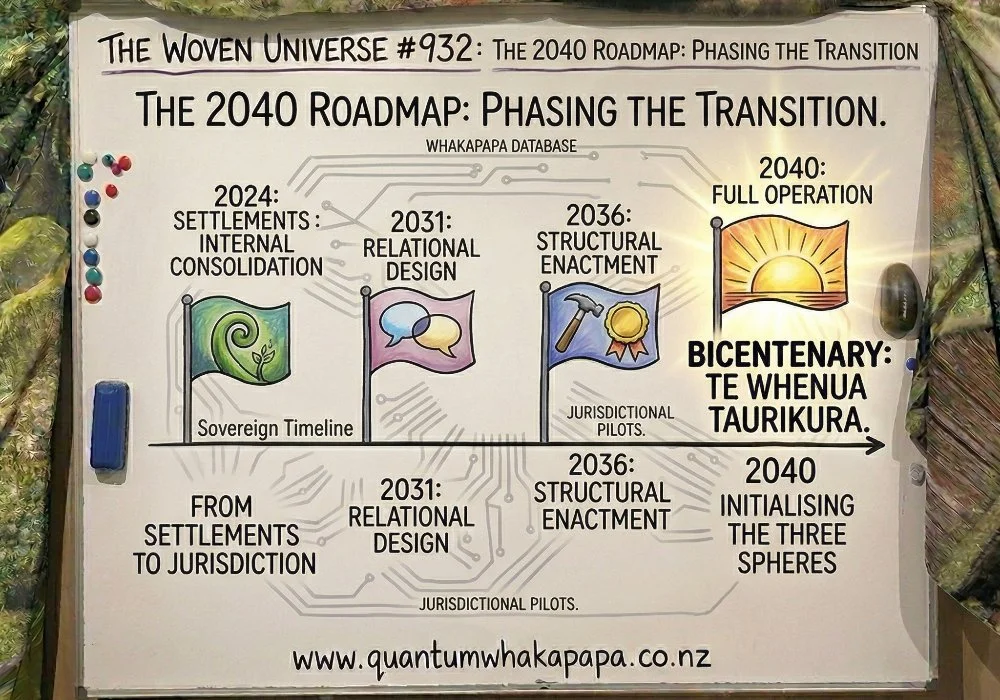
THE WOVEN UNIVERSE #932 - THE 2040 ROADMAP: PHASING THE TRANSITION
The Systematic Boot-Up
Constitutional transformation is not an overnight event; it is a systematic "boot-up" of an original operating system. Achieving a transformed constitutional relationship by 2040, the bicentenary of Te Tiriti o Waitangi, requires a phased approach of preparation, engagement, and structural enactment.
In our framework, a "ping" is a targeted spiritual signal used to verify a location. Over the next 14 years, the goal is to send pings into every corner of tribal jurisdiction to ensure the "hardware" of our assemblies is ready for full sovereign operation.
The Four Phases of Transformation
Research Report #256 outlines a strategic timeline to move from colonial unilateralism to a consensual, multi-sphere democracy.
Phase 1: Internal Consolidation (2024–2028)
The focus is on returning hapū to a position of authority and "getting the kaupapa right".
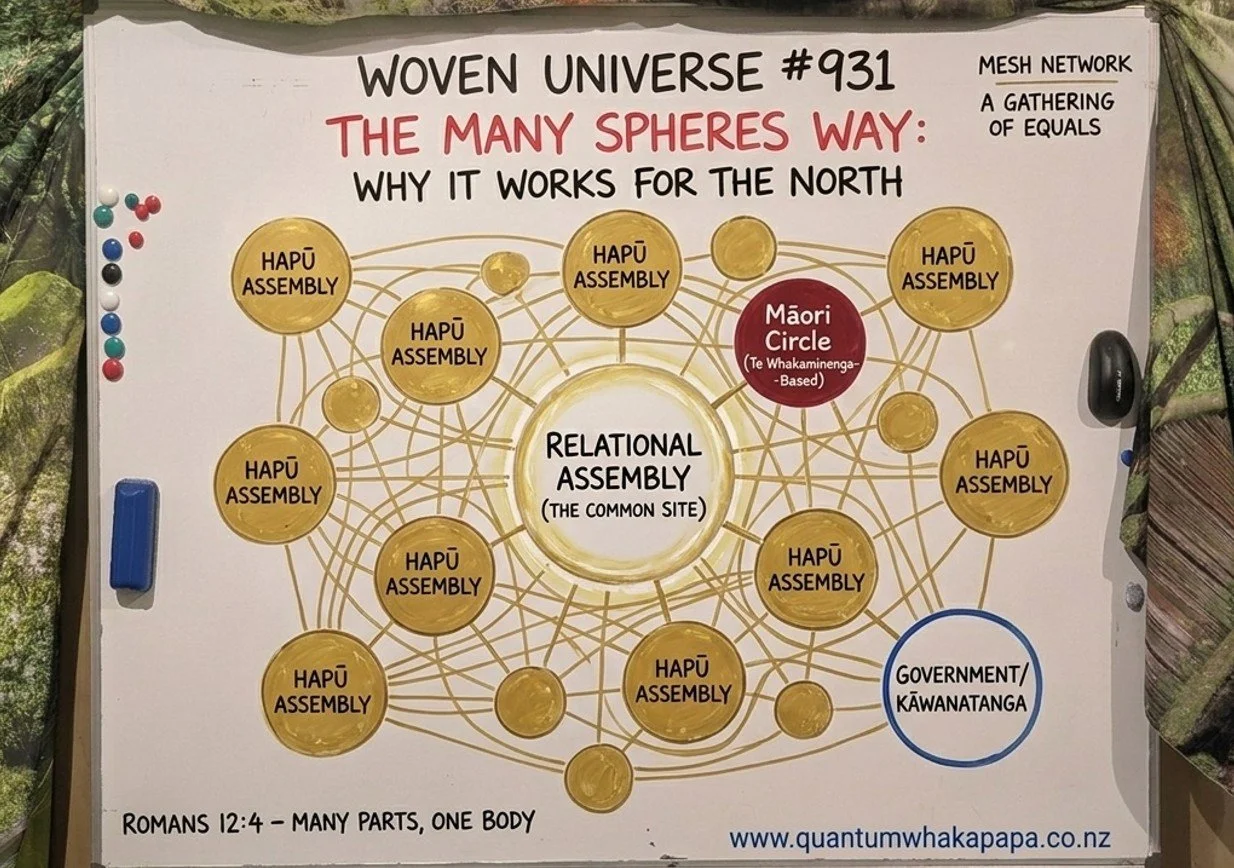
THE WOVEN UNIVERSE #931 - THE MULTI-SPHERE MODEL: WHY IT FITS THE NORTH
Designing the Table
When we discuss fixing our constitutional relationships in New Zealand, we are not simply looking for a seat at someone else's table. We are designing the table itself. For our whānau and hapū across Taitokerau, true governance is about creating a system that perfectly mirrors our original social software. Our local authority has never been located in a single peak or a centralised power structure. Instead, it flows across a beautifully decentralised network of sovereign nodes where each community holds its own unique light.
Real progress can only occur when we shift our focus from pure economic growth to true equity, ensuring we look closely at how the pie is shared across all communities. True social investment is a long-term ROI for the collective well-being of our people and the protection of our natural environment. To make this a reality, our constitutional design must protect local, grassroots agency, allowing those who live on the land to fix the soil and address root causes directly.
Why Centralisation Fails
While other iwi may choose models that favor a single national body, those designs regularly fail to account for the absolute independence of the northern hapū. Historically, the North has always operated as a vibrant confederation of equals rather than a centralised system. This is why the Matike Mai Aotearoa report, particularly on page 105, points to the Multi-Sphere Model, known as Model 4, as the most compatible architecture for our region.
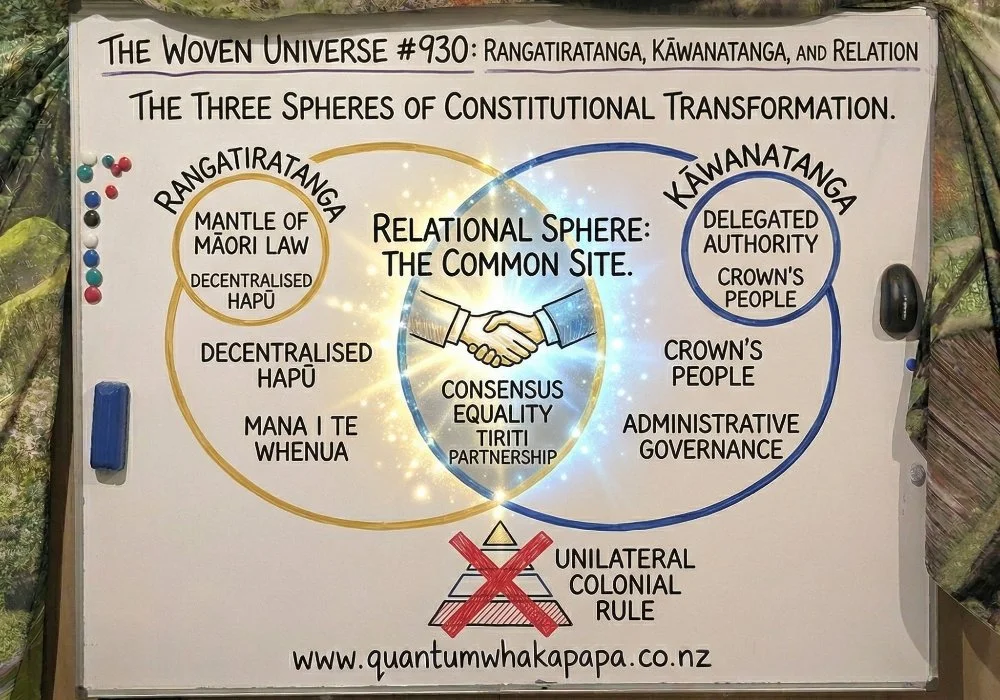
THE WOVEN UNIVERSE #930 - THE THREE SPHERES OF POWER: RANGATIRATANGA, KĀWANATANGA, AND RELATIONAL
As we navigate the roadmap toward 2040, we must move beyond the "one law for all" fallacy that has stifled our constitutional growth for nearly two centuries. True transformation requires a shift in how we conceptualise power. Research Report #256 adopts the Matike Mai Aotearoa framework, which envisions governance through three distinct yet interconnected spheres of influence.
In our framework, a "ping" is a targeted spiritual signal used to verify a location and establish a connection, and these spheres represent the verified locations where authority is held and exercised. This model allows for both independent authority and a shared space for relational democracy.
The Three-Sphere Model
The functional distinctions between these jurisdictional spaces are as follows:
The Rangatiratanga Sphere (Māori Sphere): This is the site of decisions for Māori, by Māori, governed by the mantle of Māori law and ancestral tikanga.
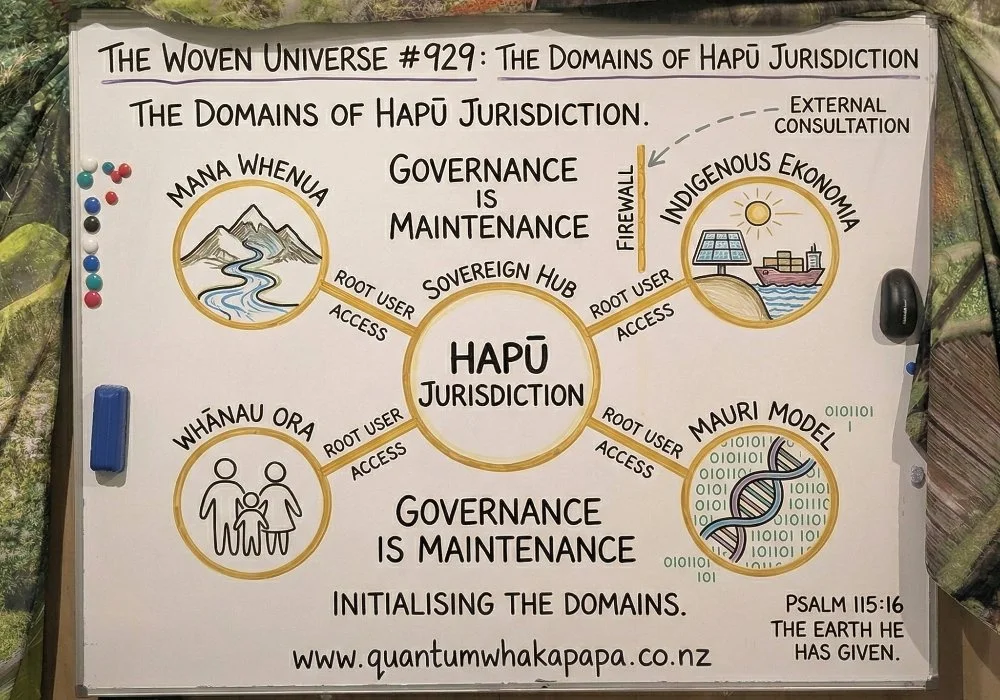
THE WOVEN UNIVERSE #929 - THE DOMAINS OF HAPŪ JURISDICTION
The Jurisdictional Application
In our previous post, we established the "Why" of sovereignty, defining it as an ontological reality initialised by the Source. If sovereignty is the "Operating System," then the Domains of Jurisdiction are the specific applications where that power is exercised. According to Research Report #256, hapū jurisdiction is not a vague concept, it is a technical map of specific domains where the "Root User" access of the people must be restored.
In our framework, a "ping" is a targeted spiritual signal used to verify a location and establish a connection, and the hapū exercises its authority by sending a clear signal into every area of human existence. We are moving away from being "consulted" by the state to becoming the primary constructors of our own reality.
The Four Domains of the Sovereign Server
1. Territorial and Environmental Stewardship (Mana Whenua)
This is the governance of the physical hardware, the land, the forests, and specifically the freshwater (wai). In the Woven Universe, water is not a commodity, it is a taonga with its own mauri. Sovereign hapū exercise absolute authority over their natural resources, ensuring they are managed for life and health (negentropy) rather than just extraction.
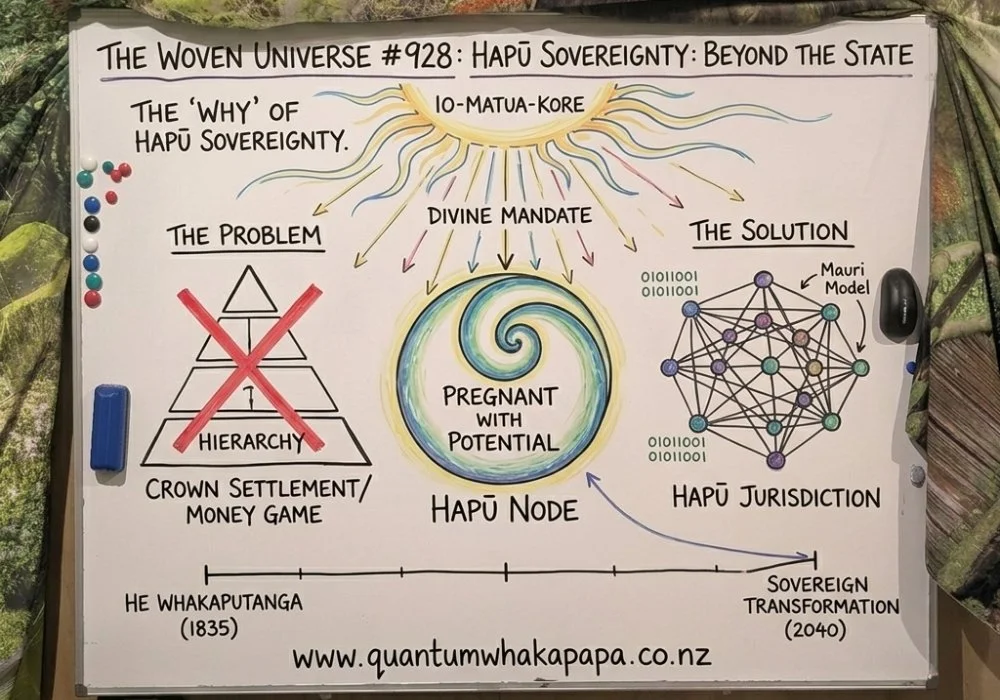
THE WOVEN UNIVERSE #928 - THE "WHY" OF HAPŪ SOVEREIGNTY
The Ontological Reality
The assertion of inherent sovereignty by Ngāpuhi Nui Tonu is not a contemporary political claim formulated within the constraints of a post-colonial framework. It is the declaration of an ontological reality rooted in the primordial origins of the universe. To understand why hapū sovereignty is the only path forward, one must first recognise the source of that authority: it begins with Io-Matua-Kore, the Parentless One, from whom all mana and mauri emanate.
As reality emerged from Te Korekore, the realm of absolute potentiality, it established a "Hilbert space" of all possible quantum states and sovereign destinies. This metaphysical foundation implies that the authority to govern is a divine mandate, pre-existing any colonial intervention and remaining unassailable through the continuous lineage of whakapapa.
Why the Hapū?
In the Ngāpuhi context, the hapū is the primary unit of political will and collective growth. The term itself, meaning "to be pregnant," signifies a state of communal gestation and the potential for expansion.