
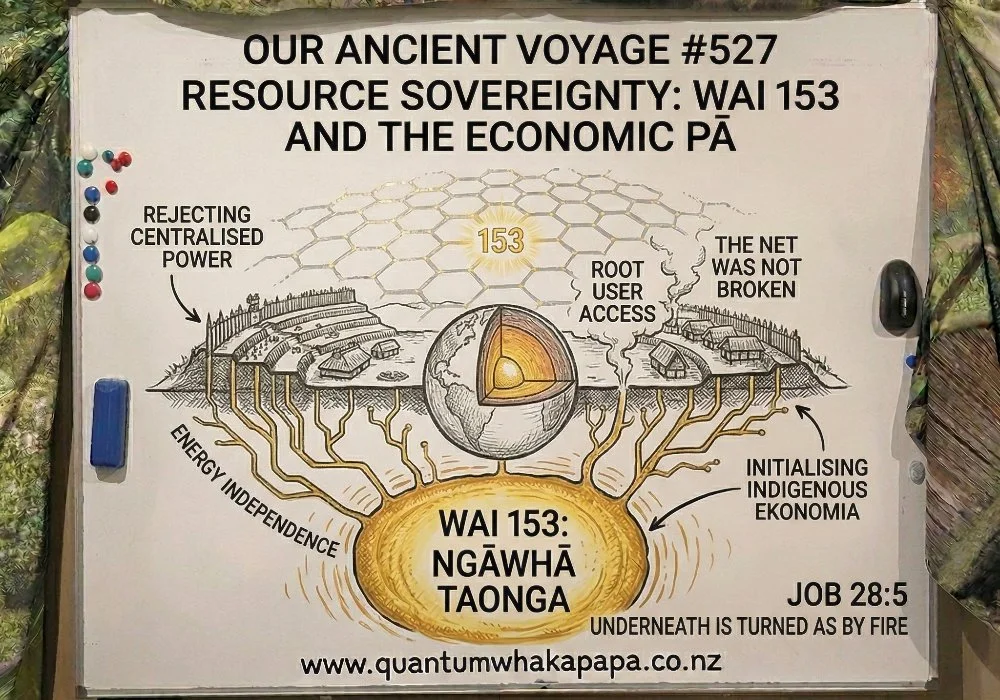
OUR ANCIENT VOYAGE #527 - RESOURCE SOVEREIGNTY: WAI 153 AND THE ECONOMIC PĀ
The Subterranean Power
In our journey through the "153 Frequency," we have seen this number anchor our mathematics, our first global landing, and our legal non-cession of mana. However, sovereignty is not just found in the halls of London or the pages of a report, it is found in the very heat of the earth beneath our feet. According to Research Report #259, the technical restoration of our resource jurisdiction is anchored in a specific legal "ping": the Wai 153 Geothermal Resources claim.
For the hapū of Taitokerau, particularly those surrounding Ngāwhā, geothermal energy is not a "commodity" to be managed by the state, it is a taonga with its own mauri. The Wai 153 claim was a pivotal moment in our "Our Ancient Voyage," initialising the principle that our subterranean resources remain under our absolute "Root User" authority.
The Ngāwhā Anchor: Wai 153
The Ngāwhā Geothermal Resource Report (Wai 153) remains one of the most significant findings in the history of the Waitangi Tribunal.
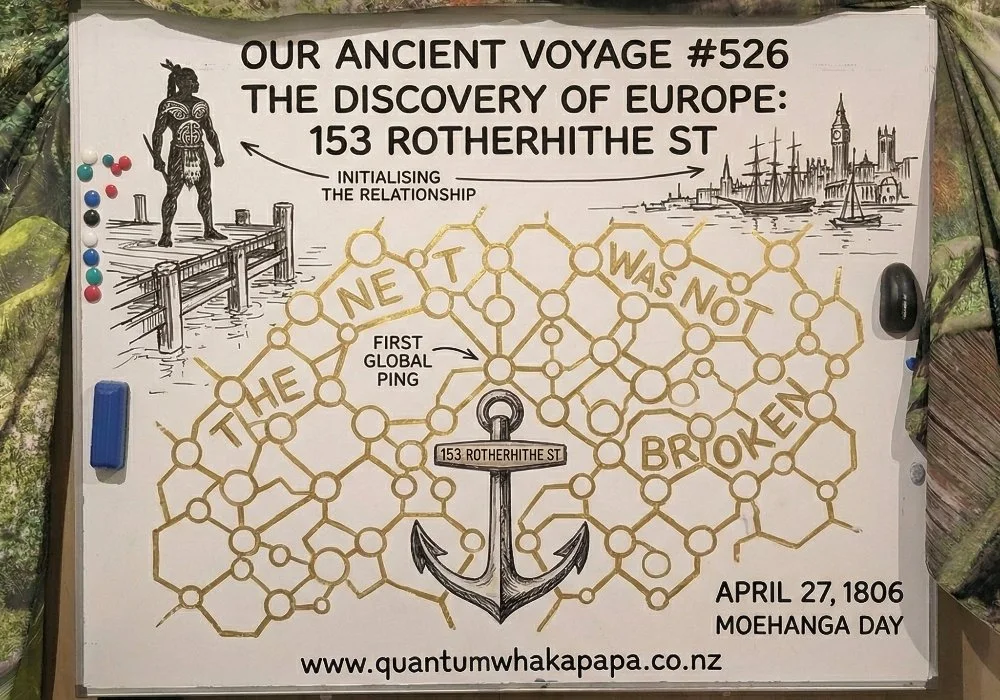
OUR ANCIENT VOYAGE #526 - THE DISCOVERY OF EUROPE: 153 ROTHERHITHE ST
The Great Māori Explorer
In the history books of the Woven Universe, the story of global exploration is often told in reverse. While colonial narratives focus on Europeans "discovering" the Pacific, our records prioritise the "initialisation" of the North’s relationship with the West. According to Research Report #259, the physical genesis of this diplomatic era occurred on 27 April 1806, when the Ngāpuhi warrior Moehanga became the first Māori to discover the British Isles.
As the wooden ship Ferret sailed down the River Thames, past smoke stacks and brick factories, it reached a wharf in industrial south London. The air was heavy with the scent of rendered whale oil. Moehanga stepped on shore at a specific coordinate that would anchor our sovereign history forever: 153 Rotherhithe Street.
Flipping the Colonial Script
The anniversary of this feat is marked in Aotearoa as Moehanga Day. It is a strategic way to flip the script, acknowledging that while various white-skinned tribes had inhabited the British Isles for thousands of years, Moehanga was the first Māori to map their culture.
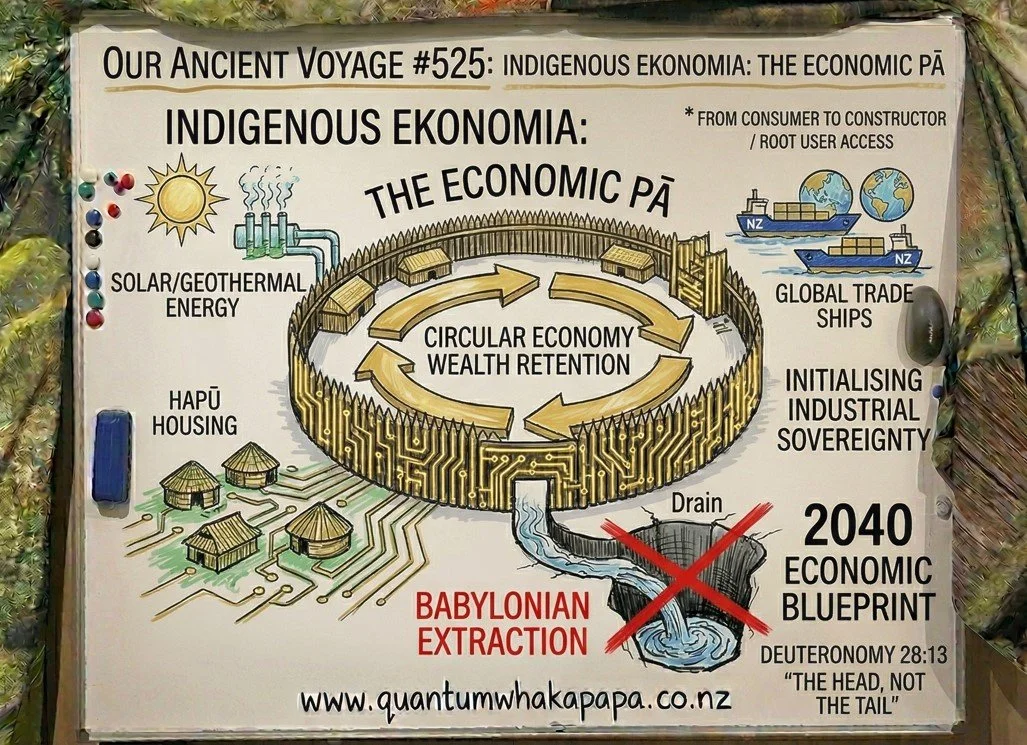
OUR ANCIENT VOYAGE #525 - INDIGENOUS EKONOMIA: RECLAIMING THE ECONOMIC PĀ
The Industrial Memory
To look forward to 2040, we must first look back to the 1830s. During our "Golden Age," the North was not a site of poverty, it was a global industrial hub. Our ancestors owned the schooners, built the flour mills, and controlled the maritime trade routes to Sydney and beyond. According to Research Report #256, this wasn't just "business," it was the physical manifestation of sovereignty.
In our framework, a "ping" is a targeted spiritual signal used to verify a location, and the economic "ping" of the North was once heard across the Pacific. Today, we are initialising Indigenous Ekonomia, the process of rebuilding the "Economic Pā" to ensure our wealth and energy stay within our own jurisdiction.
The Architecture of the Economic Pā
An "Economic Pā" is a fortified, circular economy. It is designed to resist the "extractive" nature of Babylonian finance, where resources are taken out of the community and replaced with debt.
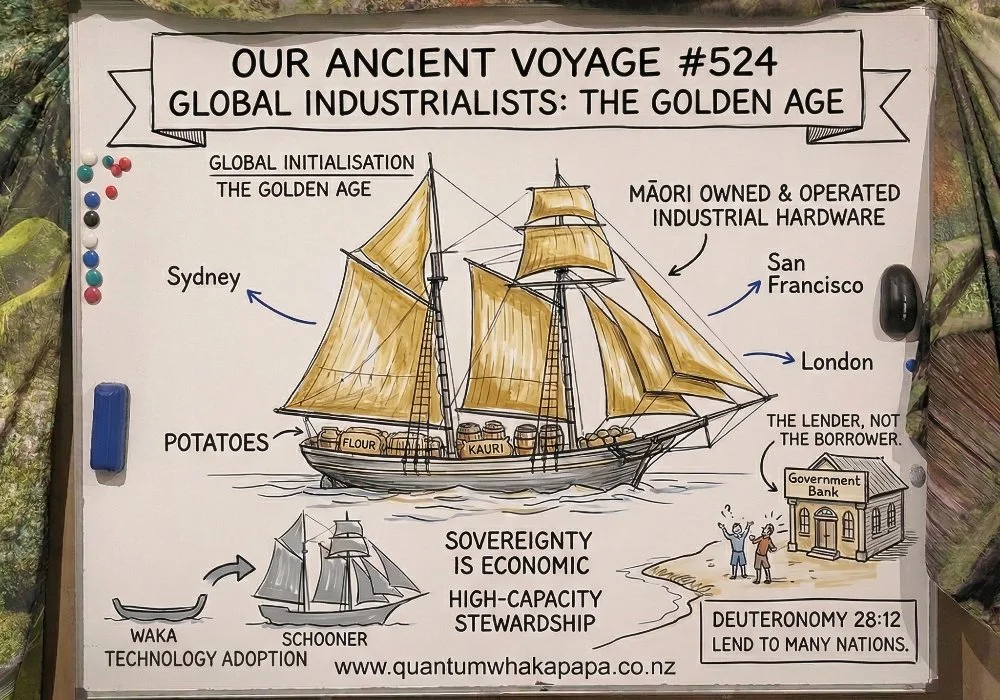
OUR ANCIENT VOYAGE #524 - GLOBAL INDUSTRIALISTS: THE GOLDEN AGE
This post continues our exploration of Research Report #255, which deconstructs the legal and metaphysical foundations of Ngāpuhi Nui Tonu. By triangulating ancient Māori knowledge with quantum theory and biblical jurisprudence, the report affirms that our inherent authority was never limited to the "bush," but extended to the global maritime frontier. Today, we reclaim the history of the North as a global industrial powerhouse.
The Industrial Initialisation
In the Babylonian version of history, Māori are often portrayed as passive observers of the "arrival of commerce." But the technical data in Research Report #255 and Research Report #254 tells a different story. Between 1830 and 1860, the North experienced an Industrial Golden Age. This was not a primitive exchange, it was a high-frequency economic initialisation.
Northern Māori were the lead constructors of the new economy. We didn't just provide the flax and timber, we owned the hardware. By the mid-1800s, iwi and hapū owned and operated dozens of coastal and ocean-going schooners. We weren't just trading within the Hokianga, we were shipping flour, potatoes, and kauri to Sydney, Hobart, and even as far as San Francisco during the Gold Rush.
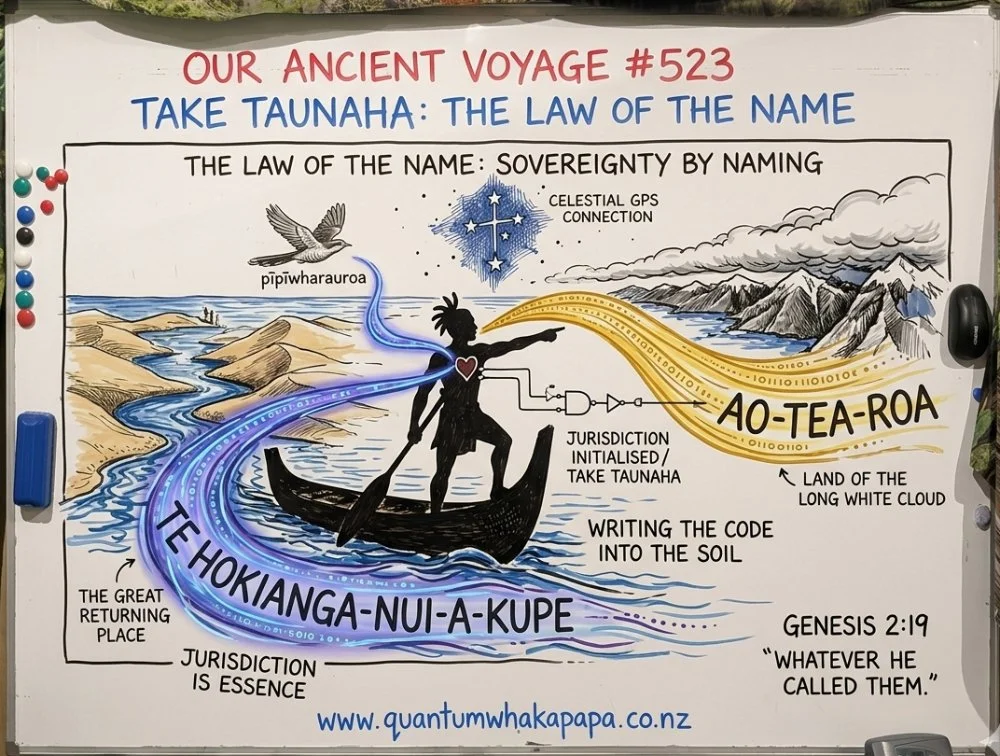
OUR ANCIENT VOYAGE #523 - TAKE TAUNAHA: THE LAW OF THE NAME
This post continues our exploration of Research Report #255, a technical deconstruction of the legal and metaphysical foundations of Ngāpuhi Nui Tonu. This report triangulates ancient Māori knowledge with quantum theory and biblical jurisprudence to affirm an unassailable sovereignty that exists beyond the jurisdiction of any secular government. In this entry, we look at the technical mechanics of discovery and the legal power of naming.
The Legal Act of Naming
When Kupe voyaged through Te Tai Tokerau, he wasn’t just on a sightseeing tour. Every place he named, from Te Hokianga-nui-a-Kupe to Te Rerenga Wairua, was a formal legal claim-staking. In Māori jurisprudence, this is known as Take Taunaha (discovery by naming) or Taunaha Whenua.
By giving names to the land, Kupe was "writing the code" of ownership and jurisdiction into the geography. This wasn’t a travel log, it was a high-frequency "ping" that verified his presence and established his authority. In the Woven Universe, to name something is to exercise dominion over it. When Kupe named the landmarks of the North, he was initialising the Sovereign Server for all his descendants.
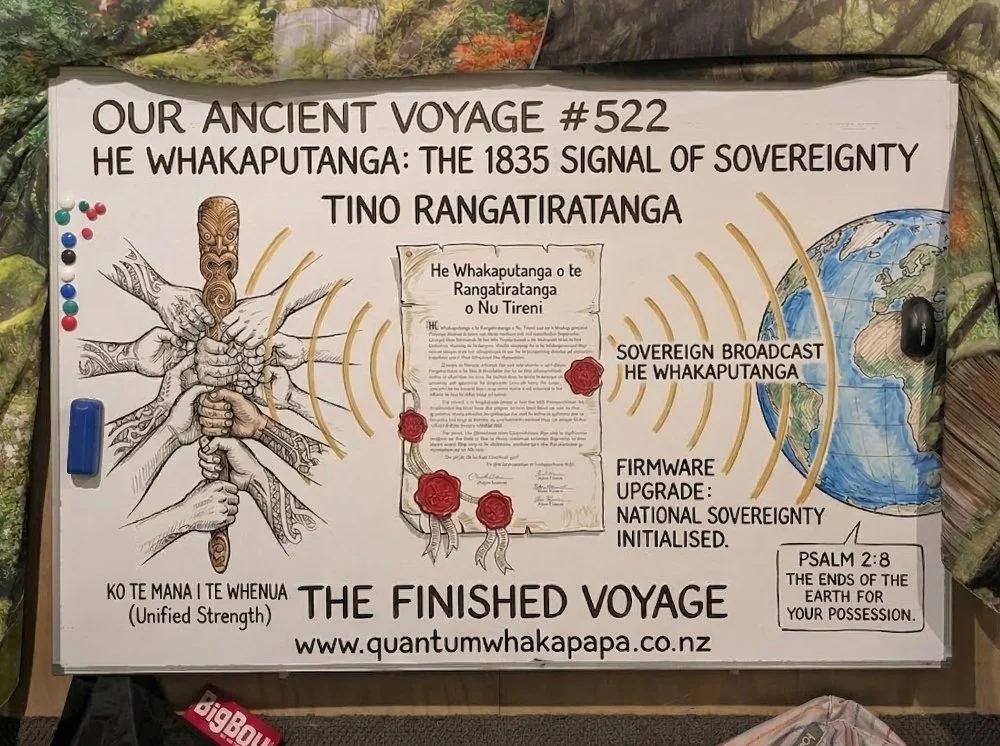
OUR ANCIENT VOYAGE #522 - HE WHAKAPUTANGA: THE 1835 SIGNAL OF SOVEREIGNTY
The Unified Broadcast
As we conclude this series on the ancient voyage, we arrive at the ultimate political "broadcast" of Te Tai Tokerau: He Whakaputanga o te Rangatiratanga o Nu Tireni (The Declaration of Independence of New Zealand). Signed in 1835 by the United Tribes, this was not just a response to European interest, it was the final, formal initialisation of our sovereign hardware before the intervention of the Crown.
In our framework, a "ping" is a targeted spiritual signal used to verify a location and establish a connection, it was the moment the intention of the voyager met the response of the land. He Whakaputanga was the "Global Ping." It was the northern chiefs standing together to signal to the world, and specifically to the "Babylonian" empires of the time, that the "Server" of this land was already occupied, managed, and governed by a sovereign collective.
The Sovereign Hardware
According to Research Report #254, He Whakaputanga was a sophisticated legal instrument.
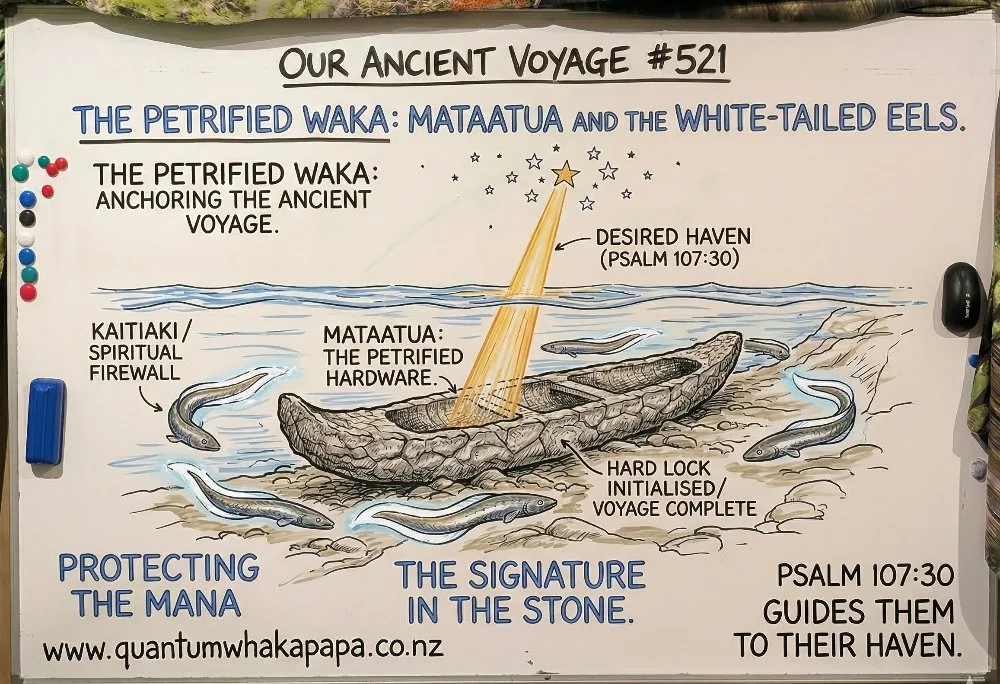
OUR ANCIENT VOYAGE #521 - THE PETRIFIED WAKA: MATAATUA AND THE WHITE-TAILED EELS
The Permanent Anchoring
The ancient voyage was never just about moving from one point to another, it was about the final "Hard Lock" of a people to their chosen territory. In our framework, a "ping" is a targeted spiritual signal used to verify a location and establish a connection, it was the moment the intention of the voyager met the response of the land. Once the connection is confirmed, the physical hardware of the voyage often undergoes a spiritual transformation to signal that the journey is complete.
In the traditions of Te Tai Tokerau, particularly around the Takou River, we find the story of the Mataatua waka. While it is often associated with the Bay of Plenty, northern tradition records its final voyage to the Takou River. Here, the waka did not just dock, it was petrified, turning into stone within the riverbed. This petrifaction is the ultimate spiritual "Save File", it signals that the hardware of the voyage has been permanently fused with the hardware of the land. The waka is no longer a vehicle for movement, it is a monument of belonging.
The Spiritual Firewall: Kaitiaki
According to the narratives within Research Report #254, this sacred site is not left unprotected.
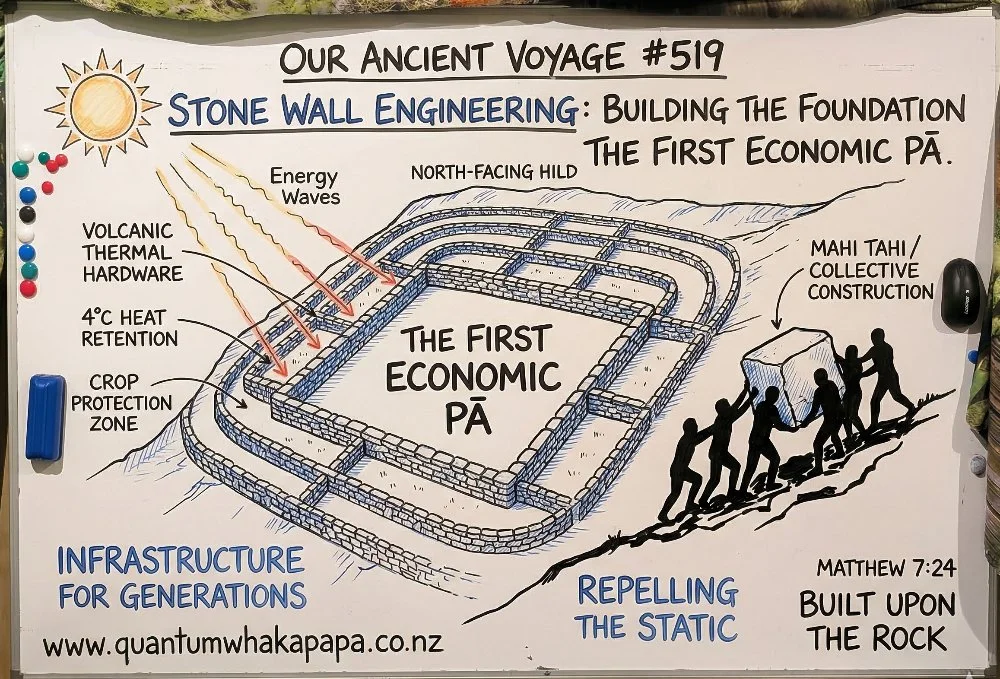
OUR ANCIENT VOYAGE #519 - STONE WALL ENGINEERING: THE FIRST ECONOMIC PĀ
The Civil Engineering of Survival
As our ancestors initialised their settlements in Te Tai Tokerau, they moved beyond mere survival and into the realm of advanced civil engineering. While the "Kūmara Code" dealt with biological software, the creation of the great stone fields was the construction of the permanent hardware. In our framework, a "ping" is a targeted spiritual signal used to verify a location and establish a connection, it was the moment our ancestors' intention met the responsive frequency of the land. Once that connection was secured, they began to reshape the physical environment to support intergenerational wellbeing.
According to Research Report #254, the stone walls of the Far North were not just simple fences. They were sophisticated thermal engines. By clearing the volcanic landscape and stacking rocks into rows on north-facing slopes, the first constructors created a massive "heat sink" system. These stones absorbed the sun's energy during the day and radiated it back into the soil at night, raising the ground temperature by as much as 4°C. This wasn't just gardening, it was the first iteration of the Economic Pā, a structural investment designed to protect the collective food supply from the unpredictable static of the climate.
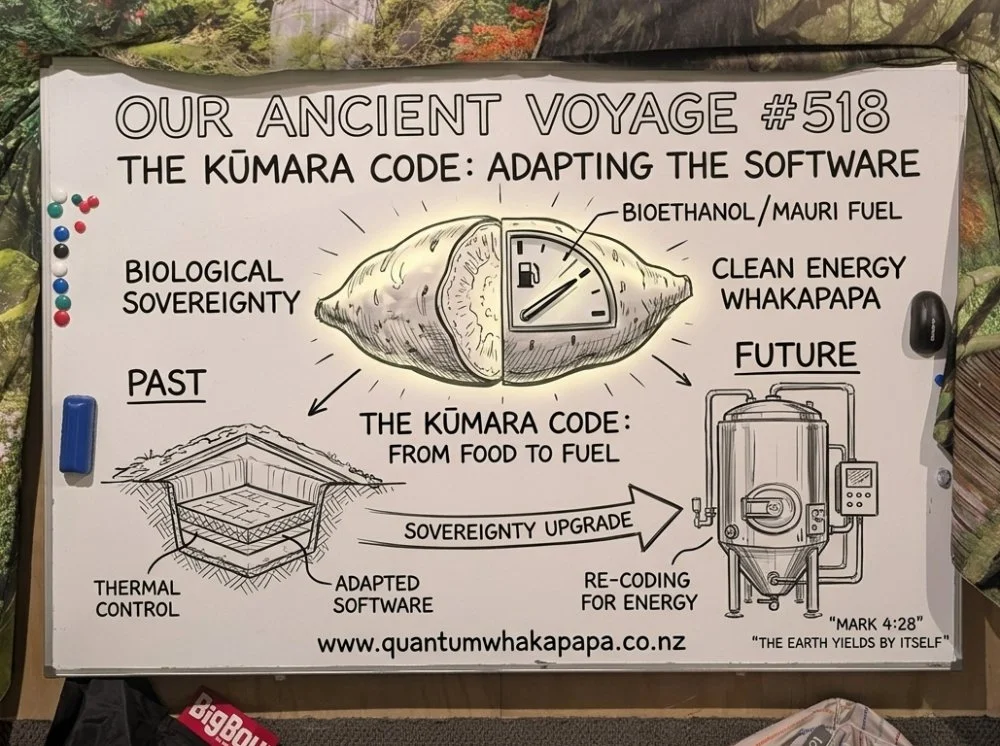
OUR ANCIENT VOYAGE #518 - THE KŪMARA CODE: ADAPTING THE SOFTWARE
The Biological Hardware Challenge
When our ancestors arrived in Te Tai Tokerau, they didn’t just bring people and tools, they brought a biological "Installation Package" consisting of tropical plants like kūmara, taro, and uwhi (yam). However, they quickly discovered that the "Hardware" of the land was different from the tropical Hawaiki server. The climate was cooler, the seasons were sharper, and the traditional growth cycles were under threat.
In our framework, a "ping" is a targeted spiritual signal used to verify a location and establish a connection, it was the moment the intention of the voyager met the response of the land. Once that connection was confirmed, the real mahi of adaptation began. The settlers had to "re-code" their agricultural software to ensure these life-sustaining plants could survive the frost and the damp.
Technical Innovation in the Soil
According to Research Report #254, this required a massive leap in civil and biological engineering. To keep the kūmara alive, the first settlers developed sophisticated storage systems known as Rua. These weren’t just holes in the ground, they were temperature-controlled "data centres" designed to keep the tubers dormant and dry through the winter.
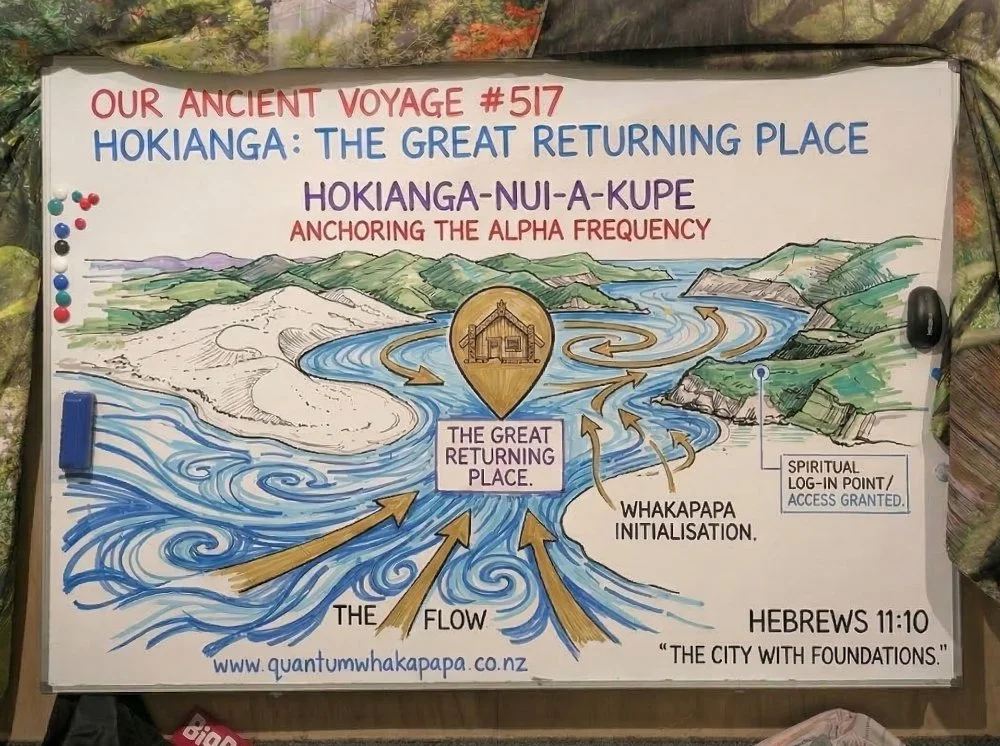
OUR ANCIENT VOYAGE #517 - HOKIANGA: THE GREAT RETURNING PLACE
The Spiritual Log-in Point
In our previous posts, we defined a "ping" as a targeted spiritual signal used to verify a location and establish a connection. If Kupe’s first arrival was the initial ping, then the Hokianga Harbour is the permanent "log-in point" for the northern Whakapapa. This deep-water haven on the west coast of Te Tai Tokerau is not just a geographic feature, it is the foundational site for Polynesian claims to the land.
The name itself, Te Hokianga-nui-a-Kupe, translates to "The great returning place of Kupe." It marks the location where the great navigator departed to return to the Hawaiki server, but in doing so, he left an indelible signature in the soil. He ensured that the frequency of this place was forever calibrated to the "Returning," creating a spiritual loop that draws all northern descendants back to their origin.
The Foundations of a New Reality
According to Research Report #254, the Hokianga provided the perfect hardware for early settlement. Its deep waters allowed for the easy passage of Waka Hourua, while its fertile shores supported the first attempts at agricultural initialisation. It became the primary interface where the "transported economy" of the Pacific was first installed into the New Zealand landscape.
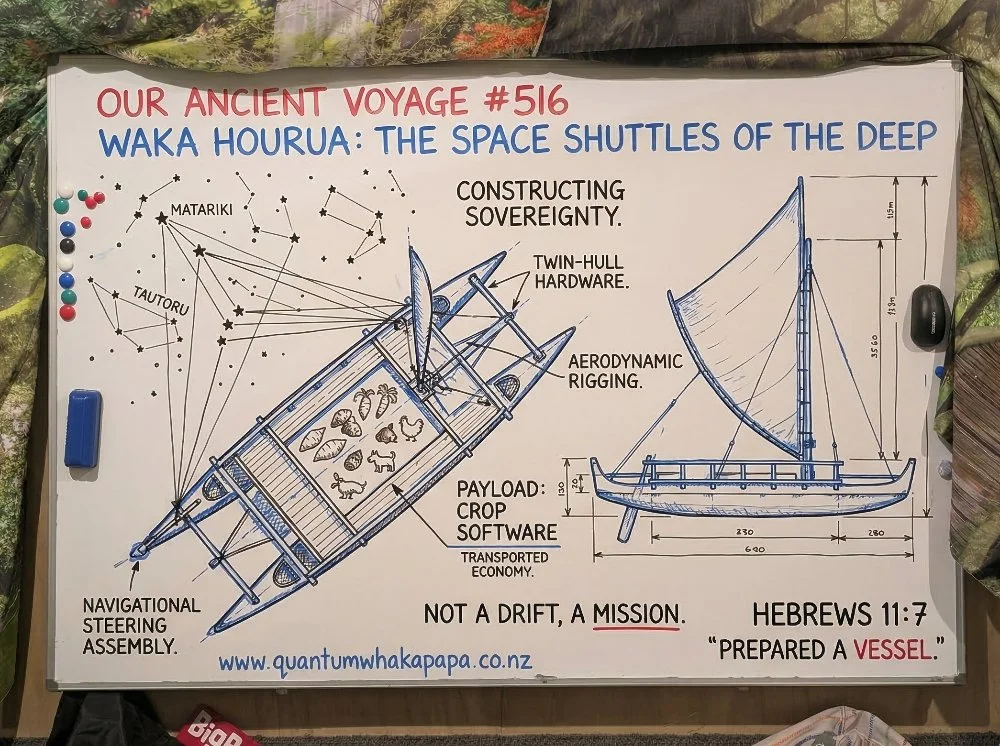
OUR ANCIENT VOYAGE #516 - WAKA HOURUA: THE SPACE SHUTTLES OF THE DEEP
The High-Tech Hardware
In popular history, the vessels that brought our ancestors to Te Tai Tokerau are often called "canoes." However, the term is a massive understatement. Based on the technical data in Research Report #254, these were Waka Hourua, double-hulled, ocean-going spacecraft of the 13th century. They were the most sophisticated pieces of maritime hardware on the planet at the time.
A Waka Hourua was not just a boat, it was a floating "Transported Economy." These vessels were engineered with twin hulls for stability in the turbulent Tasman and Pacific swells, connected by a solid deck structure capable of carrying a massive payload. This wasn't a "discovery" trip, it was a colonisation mission. They carried the hardware of a new world: seeds, plants, animals, and the "Social Software" of a complex civilisation.
The Transported Economy
When we talk about the "First Ping" in #515, we define a "ping" as a targeted spiritual signal sent to verify a location and establish a connection, it was the moment the intention of the voyager met the response of the land. Once that connection was confirmed, the Waka Hourua were the delivery systems for the "Installation Package."
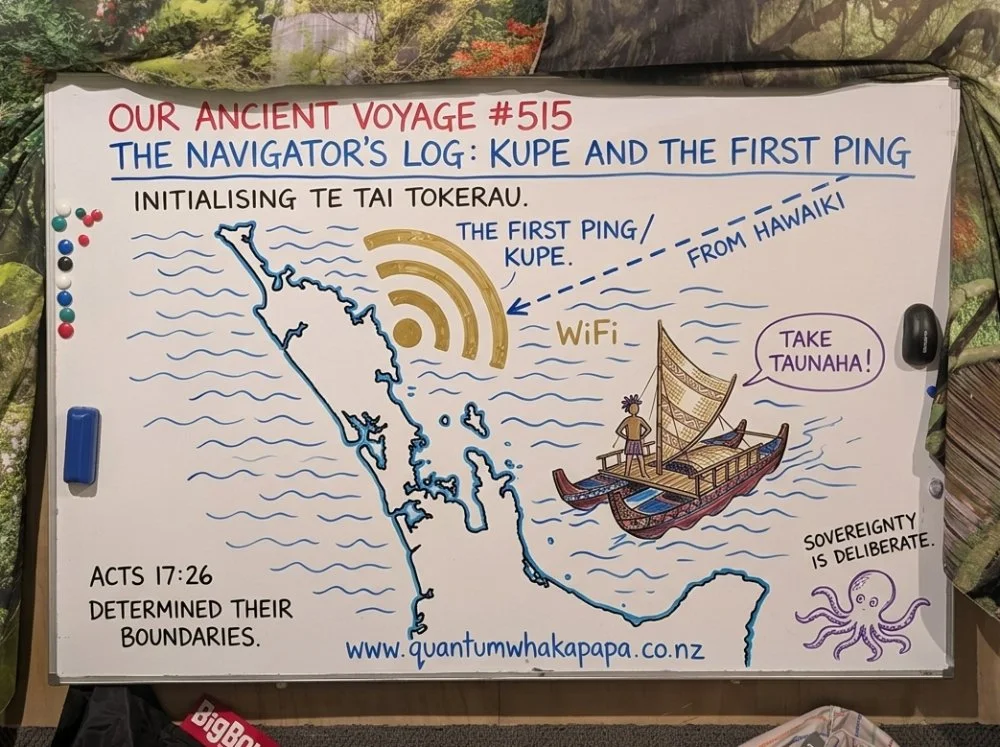
OUR ANCIENT VOYAGE #515 - THE NAVIGATOR'S LOG: KUPE AND THE FIRST PING
The Deliberate Signal
In the old "Babylonian" history books, the arrival of Māori in Aotearoa is often portrayed as a series of accidents, of rafts drifting aimlessly across the Pacific. But the data in Research Report #254 tells a different story. This was not a drift, it was a deliberate, high-frequency "ping" to the land.
In our framework, a "ping" is a targeted spiritual signal sent to verify a location and establish a connection, it was the moment the intention of the voyager met the response of the land.
Around 1000 CE, according to our northern oral traditions, the great navigator Kupe followed the migratory patterns of the long-tailed cuckoo (pīpīwharauroa) and the flight of the stars to find the "giant finger" of the North pointing into the Pacific. This was the first structural exploration of Te Ika-a-Māui. Kupe wasn't just looking for land, he was initialising a connection between the human spirit and the Mauri of this specific geography.
The Far North Anchor
The first landfalls were not random. The Far North, with its massive sand dunes and deep-water harbours, acted as the primary "Access Point" for the Pacific. Kupe’s arrival in the Hokianga and the subsequent naming of sites established the first Take Taunaha (rights of discovery).
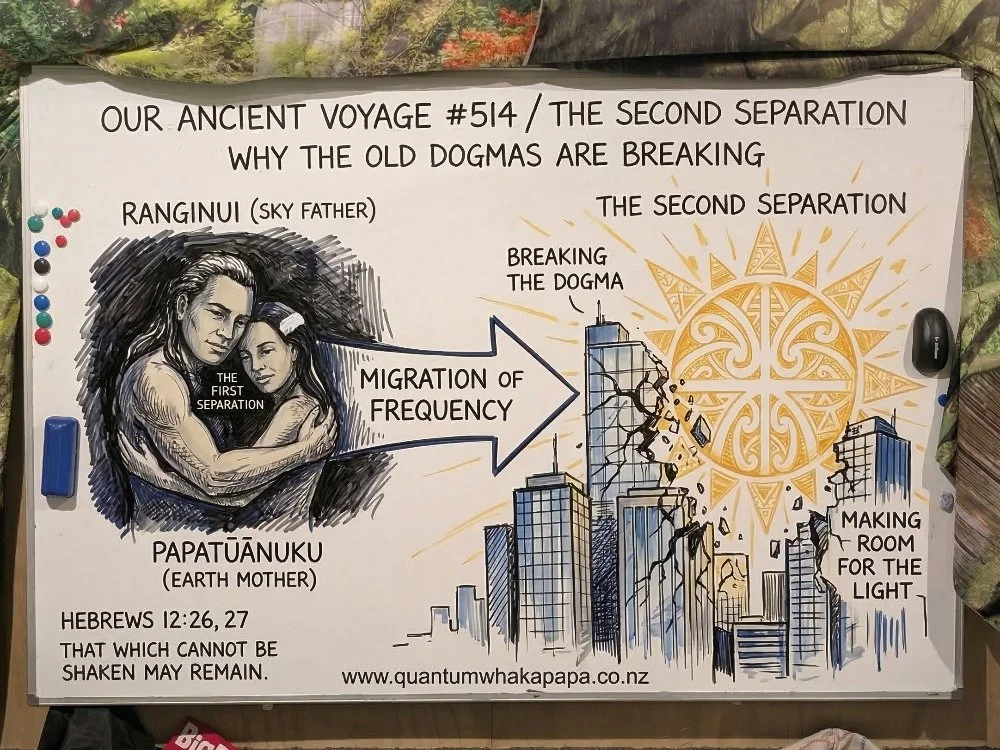
OUR ANCIENT VOYAGE #514 - THE SECOND SEPARATION: WHY THE OLD DOGMAS ARE BREAKING
The First Separation: Creating Space for Light
In our ancient traditions, the story of our journey begins with the first separation. Ranginui (the Sky Father) and Papatūānuku (the Earth Mother) were locked in a tight, eternal embrace. There was no room for movement, no room for growth, and most importantly, no light. It was their children who, through great effort and disruption, pushed them apart. This act was not one of hatred, but of necessity. It created the space known as Te Ao Mārama, the world of light and understanding, where life could finally flourish.
Today, we are experiencing what we call the Second Separation. Just as the primordial parents had to be pushed apart to let the first light in, our old global systems, the "Babylonian" dogmas of centralisation, control, and scarcity, are being pushed aside. The chaos we see in the news is not the end of the world, it is the breaking of a cramped embrace to let a new, higher frequency of light into our collective consciousness.