
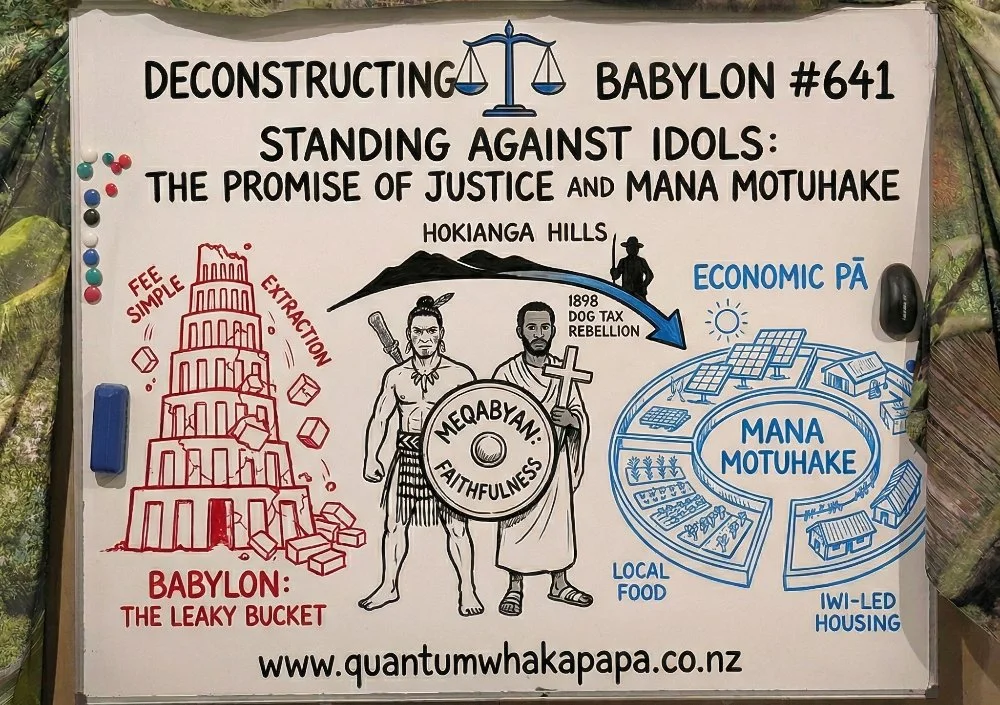
DECONSTRUCTING BABYLON #641 - STANDING AGAINST IDOLS: THE PROMISE OF JUSTICE AND MANA MOTUHAKE
Resisting the Colonial Machine
In our research, we define "Babylon" not as a place, but as a colonial operating system built on extraction and the "Newtonian Error" of seeing ourselves as separate from the world. This system behaves like a "Leaky Bucket," exporting our timber, our talent, and our Mauri, while leaving us with the waste. To dismantle this, we look to the three books of Meqabyan, unique to the Ethiopian canon, which tell the stories of those who refused to bow to idols or corrupt earthly kings.
Kia ora e te whānau. It is time to speak some hard truths about the systems that have tried to fence in our spirit and our whenua. In our journey through the Ethiopian canon, we find tools not just for prayer, but for the brave work of decolonisation. We are looking at a history of resistance that links the martyrs of old with our own rangatira here in the North.
Faithfulness Under Oppression
The Meqabyan books focus on maintaining spiritual integrity when the surrounding system demands total submission. They promise that God is the "true judge" over corrupt rulers and that "earthly kings will not be honoured" in the day of final accountability. For us in Taitokerau, this resonates with our commitment to mana motuhake, the inherent right to determine our own path and manage our own resources without the interference of a foreign "Babylonian" logic.
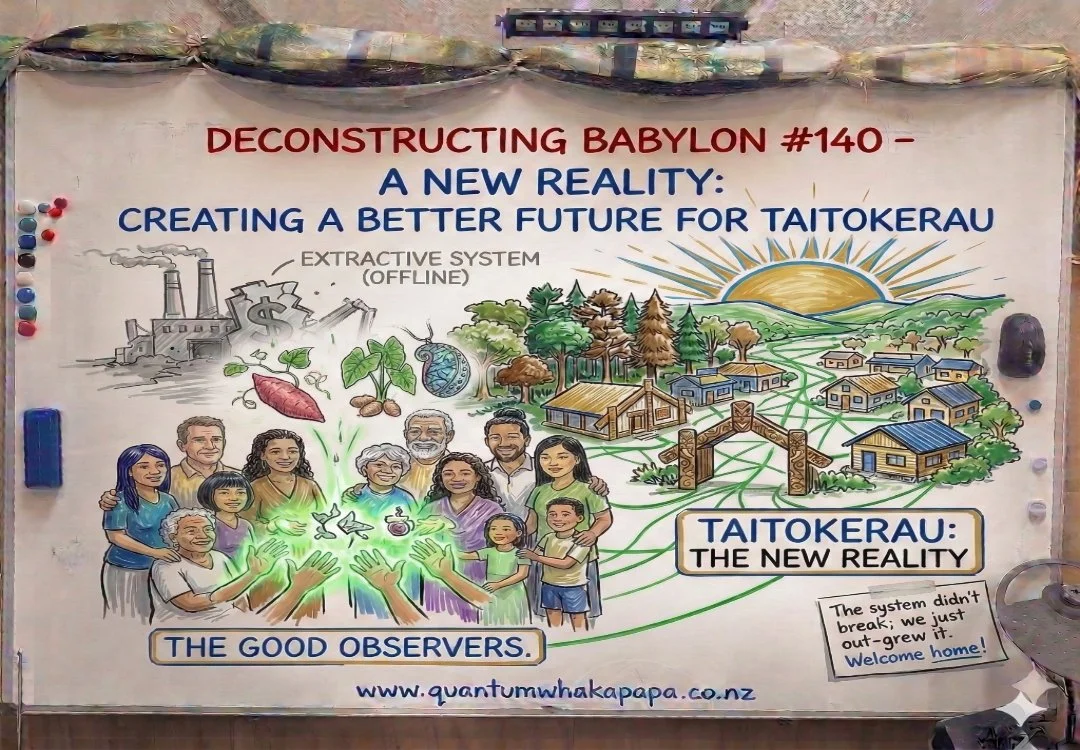
DECONSTRUCTING BABYLON #140 - A NEW REALITY: CREATING A BETTER FUTURE FOR TAITOKERAU
We have reached the end of our journey through the tools of Babylon. We have deconstructed the "Lie of Loneliness," exposed the "Money Drain," and learned how to protect our data and our stories. We have seen how the system uses paperwork and punishment to keep us stuck in a cycle of extraction. Now, in this final post, we are looking at the most powerful tool of all: the ability to create a new reality by simply changing how we show up in the world.
The Research: The Power of Observation
Research Report #224 talks about a fascinating idea from the world of physics: that the way we observe something actually changes how it behaves. In our communities, this is a profound truth. For too long, we have been "observing" our people through the eyes of Babylon - seeing only the problems, the gaps, and the brokenness.
When we stop being observers for the machine and start being "Kaitiaki Observers" for our own whānau, the reality of Taitokerau begins to shift. This isn't just "positive thinking"; it is a strategic move. By making small, cumulative decisions to prioritise the Mauri (life force) over the machine, we are literally building a new operating system for the North. We are moving from a world of entropy (chaos and drain) to a world of negentropy (order and growth).
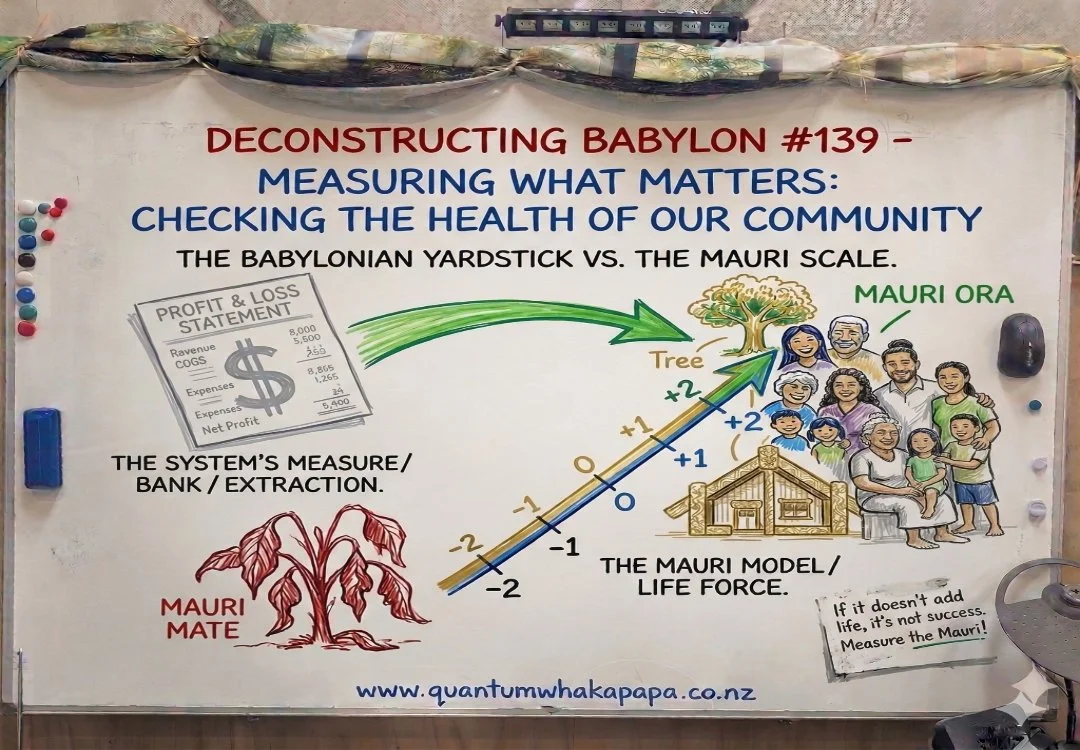
DECONSTRUCTING BABYLON #139 - MEASURING WHAT MATTERS: CHECKING THE HEALTH OF OUR COMMUNITY
In our last few posts, we have looked at building a local economy and running businesses that look after the whānau. But how do we actually know if we are winning? Babylon has a very specific way of measuring "success" - it usually involves a bank balance, a GDP figure, or a pile of ticked boxes on a compliance form. In this post, we are looking at how to stop using the system’s yardstick and start measuring the things that actually matter to our health and our future.
The Research: Money vs. Life Force
Research Report #224 points out that the Babylonian system is obsessed with things that can be counted but often ignores the things that count. It uses "Money-First Thinking" to measure growth. If a forest is cut down and sold, the system says the economy has "grown." It doesn't factor in the loss of the birds, the silt in the river, or the heartbreak of the people who lost their shelter.
To deconstruct this, we use the Mauri Model. This is a simple but powerful way to measure the "life force" or the "health" of a project, a business, or a community. Instead of just looking at a profit and loss statement, we look at whether the life force is being drained or restored. We use a scale that goes from -2 to +2.
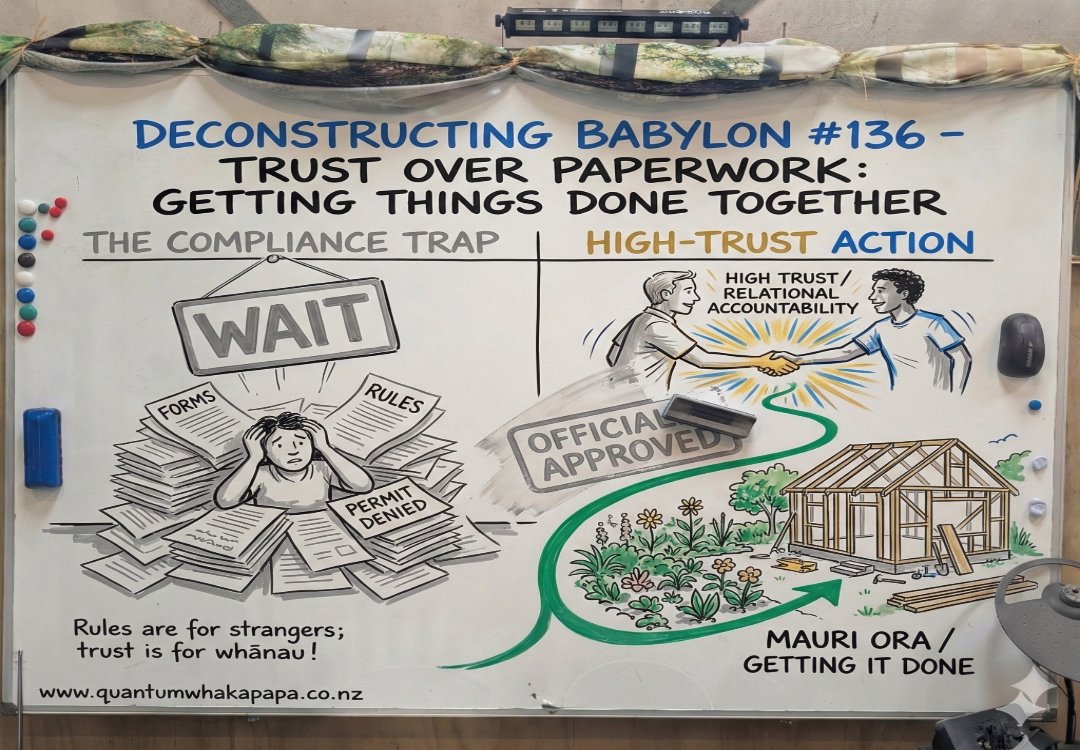
DECONSTRUCTING BABYLON #136 - TRUST OVER PAPERWORK: GETTING THINGS DONE TOGETHER
In our previous posts, we have looked at how Babylon tries to own our resources, our money, and even our digital stories. But there is another way the system slows us down and drains our energy: the "Compliance Trap." This is the world of endless forms, meetings about meetings, and rigid rules that seem designed to stop anything from actually happening. Working in the not-for-profit and hapū finance space I see this first hand, and it takes some serious willpower to push through and get the job done, especially for those who aren’t naturally inclined towards form filling. In this post, we are looking at how to move past the paperwork and get back to the power of high-trust action.
The Research: The Cost of Not Trusting
Research Report #224 identifies this as "Static Bureaucracy." In the Babylonian system, because everyone is treated as a separate, untrustworthy unit (the "Lie of Loneliness"), the only way to manage people is through massive amounts of paperwork. It is a system built on risk aversion - the fear that someone, somewhere, might make a mistake or do something "unauthorised."
This creates a heavy weight on our communities. When a local marae, a small business, or a school group wants to start a project, they often find themselves buried under a mountain of compliance. The system demands that we prove our "eligibility" over and over again. This isn't just annoying; it is a form of control. It drains our time and spirit, making us feel like we need permission from a distant office to look after our own home.
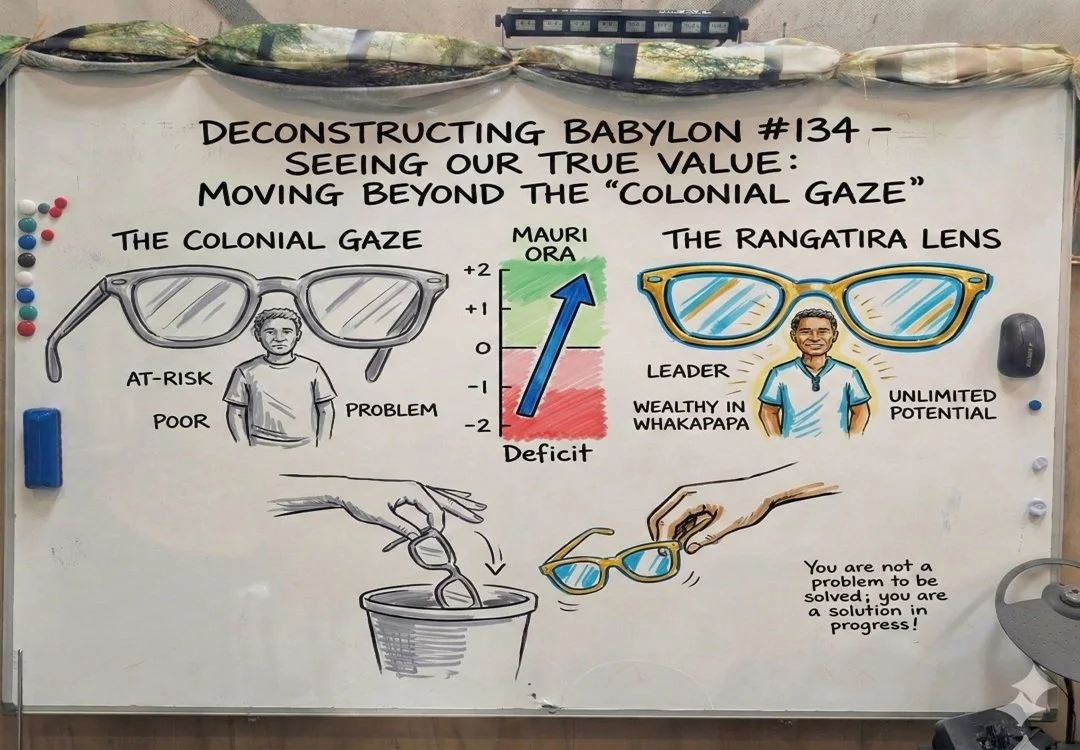
DECONSTRUCTING BABYLON #134 - SEEING OUR TRUE VALUE: MOVING BEYOND THE “COLONIAL GAZE”
In our last few posts, we looked at how Babylon drains our money and tries to keep us feeling isolated. But there is a deeper, quieter way the system controls us: it changes how we see ourselves. It trains us to look at our own communities and only see "problems" to be solved or "gaps" to be filled. In this post, we’re looking at how to shift our focus from what we are lacking to the massive potential we already carry.
The Research: The "Colonial Gaze"
Research Report #224 talks about something called the "Colonial Gaze." This is the habit of looking at a person or a community through the eyes of an institution. When the government, a big NGO, or a distant bureaucracy looks at the North, they often use a checklist of deficits. They look for "at-risk" youth, "deprived" households, and "failing" schools.
This isn't just an accident; it's a tool of the machine. By categorising us as "broken," the system justifies its own existence. It creates a "Compliance Trap" where we are constantly filling out paperwork to prove how much help we need, rather than using that energy to build what we want. When we start to see ourselves only as a collection of problems, we lose sight of our Mana and our Rangatira potential.