
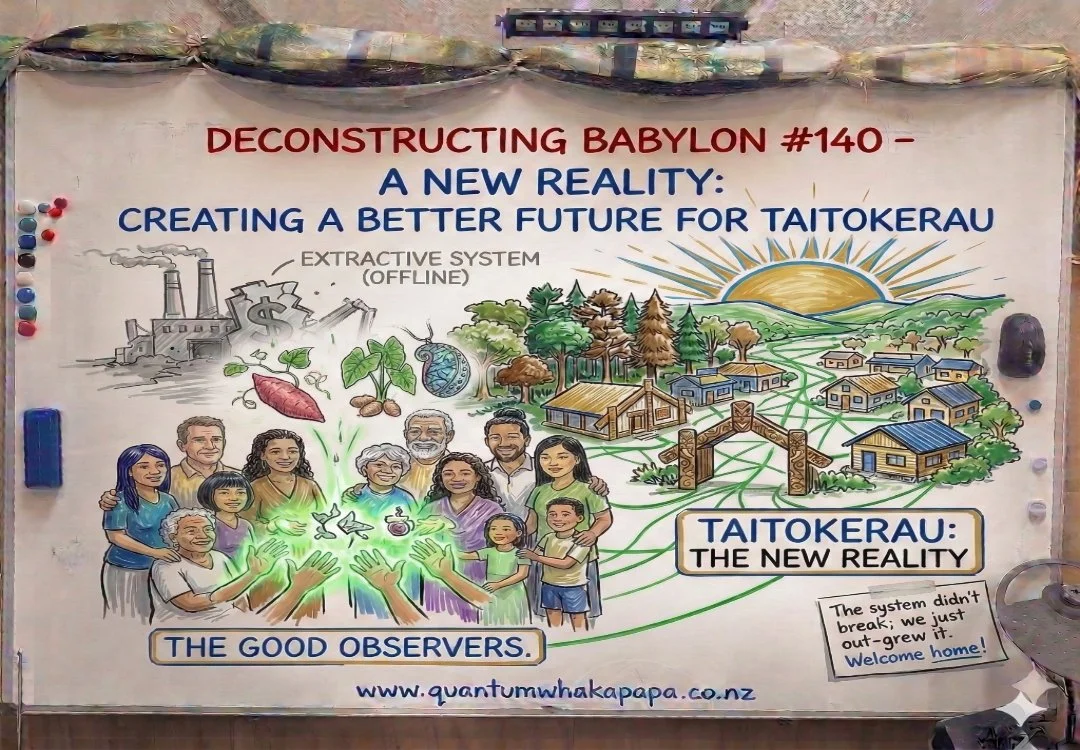
DECONSTRUCTING BABYLON #140 - A NEW REALITY: CREATING A BETTER FUTURE FOR TAITOKERAU
We have reached the end of our journey through the tools of Babylon. We have deconstructed the "Lie of Loneliness," exposed the "Money Drain," and learned how to protect our data and our stories. We have seen how the system uses paperwork and punishment to keep us stuck in a cycle of extraction. Now, in this final post, we are looking at the most powerful tool of all: the ability to create a new reality by simply changing how we show up in the world.
The Research: The Power of Observation
Research Report #224 talks about a fascinating idea from the world of physics: that the way we observe something actually changes how it behaves. In our communities, this is a profound truth. For too long, we have been "observing" our people through the eyes of Babylon - seeing only the problems, the gaps, and the brokenness.
When we stop being observers for the machine and start being "Kaitiaki Observers" for our own whānau, the reality of Taitokerau begins to shift. This isn't just "positive thinking"; it is a strategic move. By making small, cumulative decisions to prioritise the Mauri (life force) over the machine, we are literally building a new operating system for the North. We are moving from a world of entropy (chaos and drain) to a world of negentropy (order and growth).
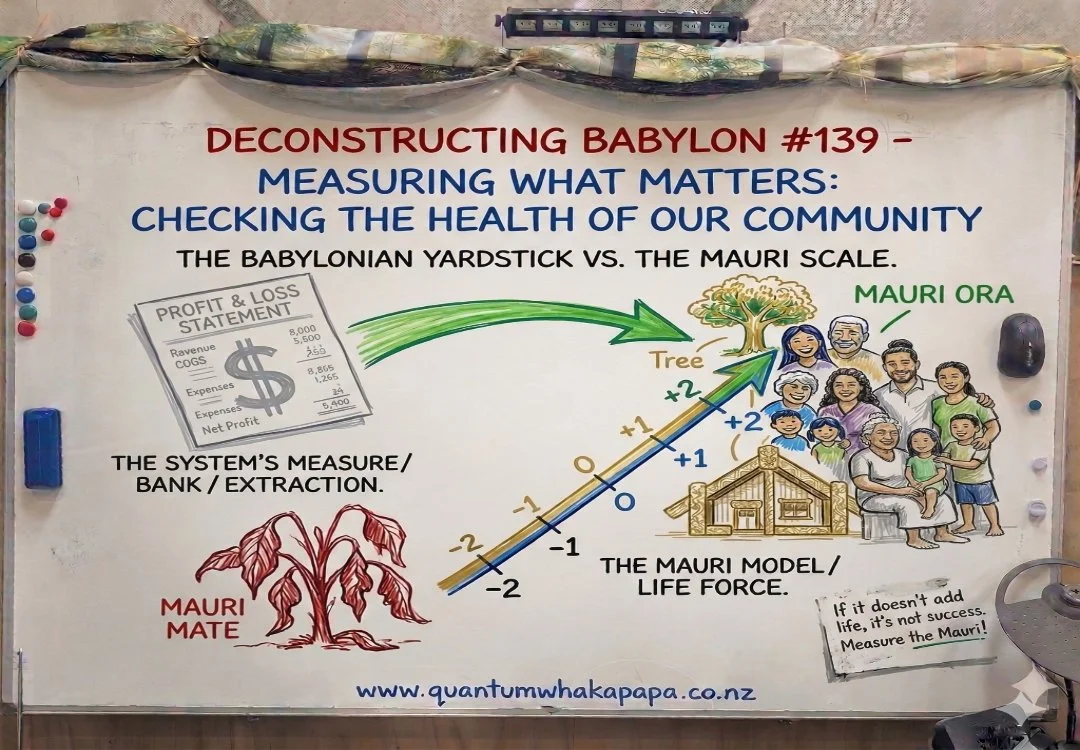
DECONSTRUCTING BABYLON #139 - MEASURING WHAT MATTERS: CHECKING THE HEALTH OF OUR COMMUNITY
In our last few posts, we have looked at building a local economy and running businesses that look after the whānau. But how do we actually know if we are winning? Babylon has a very specific way of measuring "success" - it usually involves a bank balance, a GDP figure, or a pile of ticked boxes on a compliance form. In this post, we are looking at how to stop using the system’s yardstick and start measuring the things that actually matter to our health and our future.
The Research: Money vs. Life Force
Research Report #224 points out that the Babylonian system is obsessed with things that can be counted but often ignores the things that count. It uses "Money-First Thinking" to measure growth. If a forest is cut down and sold, the system says the economy has "grown." It doesn't factor in the loss of the birds, the silt in the river, or the heartbreak of the people who lost their shelter.
To deconstruct this, we use the Mauri Model. This is a simple but powerful way to measure the "life force" or the "health" of a project, a business, or a community. Instead of just looking at a profit and loss statement, we look at whether the life force is being drained or restored. We use a scale that goes from -2 to +2.
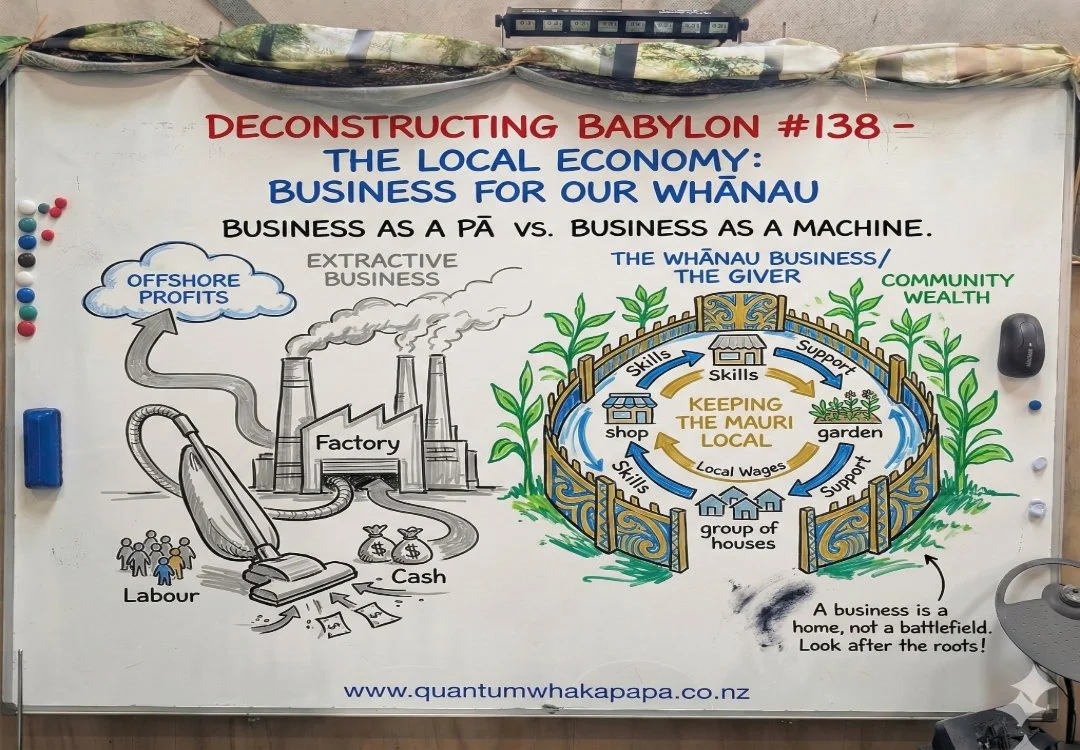
DECONSTRUCTING BABYLON #138 - THE LOCAL ECONOMY: BUSINESS FOR OUR WHĀNAU
In our last few posts, we have looked at how to stop the money drain and how to shift our focus from problems to potential. Now, we are putting those ideas into action by looking at how we run our businesses. For too long, we have been taught that business is a "battlefield" where you have to be ruthless to survive. But in the North, we are reclaiming a different way of doing trade - one that treats business as a way to strengthen the whānau and the land.
The Research: Business as a Giver, Not a Taker
Research Report #224 explains that the Babylonian way of doing business is purely "extractive." This means the business exists only to take as much value as possible from its workers, its customers, and the environment to create a profit for a distant owner. It is a "money-first" approach that sees people as just another cost to be lowered.
When we deconstruct Babylon in our local economy, we move toward "Home-First Thinking" (Ekonomia). In this model, a business is like a modern-day Pā. It is a place of safety, skill-sharing, and abundance. Instead of being a "taker" that drains the community, the business becomes a "giver" that creates health and order. Success is measured not just by the profit at the end of the year, but by how much the Mauri (the life force) of the staff and the community has grown.
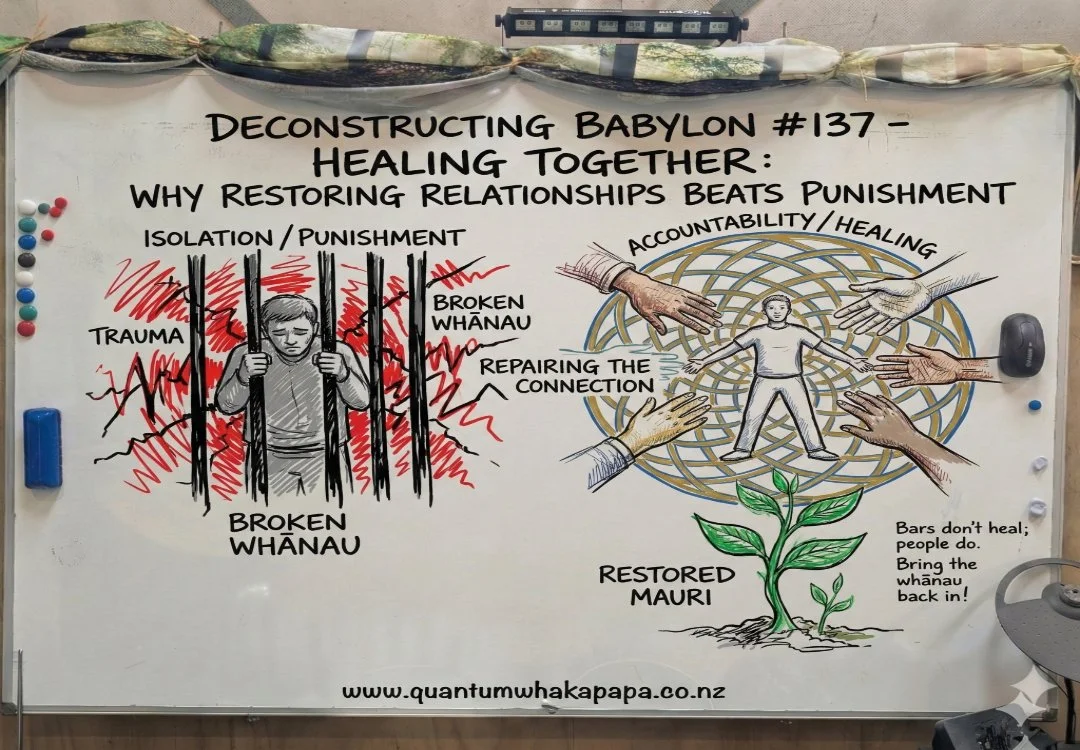
DECONSTRUCTING BABYLON #137 - HEALING TOGETHER: WHY RESTORING RELATIONSHIPS BEATS PUNISHMENT
In our last few posts, we have looked at how the Babylonian system tries to control us through paperwork and isolation. But there is a much darker side to this "Lie of Loneliness." When things go wrong in our community - when harm is caused or a mistake is made - the system’s first instinct is to punish and isolate. In this post, we are looking at why the current "justice" system is a drain on our people and how we can choose a path of healing instead.
The Research: The High Cost of Punishment
Research Report #224 identifies the modern justice system as a "High-Entropy" machine. This means it is a system that actually creates more chaos and brokenness the more it is used. When we take a person who has caused harm and lock them away in a cage, we are doubling down on the lie that they are a separate, disconnected unit.
This approach is called "Punitive Justice." It focuses almost entirely on "Which rule was broken?" and "How much should this person suffer?" This doesn't just fail the person who caused the harm; it fails the victim and the whole community. In the North, we see the results of this every day: families are torn apart, and instead of healing the original wound, the system often creates a cycle of trauma that lasts for generations.
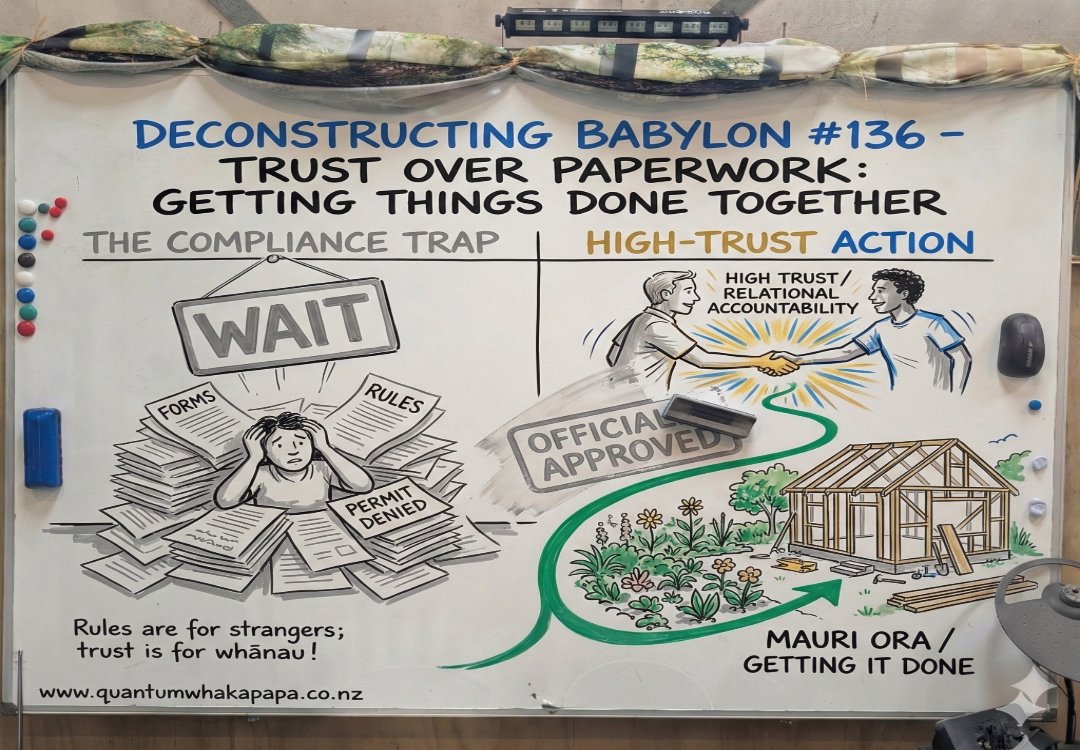
DECONSTRUCTING BABYLON #136 - TRUST OVER PAPERWORK: GETTING THINGS DONE TOGETHER
In our previous posts, we have looked at how Babylon tries to own our resources, our money, and even our digital stories. But there is another way the system slows us down and drains our energy: the "Compliance Trap." This is the world of endless forms, meetings about meetings, and rigid rules that seem designed to stop anything from actually happening. Working in the not-for-profit and hapū finance space I see this first hand, and it takes some serious willpower to push through and get the job done, especially for those who aren’t naturally inclined towards form filling. In this post, we are looking at how to move past the paperwork and get back to the power of high-trust action.
The Research: The Cost of Not Trusting
Research Report #224 identifies this as "Static Bureaucracy." In the Babylonian system, because everyone is treated as a separate, untrustworthy unit (the "Lie of Loneliness"), the only way to manage people is through massive amounts of paperwork. It is a system built on risk aversion - the fear that someone, somewhere, might make a mistake or do something "unauthorised."
This creates a heavy weight on our communities. When a local marae, a small business, or a school group wants to start a project, they often find themselves buried under a mountain of compliance. The system demands that we prove our "eligibility" over and over again. This isn't just annoying; it is a form of control. It drains our time and spirit, making us feel like we need permission from a distant office to look after our own home.
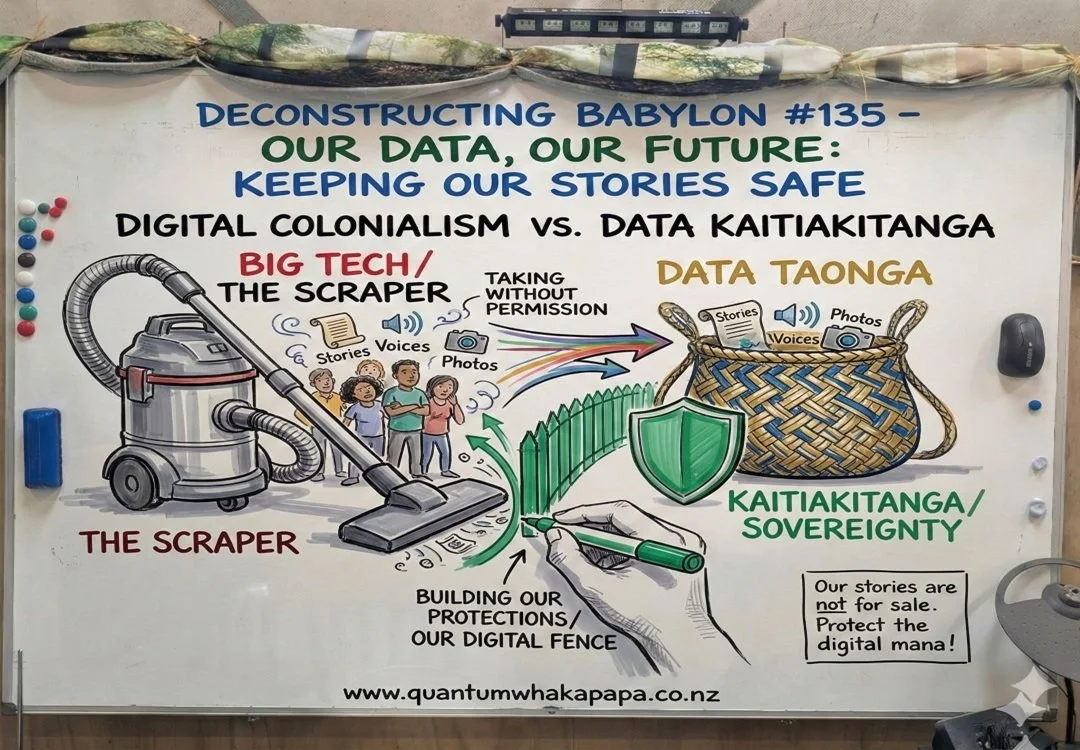
DECONSTRUCTING BABYLON #135 - OUR DATA, OUR FUTURE: KEEPING OUR STORIES SAFE
In our previous posts, we have looked at how the Babylonian system extracts our physical resources like timber and gold, and our financial resources through the "Leaky Bucket" economy. But there is a new frontier for the machine: our data. In the digital age, our stories, our voices, and even our whakapapa are being treated like "empty land" that anyone can walk onto and claim. In this post, we are looking at how to protect our digital heritage and reclaim our power in the online world.
The Research: Digital Colonialism
Research Report #224 identifies a modern version of an old problem: "Digital Colonialism." Just as the "Doctrine of Discovery" was used to claim land that already belonged to indigenous people, big tech companies today treat the internet like "Digital Terra Nullius" (empty land). They "scrape" our social media posts, our recorded kōrero, and our family photos to train their AI models and make massive profits, often without our consent or even our knowledge.
This is a new form of extraction. The system takes our "Digital Flesh" - our unique cultural data - and exports it to build tools that don't always understand or respect our values. When our stories are taken out of our hands, we lose the ability to tell them in our own way. We become products of the machine rather than the authors of our own future.
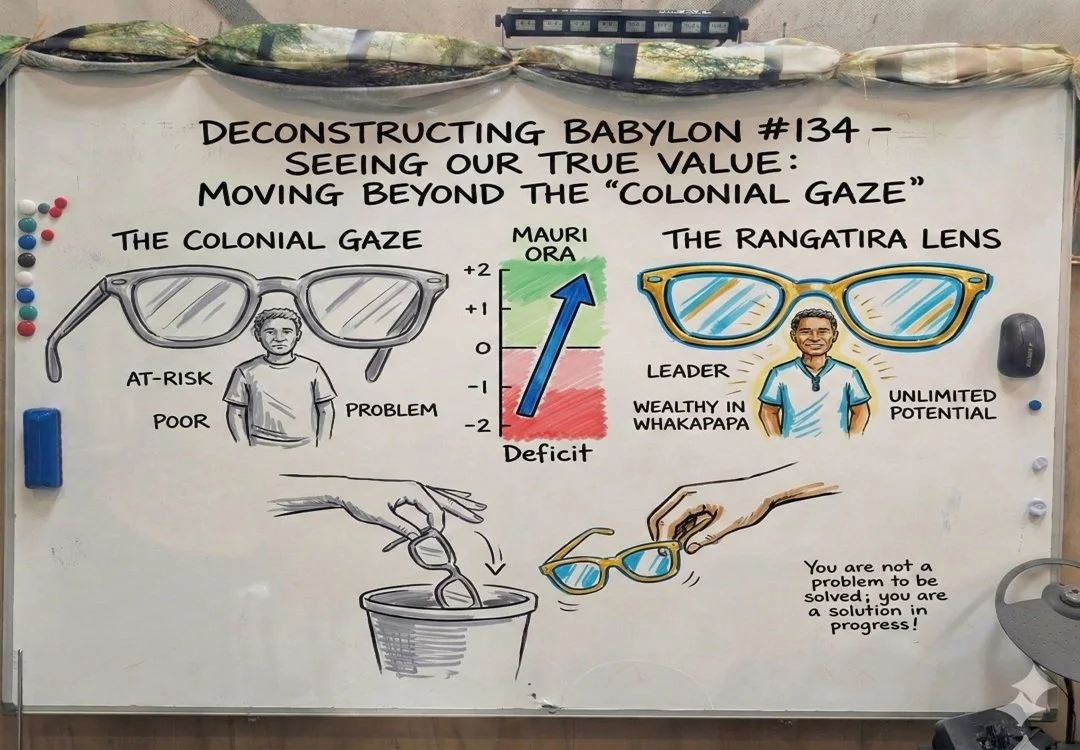
DECONSTRUCTING BABYLON #134 - SEEING OUR TRUE VALUE: MOVING BEYOND THE “COLONIAL GAZE”
In our last few posts, we looked at how Babylon drains our money and tries to keep us feeling isolated. But there is a deeper, quieter way the system controls us: it changes how we see ourselves. It trains us to look at our own communities and only see "problems" to be solved or "gaps" to be filled. In this post, we’re looking at how to shift our focus from what we are lacking to the massive potential we already carry.
The Research: The "Colonial Gaze"
Research Report #224 talks about something called the "Colonial Gaze." This is the habit of looking at a person or a community through the eyes of an institution. When the government, a big NGO, or a distant bureaucracy looks at the North, they often use a checklist of deficits. They look for "at-risk" youth, "deprived" households, and "failing" schools.
This isn't just an accident; it's a tool of the machine. By categorising us as "broken," the system justifies its own existence. It creates a "Compliance Trap" where we are constantly filling out paperwork to prove how much help we need, rather than using that energy to build what we want. When we start to see ourselves only as a collection of problems, we lose sight of our Mana and our Rangatira potential.
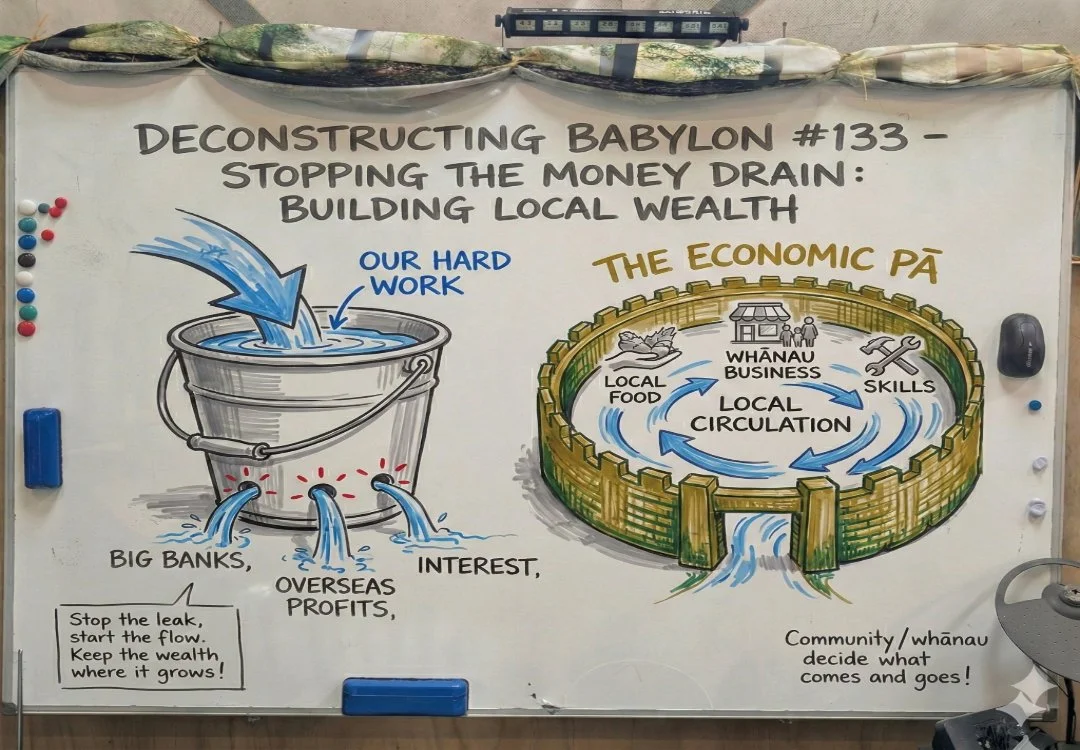
DECONSTRUCTING BABYLON #133 - STOPPING THE MONEY DRAIN: BUILDING LOCAL WEALTH
In our last post, we looked at how the system tries to keep us lonely and separate. Once we are isolated, we are much easier to plug into the "Leaky Bucket" economy. This is the part of Babylon that focuses on extracting every cent it can from our communities and sending it away to big banks and overseas corporations. In this post, we are looking at how to plug those leaks and start building wealth that actually stays in the North.
The Research: The Difference Between Making Money and Making a Home
Research Report #224 highlights a very important distinction that the modern world has forgotten. It is the difference between two ways of thinking about wealth:
Money-First Thinking (Chrematistics): This is the Babylonian way. It is the study of how to accumulate money for its own sake. In this model, people, land, and resources are just tools to be used up to make a bank balance grow. It doesn't matter if the community is left poor or the river is left dirty, as long as the profit is "exported" to the shareholders.
Home-First Thinking (Ekonomia): This is the original meaning of "economy." It is the art of stewardship - looking after the household so that everyone has enough. It is about the health of the family, the garden, and the neighbourhood. Wealth is measured not by how much you take, but by how well everyone is cared for.
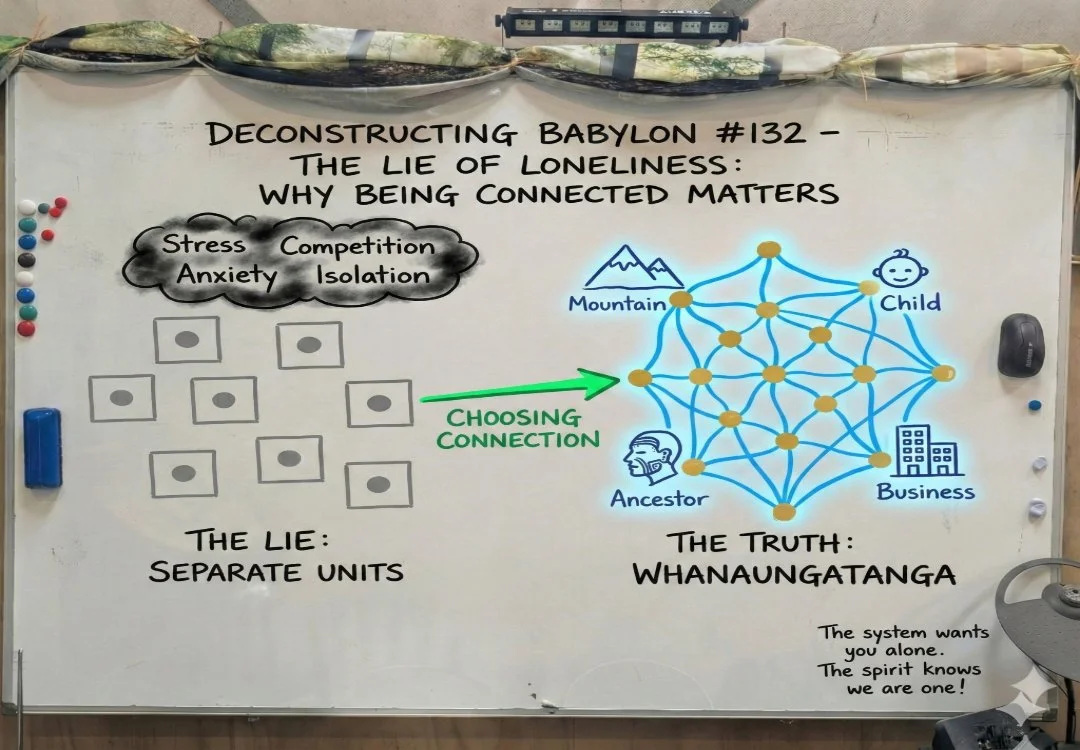
DECONSTRUCTING BABYLON #132 - THE LIE OF LONELINESS: WHY BEING CONNECTED MATTERS
In our last post, we looked at how Babylon acts like a giant machine, sucking wealth and talent out of the North. But how does it get away with it? It uses a very old trick: it tries to convince us that we are all alone. It tells us that we are just separate individuals, like little cogs in a machine, who have to compete against each other just to survive. In this post, we are looking at why this "Lie of Loneliness" is the foundation of the system, and how we can break it by simply remembering who we are.
The Research: The Mistake of Separation
Research Report #224 explains that the Babylonian system is built on a massive mistake. It treats people, land, and nature as separate "things" that can be moved around, used, and discarded. Scientists and historians sometimes call this the "Newtonian Error" - the idea that the world is just a big clock made of separate parts that don't really affect each other unless they bump together.
When the system convinces us that we are separate units, we become much easier to manage and far easier to exploit. If you are "just an individual," the system can sell you "privacy" as a luxury, when really it is just isolation. It can tell you that your neighbour is your competitor for a job or a resource, rather than your teammate. This intentional separation creates a huge amount of stress and a deep, underlying sense of loneliness. Babylon then steps in to "fix" that loneliness by selling us products, entertainment, and distractions. It’s a cycle that keeps the machine running on our energy while leaving us feeling empty and exhausted.
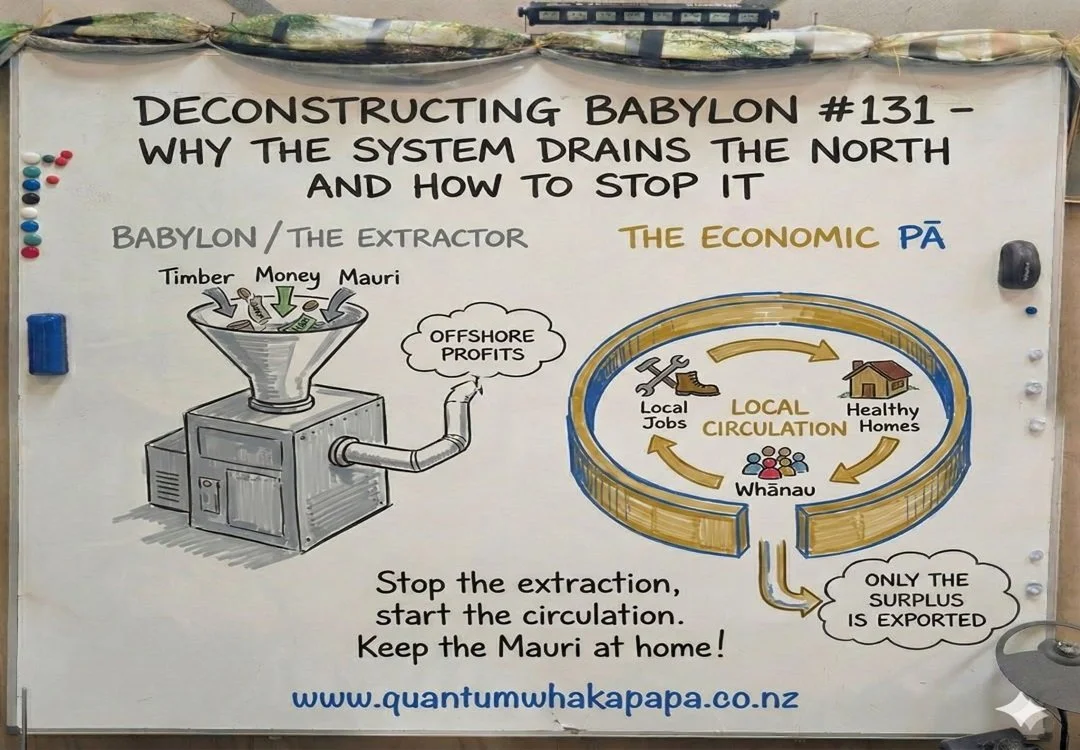
DECONSTRUCTING BABYLON #131 - WHY THE SYSTEM DRAINS THE NORTH AND HOW TO STOP IT
Tēnā koutou e te whānau. I am circling back to some of my earlier content to recreate it from the ground up. In the short time since I first started this project, I have learned a lot, and looking back, some of that early stuff sounds, honestly, a bit cringe. It was too sciency, too full of jargon, and felt a bit detached from the real world we live in. This new series is a fresh look at Deconstructing Babylon, focusing on practical, simple changes we can make in our own lives, businesses, and communities.
What is Babylon?
In Research Report #224, we look at "Babylon" not as a person or a specific government, but as a system of extraction. It is a way of organising the world that is based on taking. It takes our talent, our resources, our money, and our data, and it sends them away to benefit someone else, usually leaving behind a bit of a mess for us to clean up.
In the North, we feel this every day. Babylon is the system that treats Taitokerau like a quarry to be mined rather than a home to be cared for. It puts making money for big corporations ahead of looking after our families and our land. It’s the difference between "money-first thinking" and "caring for the household." One focuses on the bank balance, the other focuses on the wellbeing of everyone in the home.