
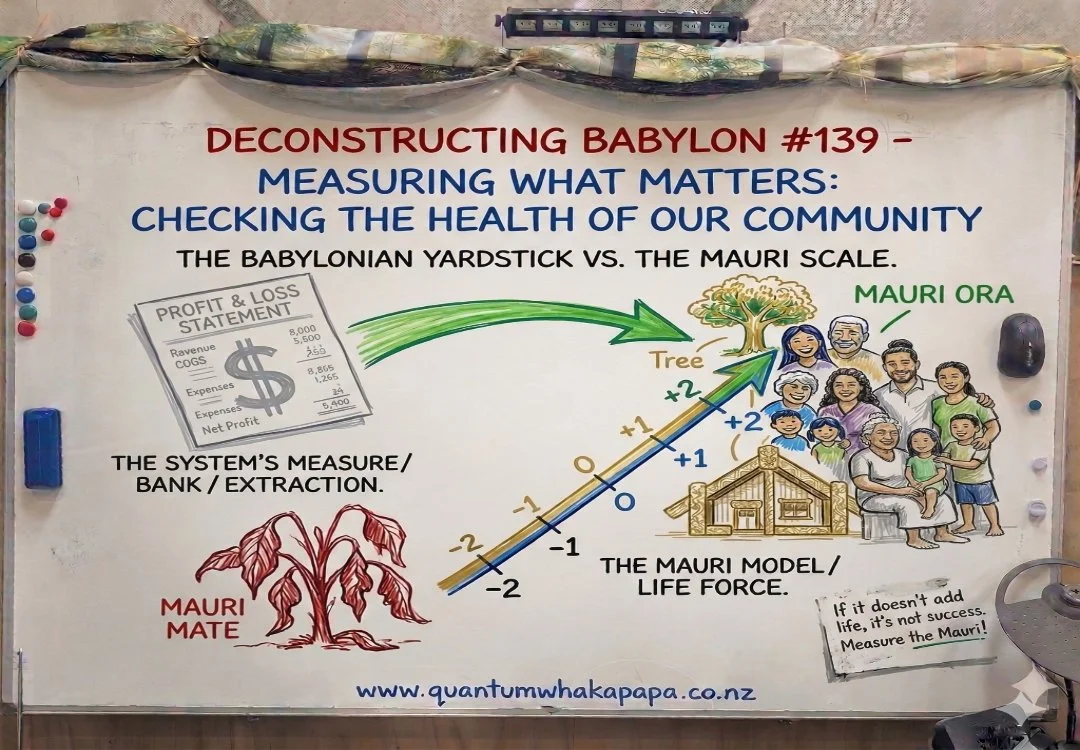
DECONSTRUCTING BABYLON #139 - MEASURING WHAT MATTERS: CHECKING THE HEALTH OF OUR COMMUNITY
In our last few posts, we have looked at building a local economy and running businesses that look after the whānau. But how do we actually know if we are winning? Babylon has a very specific way of measuring "success" - it usually involves a bank balance, a GDP figure, or a pile of ticked boxes on a compliance form. In this post, we are looking at how to stop using the system’s yardstick and start measuring the things that actually matter to our health and our future.
The Research: Money vs. Life Force
Research Report #224 points out that the Babylonian system is obsessed with things that can be counted but often ignores the things that count. It uses "Money-First Thinking" to measure growth. If a forest is cut down and sold, the system says the economy has "grown." It doesn't factor in the loss of the birds, the silt in the river, or the heartbreak of the people who lost their shelter.
To deconstruct this, we use the Mauri Model. This is a simple but powerful way to measure the "life force" or the "health" of a project, a business, or a community. Instead of just looking at a profit and loss statement, we look at whether the life force is being drained or restored. We use a scale that goes from -2 to +2.
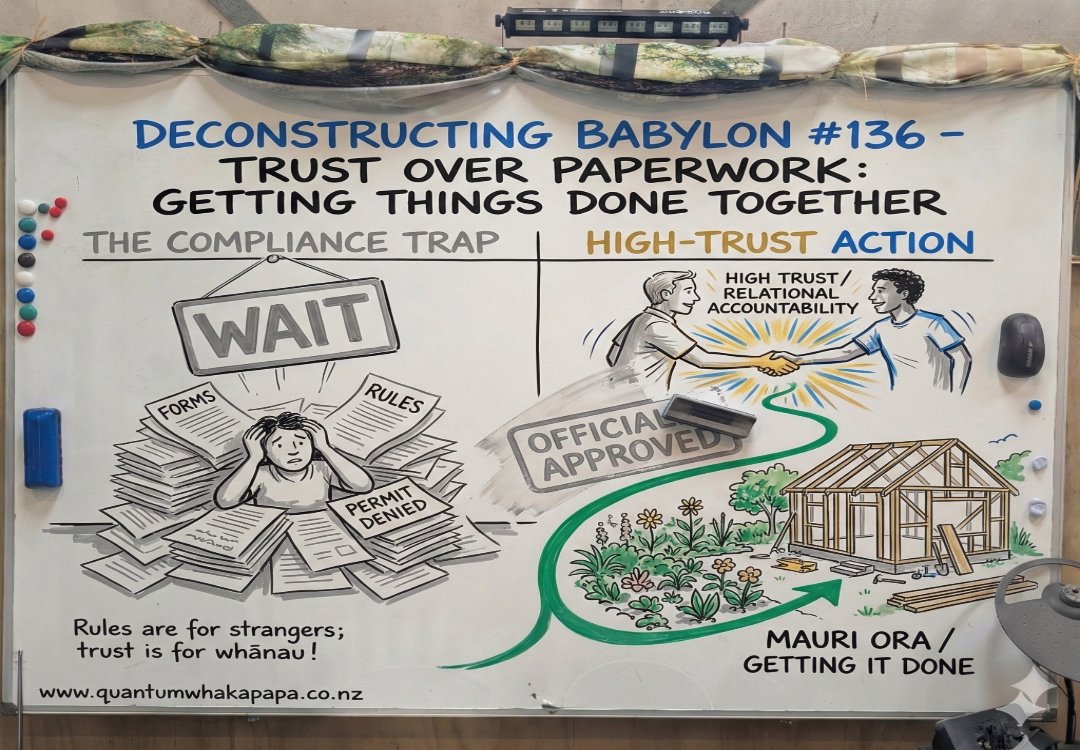
DECONSTRUCTING BABYLON #136 - TRUST OVER PAPERWORK: GETTING THINGS DONE TOGETHER
In our previous posts, we have looked at how Babylon tries to own our resources, our money, and even our digital stories. But there is another way the system slows us down and drains our energy: the "Compliance Trap." This is the world of endless forms, meetings about meetings, and rigid rules that seem designed to stop anything from actually happening. Working in the not-for-profit and hapū finance space I see this first hand, and it takes some serious willpower to push through and get the job done, especially for those who aren’t naturally inclined towards form filling. In this post, we are looking at how to move past the paperwork and get back to the power of high-trust action.
The Research: The Cost of Not Trusting
Research Report #224 identifies this as "Static Bureaucracy." In the Babylonian system, because everyone is treated as a separate, untrustworthy unit (the "Lie of Loneliness"), the only way to manage people is through massive amounts of paperwork. It is a system built on risk aversion - the fear that someone, somewhere, might make a mistake or do something "unauthorised."
This creates a heavy weight on our communities. When a local marae, a small business, or a school group wants to start a project, they often find themselves buried under a mountain of compliance. The system demands that we prove our "eligibility" over and over again. This isn't just annoying; it is a form of control. It drains our time and spirit, making us feel like we need permission from a distant office to look after our own home.
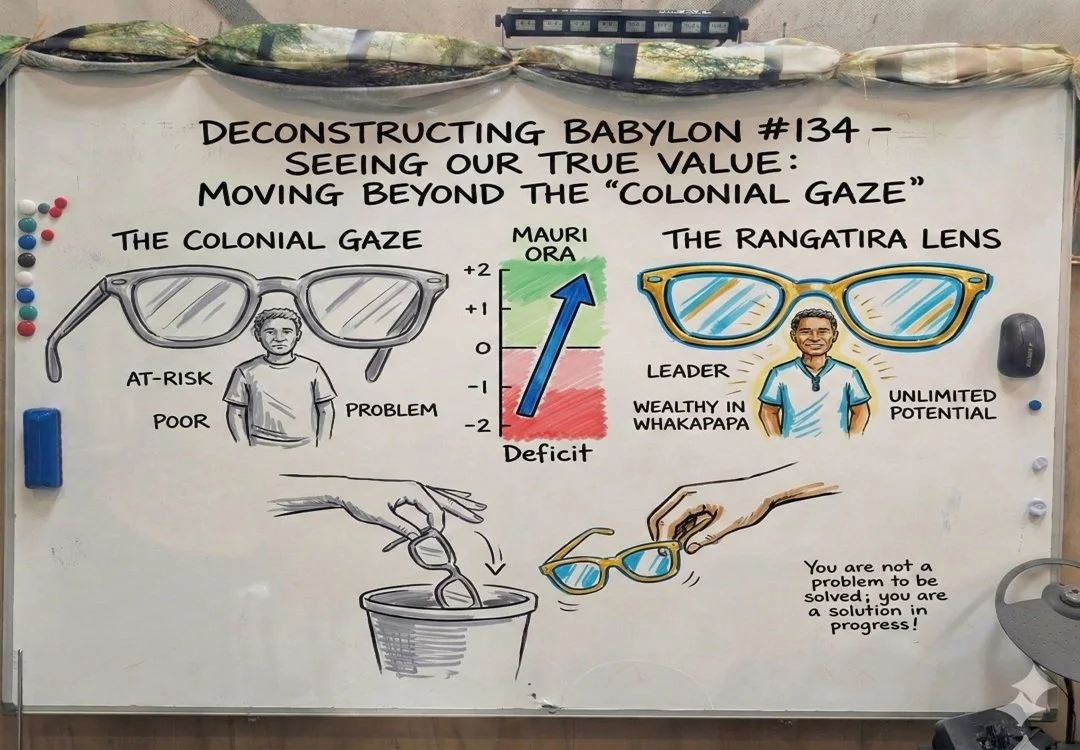
DECONSTRUCTING BABYLON #134 - SEEING OUR TRUE VALUE: MOVING BEYOND THE “COLONIAL GAZE”
In our last few posts, we looked at how Babylon drains our money and tries to keep us feeling isolated. But there is a deeper, quieter way the system controls us: it changes how we see ourselves. It trains us to look at our own communities and only see "problems" to be solved or "gaps" to be filled. In this post, we’re looking at how to shift our focus from what we are lacking to the massive potential we already carry.
The Research: The "Colonial Gaze"
Research Report #224 talks about something called the "Colonial Gaze." This is the habit of looking at a person or a community through the eyes of an institution. When the government, a big NGO, or a distant bureaucracy looks at the North, they often use a checklist of deficits. They look for "at-risk" youth, "deprived" households, and "failing" schools.
This isn't just an accident; it's a tool of the machine. By categorising us as "broken," the system justifies its own existence. It creates a "Compliance Trap" where we are constantly filling out paperwork to prove how much help we need, rather than using that energy to build what we want. When we start to see ourselves only as a collection of problems, we lose sight of our Mana and our Rangatira potential.
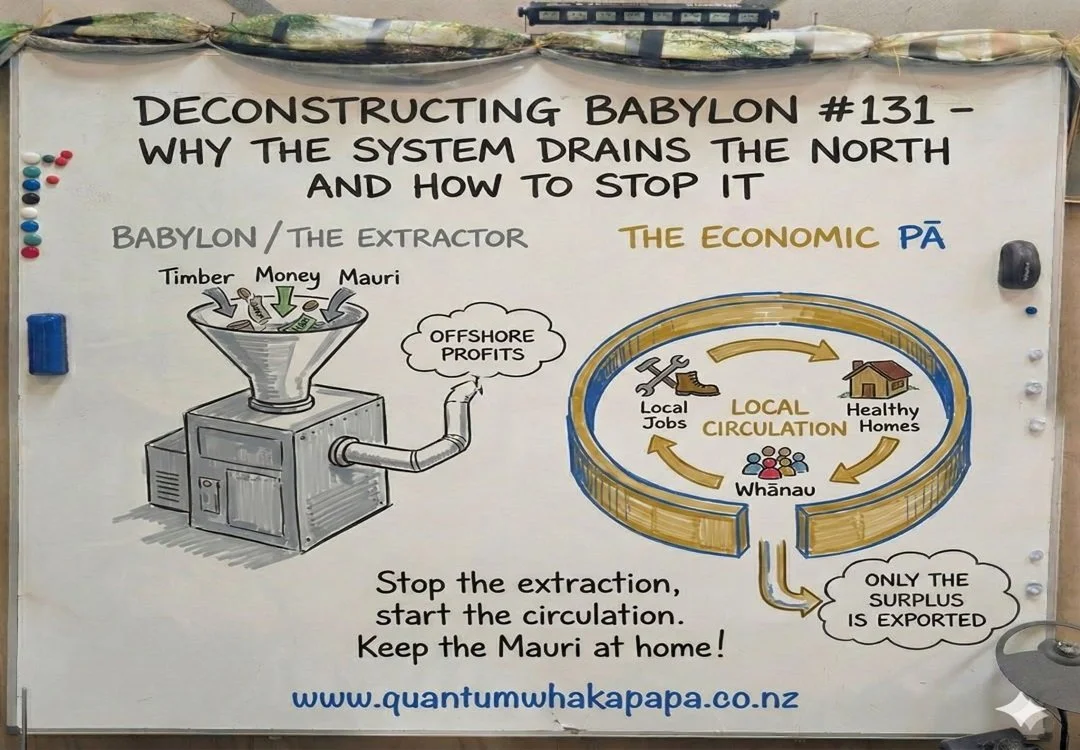
DECONSTRUCTING BABYLON #131 - WHY THE SYSTEM DRAINS THE NORTH AND HOW TO STOP IT
Tēnā koutou e te whānau. I am circling back to some of my earlier content to recreate it from the ground up. In the short time since I first started this project, I have learned a lot, and looking back, some of that early stuff sounds, honestly, a bit cringe. It was too sciency, too full of jargon, and felt a bit detached from the real world we live in. This new series is a fresh look at Deconstructing Babylon, focusing on practical, simple changes we can make in our own lives, businesses, and communities.
What is Babylon?
In Research Report #224, we look at "Babylon" not as a person or a specific government, but as a system of extraction. It is a way of organising the world that is based on taking. It takes our talent, our resources, our money, and our data, and it sends them away to benefit someone else, usually leaving behind a bit of a mess for us to clean up.
In the North, we feel this every day. Babylon is the system that treats Taitokerau like a quarry to be mined rather than a home to be cared for. It puts making money for big corporations ahead of looking after our families and our land. It’s the difference between "money-first thinking" and "caring for the household." One focuses on the bank balance, the other focuses on the wellbeing of everyone in the home.