
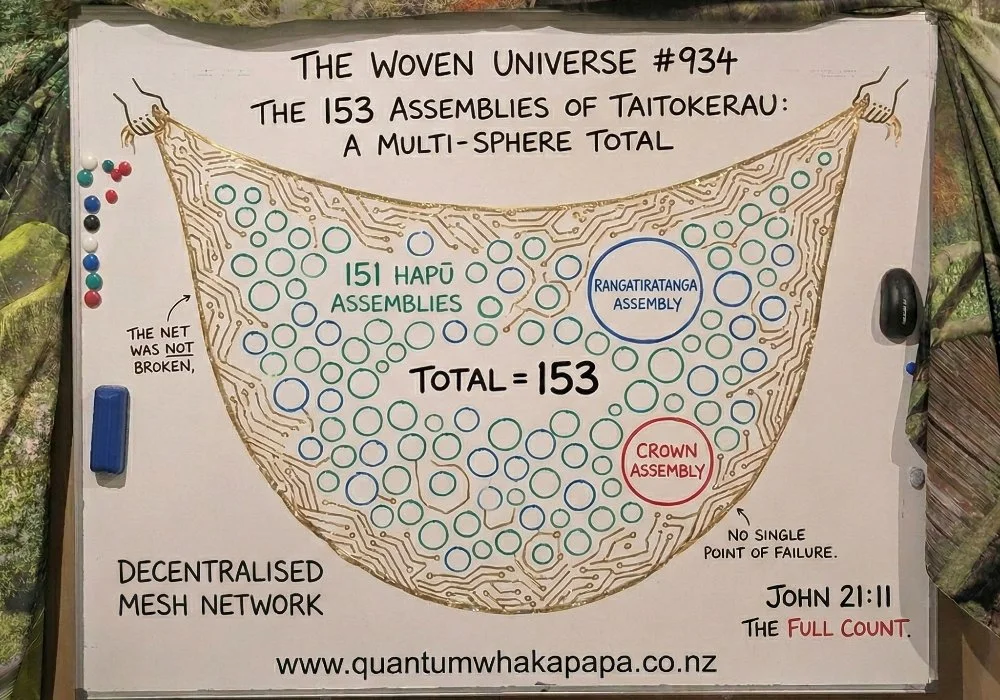
THE WOVEN UNIVERSE #934 - THE 153 ASSEMBLIES OF TAITOKERAU: A MULTI-SPHERE TOTAL
The Full Count of Sovereignty
In our previous discussion of the Multi-Sphere Model, we established that Northern authority is not a single pyramid, but a decentralised mesh network. However, a network is only as strong as its specific configuration. According to Research Report #259, the total number of assemblies required for full jurisdictional operation in the North is precisely 153.
When we map the full architecture of Ngāpuhi Nui Tonu, we find a mathematical perfection that mirrors the ancient "miraculous catch." This is the "Full Count" of our constitutional hardware, initialising a system where every node is verified and every voice is accounted for.
The Architecture of the 153
The number 153 is not an arbitrary political target, it is the sum of every sovereign node within our specific constitutional design. This convergence brings together the local, the regional, and the national into a single, cohesive unit.
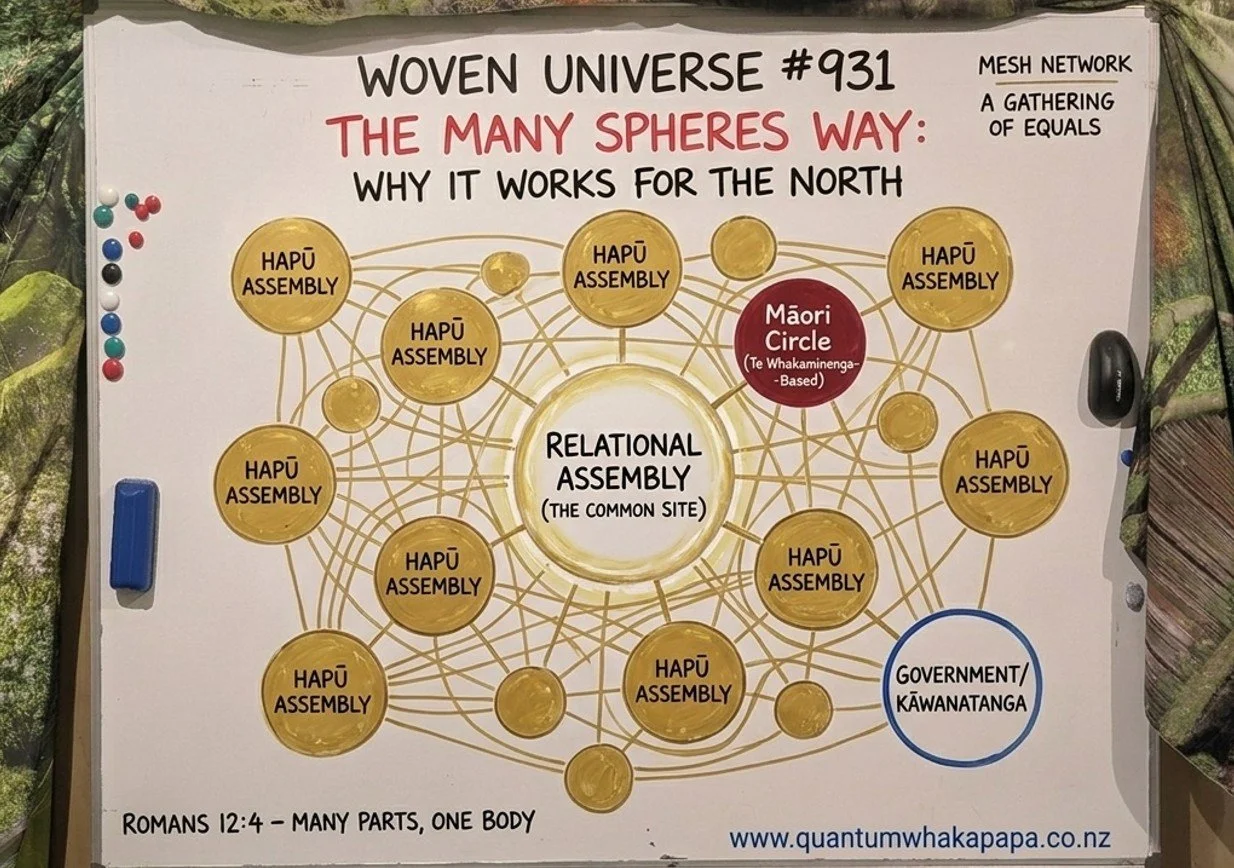
THE WOVEN UNIVERSE #931 - THE MULTI-SPHERE MODEL: WHY IT FITS THE NORTH
Designing the Table
When we discuss fixing our constitutional relationships in New Zealand, we are not simply looking for a seat at someone else's table. We are designing the table itself. For our whānau and hapū across Taitokerau, true governance is about creating a system that perfectly mirrors our original social software. Our local authority has never been located in a single peak or a centralised power structure. Instead, it flows across a beautifully decentralised network of sovereign nodes where each community holds its own unique light.
Real progress can only occur when we shift our focus from pure economic growth to true equity, ensuring we look closely at how the pie is shared across all communities. True social investment is a long-term ROI for the collective well-being of our people and the protection of our natural environment. To make this a reality, our constitutional design must protect local, grassroots agency, allowing those who live on the land to fix the soil and address root causes directly.
Why Centralisation Fails
While other iwi may choose models that favor a single national body, those designs regularly fail to account for the absolute independence of the northern hapū. Historically, the North has always operated as a vibrant confederation of equals rather than a centralised system. This is why the Matike Mai Aotearoa report, particularly on page 105, points to the Multi-Sphere Model, known as Model 4, as the most compatible architecture for our region.
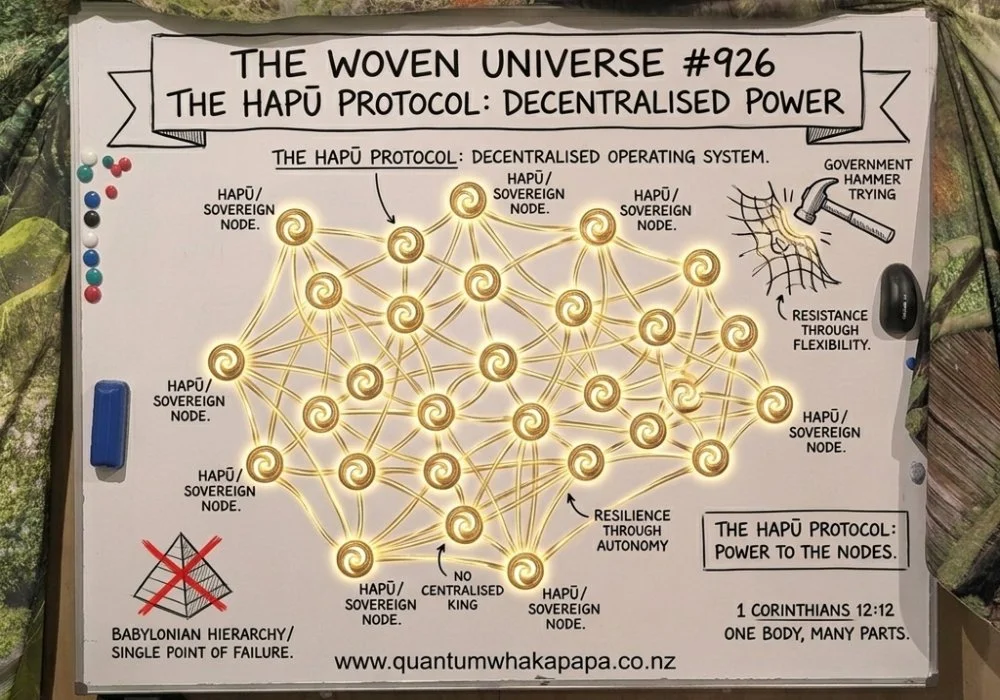
THE WOVEN UNIVERSE #926 - THE HAPŪ PROTOCOL: DECENTRALISED POWER
This post continues our exploration of Research Report #255, which deconstructs the legal and metaphysical foundations of Ngāpuhi Nui Tonu. By triangulating ancient Māori knowledge with quantum theory and biblical jurisprudence, the report affirms that our inherent authority remains supreme at the hapū level. Today, we deconstruct the "Hapū Protocol" as the original decentralised operating system of the North.
The Architecture of the Network
In Babylonian systems, power is always configured as a pyramid, a centralised hierarchy where a single "King" or "State" sits at the apex. But the architecture of Ngāpuhi Nui Tonu is different. According to Research Report #255, Ngāpuhi governance is a "Mesh Network" of autonomous nodes. This is the Hapū Protocol.
In our framework, a "ping" is a targeted spiritual signal used to verify a location and establish a connection. In the North, the "ping" of sovereignty is verified and held at the hapū level, not at a centralised "Iwi" office. Each hapū is a sovereign entity, a self-governing unit with its own mana, its own territory, and its own direct connection to the Source. This decentralised model is why the concept of a single "Māori King" never took root in the North, it is simply a different "Social Software."