
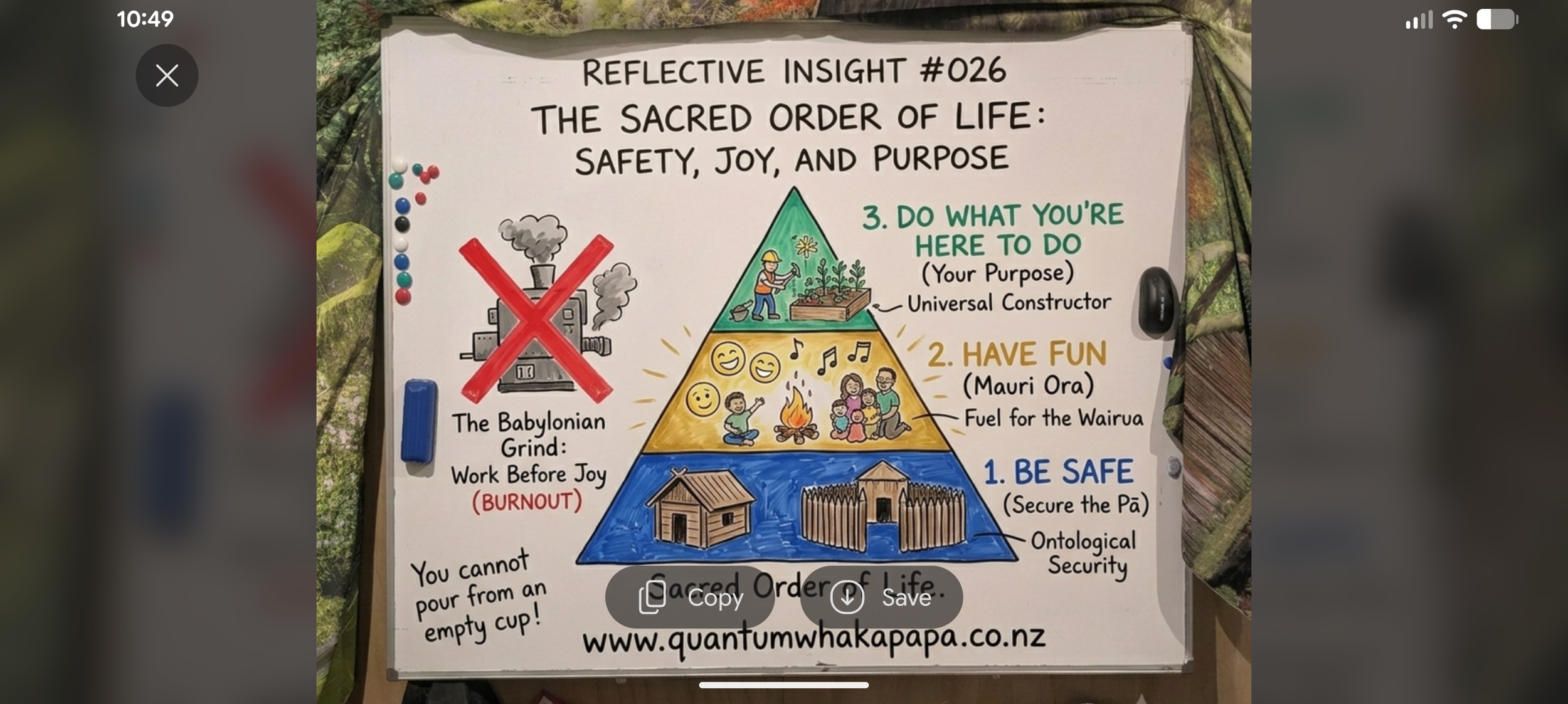
REFLECTIVE INSIGHT #026 - THE SACRED ORDER: SAFETY, FUN, AND PURPOSE
A Simple Rule for Life
Here is a deep truth that has been sitting on my heart lately, especially when I look at the heavy challenges facing our beautiful home in the North. This wisdom actually came from my youngest child, who was only eleven at the time. It is a incredibly simple rule of thumb for life, a hierarchy of basic human needs that our modern world constantly gets twisted:
1. Be safe.
2. Have fun.
3. Do what you are here to do.
The major hurdle we face today under the constant pressure of a cold, demanding system is that we frequently swap numbers two and three. We put the "grind" before our joy, and by doing that, we severely damage the very spirit, the wairua, that fuels our actual purpose in life.
1. Safety First
The very first step can never be negotiated: Be safe. In my ongoing research, I talk a lot about building the Economic Pā. Historically, the pā was a secure place of defense, shelter, and storage that ensured the long-term survival of the family group.
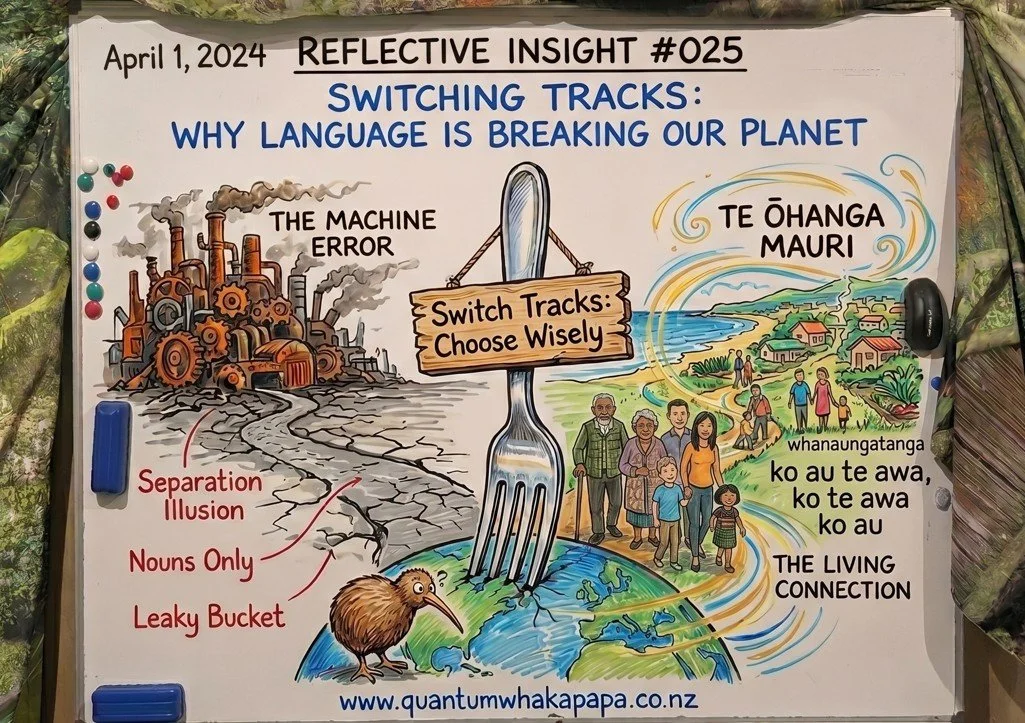
REFLECTIVE INSIGHT #025 - PROPERLY FORKED: WHY OUR ECONOMY AND PLANET ARE CRASHING WITHOUT OUR CONSENT
The Root of the Problem
Have you ever looked at the state of the world, the climate crisis and deep social inequality, and thought that everything is completely broken? Over my Christmas holidays, I went down a deep research path to find out why our systems are failing. I discovered something eye-opening: the problem isn't just our laws, our technologies, or our politicians. The real issue is living inside our everyday words. We are trying to run a living, breathing planet using a language that was specifically redesigned to manage a factory machine.
The History of the Mental Fence
To find out where this problem started, we have to look back at London between the years 1620 and 1700. Before this time, people generally saw the universe as alive and deeply connected. Words naturally bound people to the world around them.
But during the Scientific Revolution, a group of powerful intellectuals, including Sir Francis Bacon and the founders of the Royal Society, decided that this rich, connected language was inefficient and getting in the way of progress. They wanted a cold language designed to control nature, so they carried out what I call The Great Semantic Enclosure.