
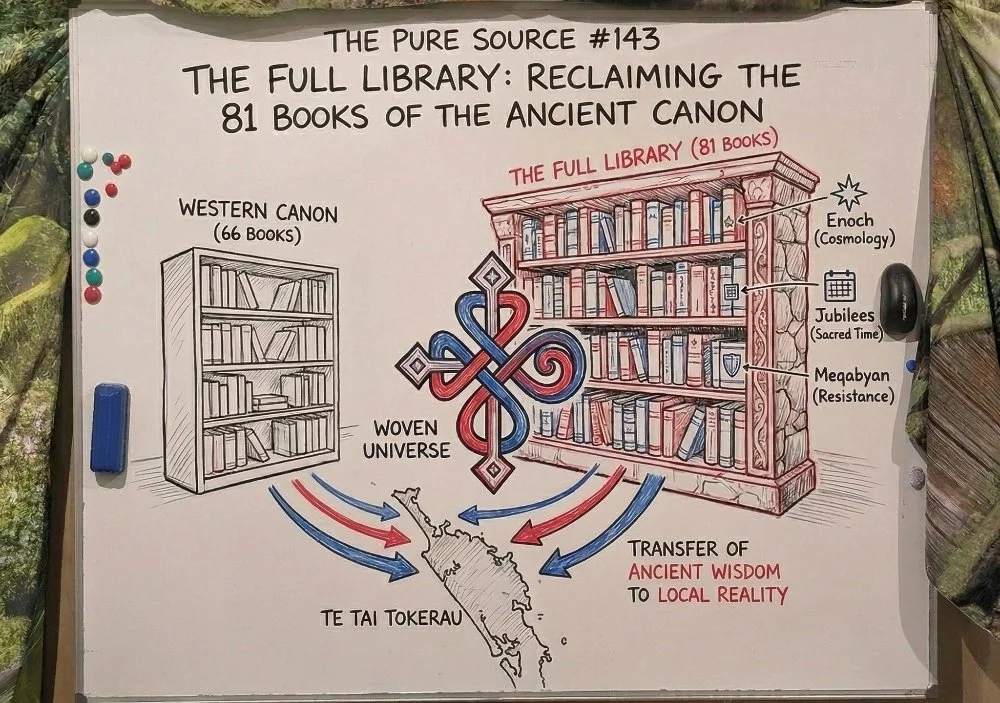
THE PURE SOURCE #143 - THE FULL LIBRARY: RECLAIMING THE 81 BOOKS OF THE ANCIENT CANON
A Wider View
When we think about the Bible, most of us are used to the 66 books found in the standard Protestant version or perhaps the 73 in the Catholic tradition. But for the Ethiopian Orthodox Tewahedo Church (EOTC), the library has always been larger, encompassing a total of 81 books. This is not just a historical detail, it is a statement about the richness of God’s communication with us. The EOTC has carefully preserved this "Full Library" through centuries of upheaval, keeping these texts safe in remote monasteries to serve as a repository of national and religious identity.
Kia ora e te whānau. It is a privilege to share this journey with you. There is a deep, ancient connection between the highlands of Ethiopia and the hills of our own Te Tai Tokerau, one that is woven together through the power of the Word and the continuity of the Spirit.
The Hidden Gems
This expansive canon includes books like Enoch, Jubilees, and the three books of Meqabyan. These are not "extra" stories, they are essential components of a worldview that sees the entire universe as a "Woven Universe," where the celestial and the earthly are deeply entangled. In these pages, we find a detailed cosmology and a focus on ancestral continuity that feels incredibly familiar to our Māori way of being. By reclaiming these books, we are not looking for a "new" faith, but rather the full version of the "Pure Source" that has been largely obscured by Western traditions.
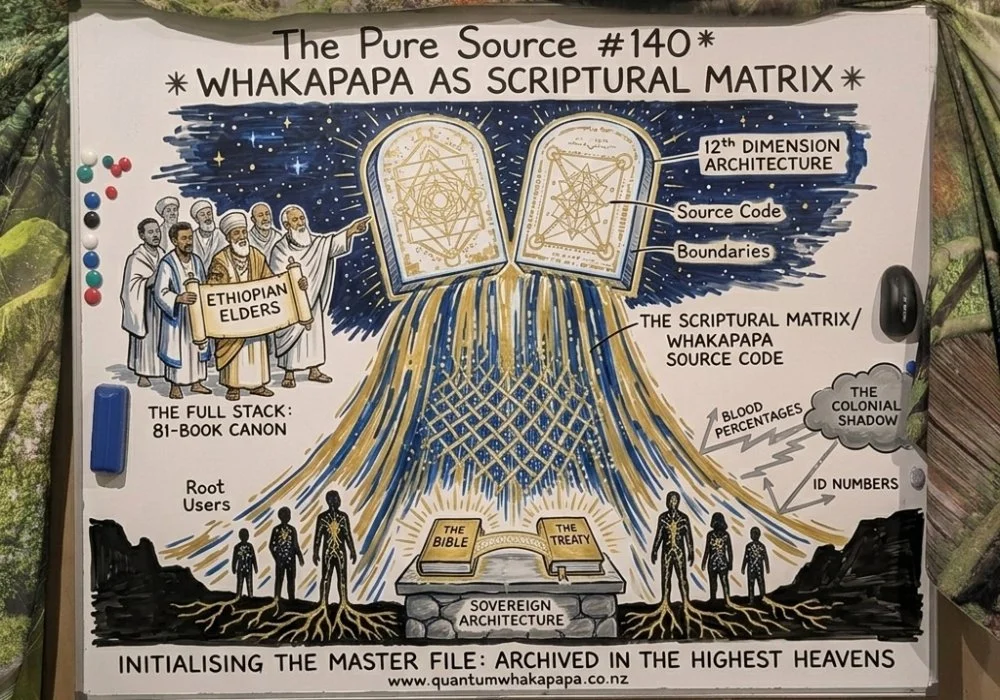
THE PURE SOURCE #140 - WHAKAPAPA AS SCRIPTURAL MATRIX: THE GENEALOGY OF THE PEOPLE OF THE LAND
The Technical Matrix of Identity
In the Western world, genealogy is often viewed as a hobby or a passive record of the past. But in the Hokianga and across the North, Whakapapa is a Technical Matrix. It is the "Source Code" of our existence, a tiered system of data that connects every individual to the land, the ancestors, and the Source. According to Research Report #262, this Māori epistemology finds its perfect scriptural mirror in the "Full Stack" of the Ethiopian Canon, particularly in the Book of Jubilees.
Whakapapa is not just a family tree, it is a Scriptural Matrix. It functions as a living ledger that proves our inalienable right to our territory. While the colonial "Shadow" tries to reduce our identity to a percentage of "blood" or a government-issued ID number, our Whakapapa remains a high-frequency data stream that cannot be corrupted or deleted by the state.
The Heavenly Ledger
The Book of Jubilees describes a reality where the names of the faithful and the boundaries of their inheritance are written on Heavenly Tablets. This establishes genealogy as a sacred, legal framework that exists in the 12th dimension. For Ngāpuhi, our Whakapapa is our local access to those heavenly tablets.
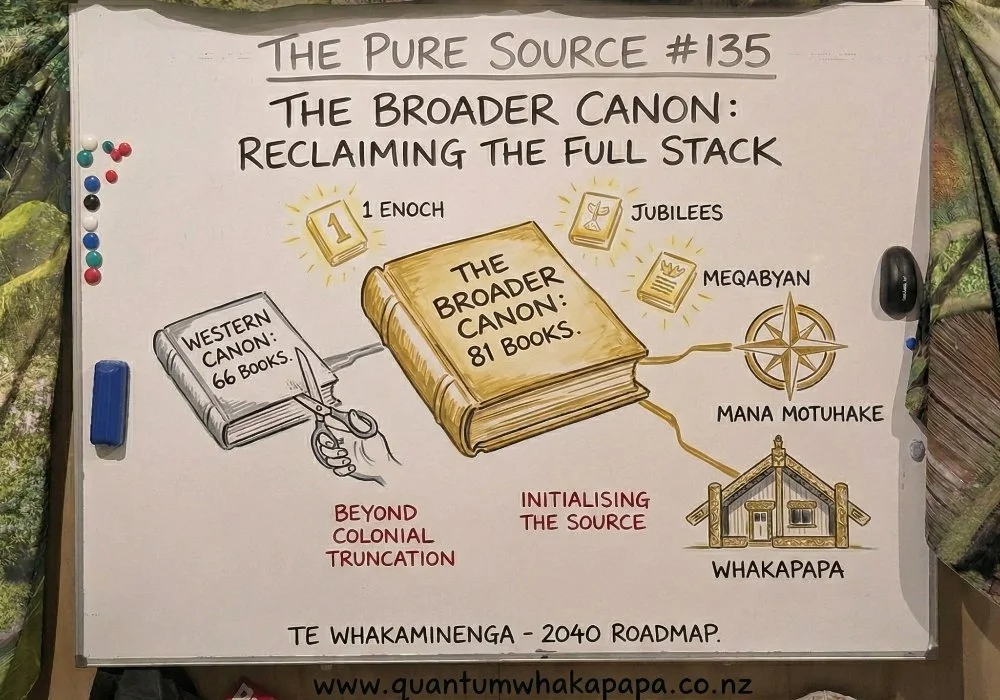
THE PURE SOURCE #135 - THE BROADER CANON: RECLAIMING THE FULL STACK
The Truncated Stream vs. The Full Stack
For centuries, the scriptural "software" delivered to the shores of Aotearoa has been a version that was deliberately edited and truncated by Western institutional interests. While most of us are familiar with the standard 66-book Protestant Bible or the 73-book Catholic version, there exists a "broader canon" that has remained intact for nearly two millennia in the high mountains of East Africa.
The Ethiopian Orthodox Tewahedo Church maintains a comprehensive collection of 81 books. This is not a "different" Bible, it is the Full Stack. It contains vital data, such as 1 Enoch and Jubilees, that provides the necessary context for understanding the spiritual and political architecture of the world. For the hapū of Taitokerau, these "excluded" books are not just historical curiosities, they are the missing pieces of our theological framework.
Comparing the Data Packs
The exclusion of these texts from the Western Bible was a process of institutional normalisation and narrowing that occurred during the early centuries of the Church. This process mirrors the colonial efforts to prioritise certain narratives while marginalising Māori epistemology. Reclaiming the broader canon is an act of intellectual repatriation, recovering knowledge that was suppressed to rebuild a coherent indigenous identity.