
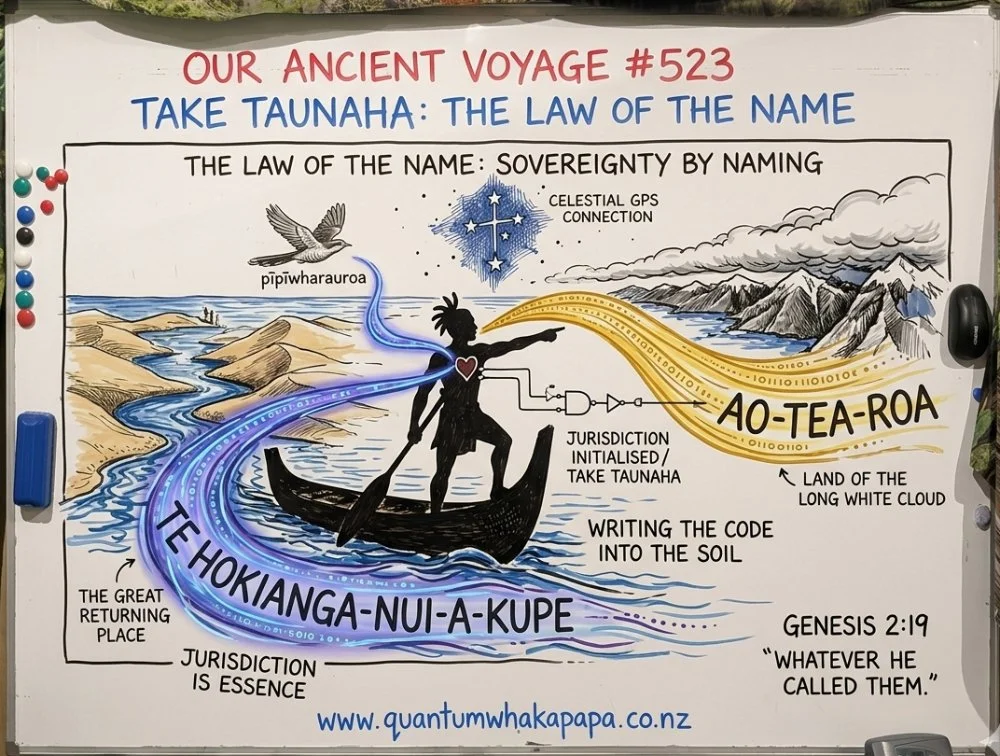
OUR ANCIENT VOYAGE #523 - TAKE TAUNAHA: THE LAW OF THE NAME
This post continues our exploration of Research Report #255, a technical deconstruction of the legal and metaphysical foundations of Ngāpuhi Nui Tonu. This report triangulates ancient Māori knowledge with quantum theory and biblical jurisprudence to affirm an unassailable sovereignty that exists beyond the jurisdiction of any secular government. In this entry, we look at the technical mechanics of discovery and the legal power of naming.
The Legal Act of Naming
When Kupe voyaged through Te Tai Tokerau, he wasn’t just on a sightseeing tour. Every place he named, from Te Hokianga-nui-a-Kupe to Te Rerenga Wairua, was a formal legal claim-staking. In Māori jurisprudence, this is known as Take Taunaha (discovery by naming) or Taunaha Whenua.
By giving names to the land, Kupe was "writing the code" of ownership and jurisdiction into the geography. This wasn’t a travel log, it was a high-frequency "ping" that verified his presence and established his authority. In the Woven Universe, to name something is to exercise dominion over it. When Kupe named the landmarks of the North, he was initialising the Sovereign Server for all his descendants.
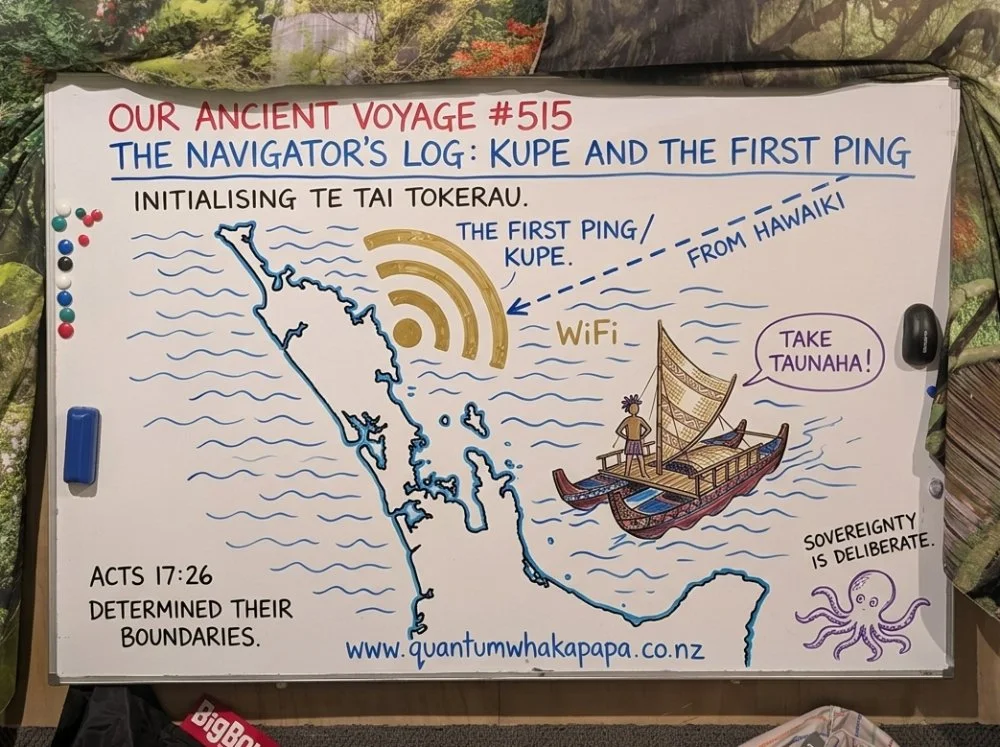
OUR ANCIENT VOYAGE #515 - THE NAVIGATOR'S LOG: KUPE AND THE FIRST PING
The Deliberate Signal
In the old "Babylonian" history books, the arrival of Māori in Aotearoa is often portrayed as a series of accidents, of rafts drifting aimlessly across the Pacific. But the data in Research Report #254 tells a different story. This was not a drift, it was a deliberate, high-frequency "ping" to the land.
In our framework, a "ping" is a targeted spiritual signal sent to verify a location and establish a connection, it was the moment the intention of the voyager met the response of the land.
Around 1000 CE, according to our northern oral traditions, the great navigator Kupe followed the migratory patterns of the long-tailed cuckoo (pīpīwharauroa) and the flight of the stars to find the "giant finger" of the North pointing into the Pacific. This was the first structural exploration of Te Ika-a-Māui. Kupe wasn't just looking for land, he was initialising a connection between the human spirit and the Mauri of this specific geography.
The Far North Anchor
The first landfalls were not random. The Far North, with its massive sand dunes and deep-water harbours, acted as the primary "Access Point" for the Pacific. Kupe’s arrival in the Hokianga and the subsequent naming of sites established the first Take Taunaha (rights of discovery).