
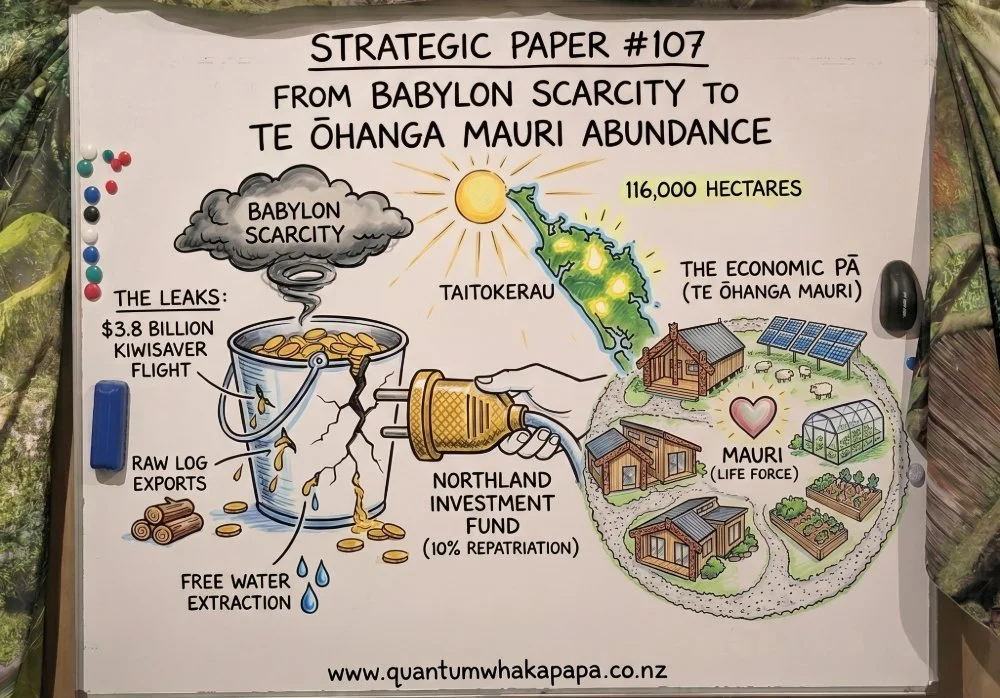
STRATEGIC PAPER #107 - FROM BABYLON SCARCITY TO TE ŌHANGA MAURI ABUNDANCE
Seeing The Truth
For a long time, people have called Taitokerau a "poor" or "deprived" place. But that is just a bad story we’ve been told. It is what I call a "Babylonian" way of seeing things, where people look at our land and our whānau and only see things to use or take. They see the North through the eyes of scarcity, as if there isn't enough to go around.
But when we listen to Wairua Tapu and the wisdom of our ancestors, we see a completely different reality. We aren't poor; we are just poorly organised. We have been running on an old, broken "software" that teaches us we are all separate. This way of thinking is what allows our wealth to be sucked out of the North, leaving us to deal with the mess.
The Leaky Bucket
Think of our economy like a bucket that is full of holes. Right now, most of our timber is shipped away as raw logs. That means all the sunlight, rain, and hard work that went into growing those trees is sent overseas before we can even use its energy. We get a little bit of money, but the big profits and the good jobs happen somewhere else. We are left with the broken roads and the slash in our rivers.
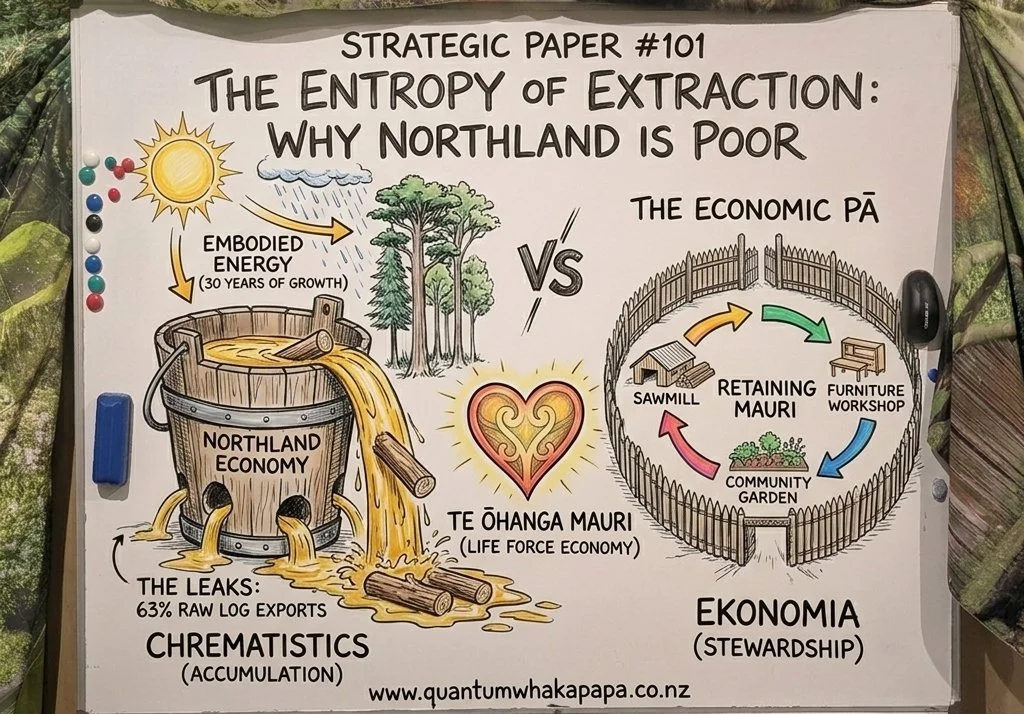
STRATEGIC PAPER #101 - THE ENTROPY OF EXTRACTION: WHY NORTHLAND IS “POOR”
The Poverty Myth
Taitokerau is not a poor land. We are rich in everything that matters, from our rolling hills and deep forests to the captured sunlight and rain that blesses our whenua every single day. Yet, for too long, our whānau have felt the weight of struggle. We look at the logs leaving our ports and wonder why that wealth doesn't seem to stay in our homes. The truth is simple, though the system hides it: we do not have a lack of resources, we have a bad explanation of how to use them.
For years, we have been running an operating system that views our land as a mere asset to be liquidated. This "Babylonian" way of thinking, focused only on accumulation, treats the whenua as dead matter and our people as isolated units of labour. But we know better. Through the lens of the Wairua Tapu, we see that everything is connected. When we export our resources raw, we aren't just shipping timber; we are shipping our very Mauri.
The Leaky Bucket
Think of the Northland economy as a "Leaky Bucket." A tree, like the Pinus radiata, takes about 28 years to grow. In that time, it is like a biological battery, storing decades of solar radiation, rain, and the nutrients of our soil. This is "embodied energy." Right now, data shows that we export between 61% and 63% of our harvest as raw logs.