
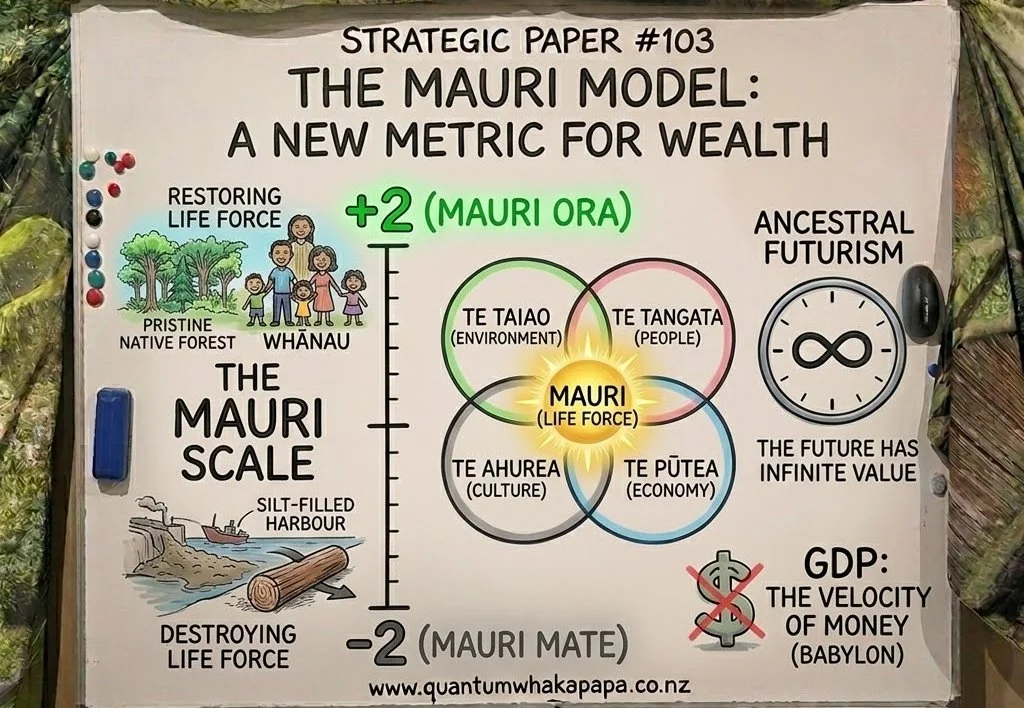
STRATEGIC PAPER #103 - THE MAURI MODEL: A NEW METRIC FOR WEALTH
Beyond The Dollar
For decades, we have been told that the health of our region is measured by a single number: GDP. Gross Domestic Product measures the speed at which money moves through our hands, but it is a blind metric. It counts the money made from cutting down a forest, but it doesn't count the loss of the birds, the silt in our rivers, or the broken spirits of our people. GDP is the law of Babylon, a system that prioritises the velocity of cash over the endurance of life.
Guided by Wairua Tapu, we must realise that true wealth cannot be measured by what we liquidate, but by what we sustain. We need a new law of value, one that aligns with the eternal timeline of Whakapapa. This is why I advocate for the Mauri Model, a framework created by Dr. Kepa Morgan that acts as a Sermon on the Mount for our modern economy.
The Mauri Scale
The Mauri Model does not just look at bank balances, it looks at the life force, or Mauri, of four critical dimensions: Te Taiao (Environment), Te Tangata (People), Te Ahurea (Culture), and Te Pūtea (Economy). Instead of a simple "profit or loss" column, we use a scale from +2 to -2 to measure our impact on the world.
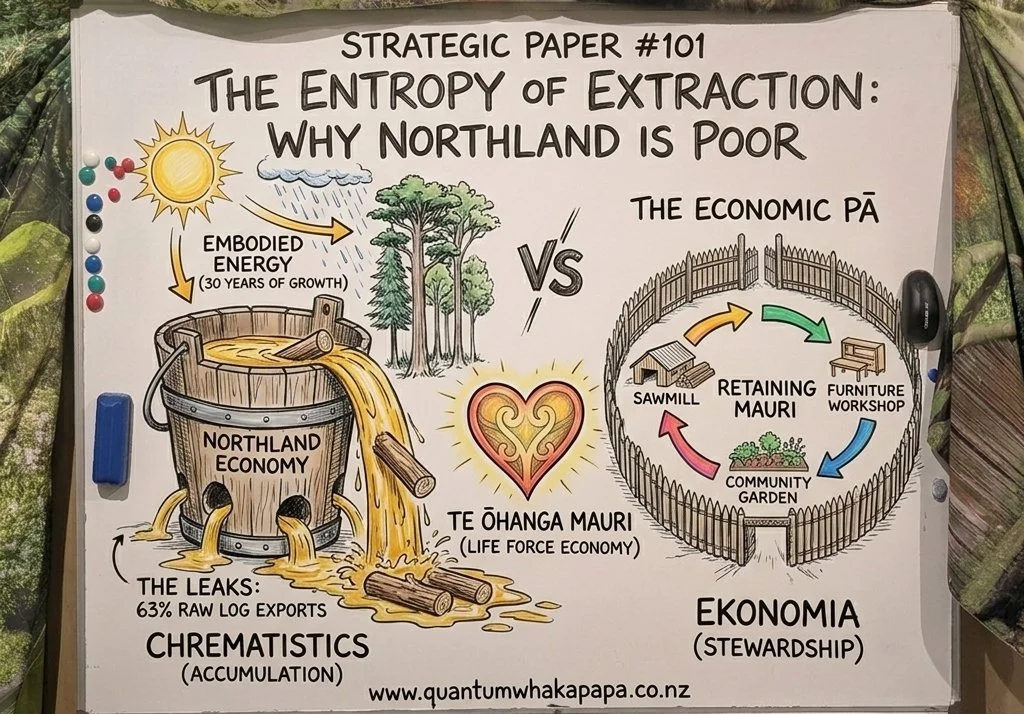
STRATEGIC PAPER #101 - THE ENTROPY OF EXTRACTION: WHY NORTHLAND IS “POOR”
The Poverty Myth
Taitokerau is not a poor land. We are rich in everything that matters, from our rolling hills and deep forests to the captured sunlight and rain that blesses our whenua every single day. Yet, for too long, our whānau have felt the weight of struggle. We look at the logs leaving our ports and wonder why that wealth doesn't seem to stay in our homes. The truth is simple, though the system hides it: we do not have a lack of resources, we have a bad explanation of how to use them.
For years, we have been running an operating system that views our land as a mere asset to be liquidated. This "Babylonian" way of thinking, focused only on accumulation, treats the whenua as dead matter and our people as isolated units of labour. But we know better. Through the lens of the Wairua Tapu, we see that everything is connected. When we export our resources raw, we aren't just shipping timber; we are shipping our very Mauri.
The Leaky Bucket
Think of the Northland economy as a "Leaky Bucket." A tree, like the Pinus radiata, takes about 28 years to grow. In that time, it is like a biological battery, storing decades of solar radiation, rain, and the nutrients of our soil. This is "embodied energy." Right now, data shows that we export between 61% and 63% of our harvest as raw logs.