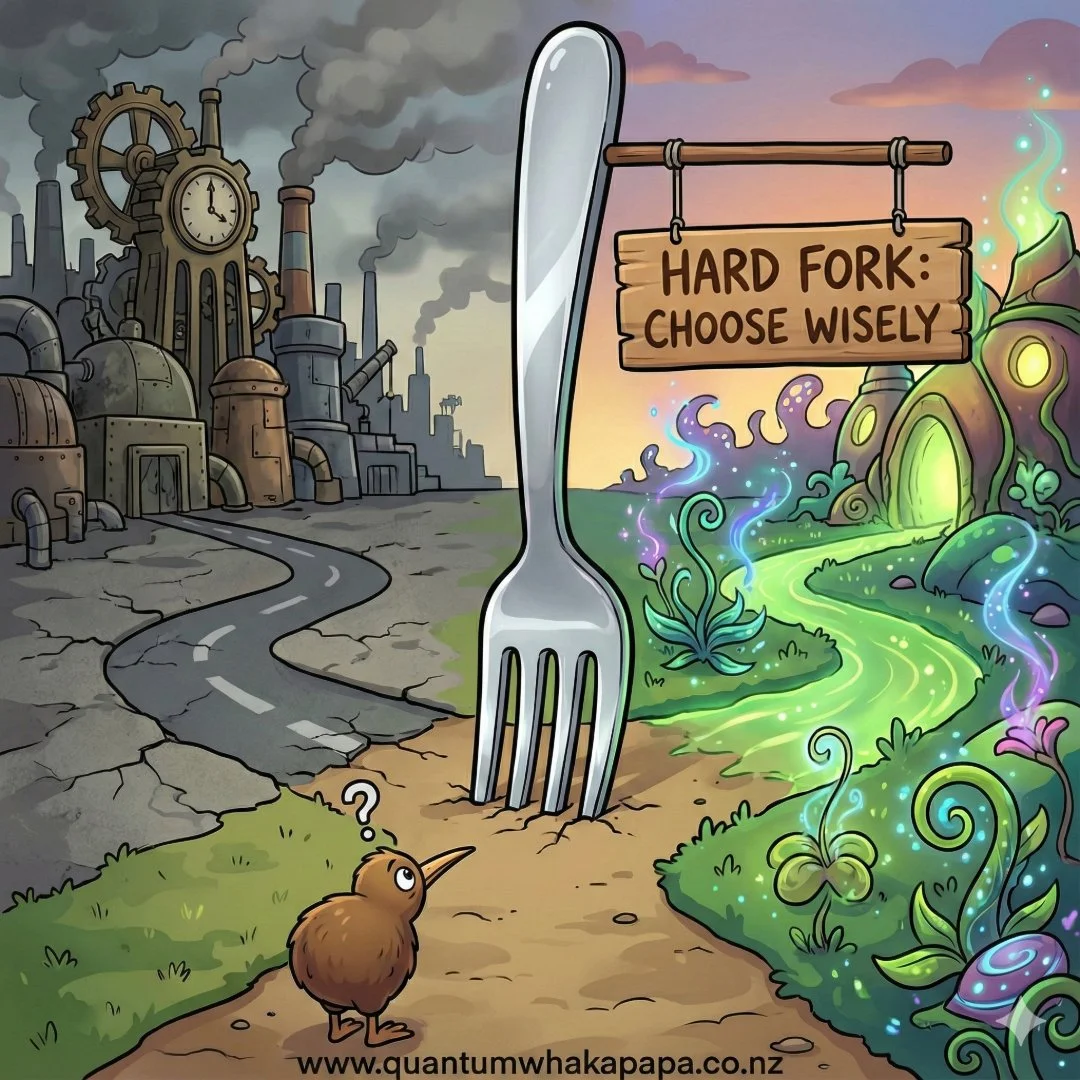
REFLECTIVE INSIGHT #025 - PROPERLY FORKED - WHY OUR ECONOMY AND PLANET ARE CRASHING WITHOUT OUR CONSENT

Have you ever looked at the state of the world—the climate crisis, the social inequality, the fact that a lettuce recently outlasted a British Prime Minister—and thought, "Man, this is properly forked"?

Well, over my Christmas holiday (when I should have been eating ham and ignoring my emails), I went down a research rabbit hole so deep I nearly bumped into Alice. And I found out something terrifying: we actually are forked. But not in the way you think. It’s not just our politics or our economics that are broken. It’s our words.

We are trying to run a complex, living, breathing planet using a linguistic operating system designed for a steam engine.

Read More

REFLECTIVE INSIGHT #024 - THE GREAT SEMANTIC ENCLOSURE - WHY WE NEED A LINGUISTIC ‘HARD FORK’ FOR OUR FUTURE

Have you ever wondered why we struggle to solve 21st-century problems like climate change, social inequality, and ecological collapse using the tools of our current economic system? My recent research with The Quantum Whakapapa Project suggests the problem isn’t just in our policies, our technologies, or our politicians—it is in our words.

Over my Christmas holidays, I've been conducting a forensic investigation into the "source code" of our reality (Research Reports #228 and #229). My investigation explores the critical intersection of language and ontology. Put simply, ontology is the study of the nature of reality—it asks what things actually are and how they relate to one another. If your ontology is flawed (e.g., you believe the world is made of dead, separate objects), your economy will be destructive. If your ontology is accurate (e.g., you understand the world is a web of living, entangled connections), your economy can be regenerative.

Read More

REFLECTIVE INSIGHT #023 - THE GREAT SEMANTIC ENCLOSURE - UNDERSTANDING THE HISTORICAL LANGUAGE SHIFT FROM CONNECTION TO COMMERCE

My parents were both into languages. I remember fairly often as a child when they couldn’t think of an English word to say what they wanted to say, so they’d use a Maori or French or Japanese word. I didn’t think too much of it at the time, i supposed that maybe some concepts just weren’t part of English culture. As it turns out, the form of English used to colonise much of the world, the language of commerce, fails to clearly describe many aspects of reality clearly. This isn't an accident of history; it’s the result of a deliberate "re-engineering" of the English language that happened between 1620 and 1700. 

Read More