
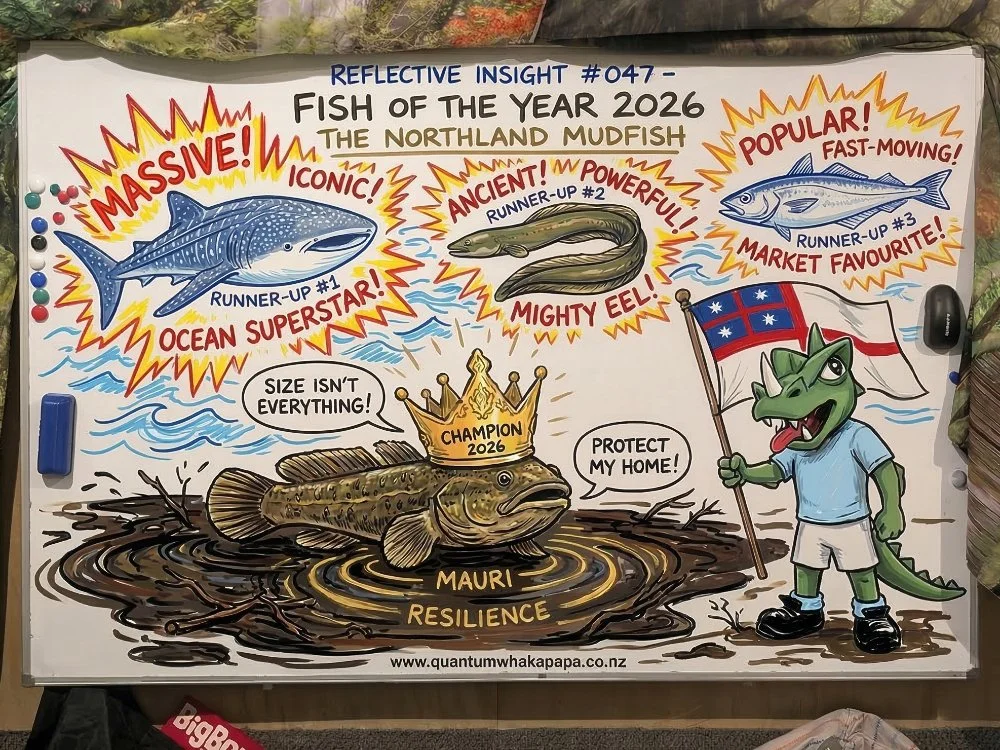
REFLECTIVE INSIGHT #047 - THE NORTH’S QUIET CHAMPION: HONOURING THE KŌWARO
The Great Upset
In a world that usually cheers for the biggest and the loudest, something special just happened. The Northland Mudfish (Kōwaro) was just named "Fish of the Year" for 2026.
At the halfway point of the contest, this little fish wasn't even in the top ten. But in the final 24 hours, the people of the North got together and pushed it into first place. It is the first freshwater fish and the smallest species ever to win, beating out giants like the whale shark and the longfin eel.
Tough as the North
The Kōwaro is a lot like the people of Te Tai Tokerau. It doesn't need to be flashy to be a champion. It’s only 15cm long and spends most of its time hidden away, but it is incredibly tough. When the wetlands dry up in the summer, this fish doesn’t give up. It buries itself in the mud and waits for the rain to come back.
Just like our people, the mudfish knows how to survive the hard times by staying grounded. It doesn't ask for the spotlight, but it gets the job done. It proves that you don't have to be a "heavyweight" to be the best, you just have to have heart and stay true to your roots.
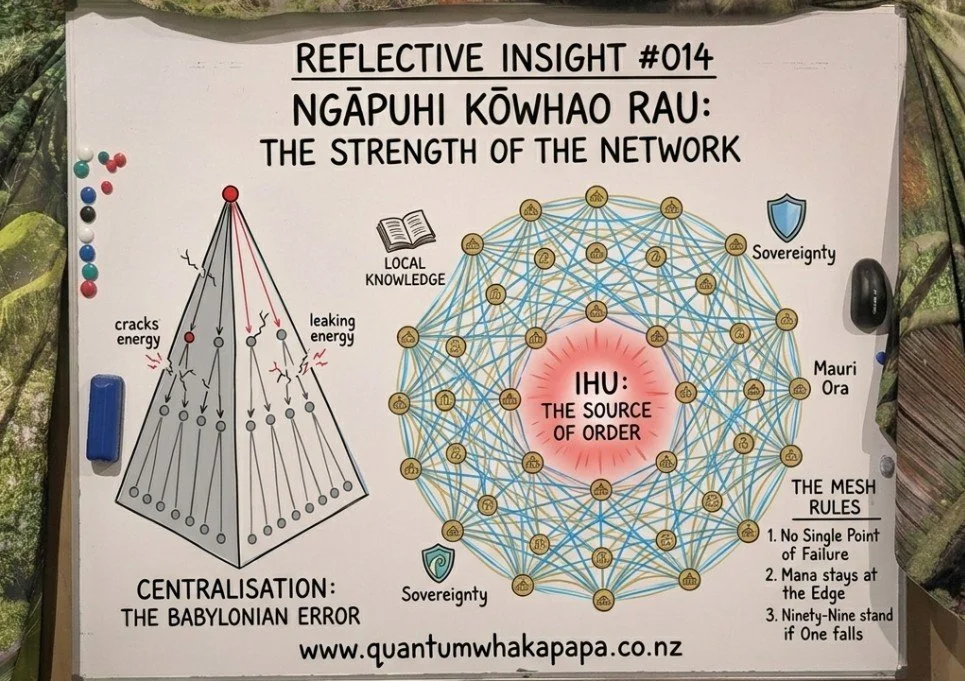
REFLECTIVE INSIGHT #014 - NGĀPUHI KŌWHAO RAU: THE STRENGTH OF THE NETWORK
The Top-Down Error
For nearly two centuries, we have been told that order must be imposed from the top down. Whether it is a government department in Wellington or a centralised trust board in a city office, the message remains the same, the "centre" knows best. But here in Te Tai Tokerau, we know this is a "bad explanation" that has left our regions drained and our people waiting for permission to thrive. This centralised model is what I call the Babylonian system, and it is thermodynamically broken. It tries to force order from a single point into a complex world, which only creates disorder and waste.
The Hundred Holes
Our tūpuna already had the solution to this problem, long before modern scientists started talking about networks. There is an ancient Ngāpuhi whakataukī that defines our identity: "Ngāpuhi kōwhao rau," or "Ngāpuhi of a hundred holes." In our traditions, this was a way of describing our unique strength. While other iwi might have had a single paramount chief or a central point of power, Ngāpuhi operated as a massive, decentralised network of hapū and marae. Each kōwhao, or hole, represents a place of authority, a node where mana sits directly with the people on the land.