
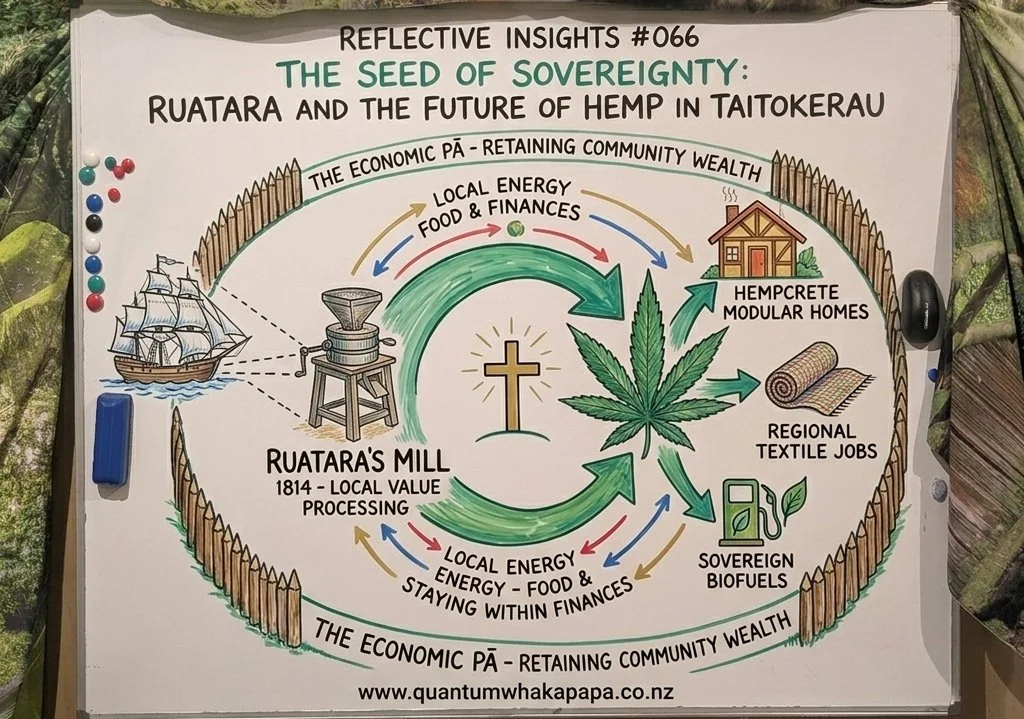
REFLECTIVE INSIGHT #066 - THE SEED OF SOVEREIGNTY: RUATARA AND THE FUTURE OF HEMP IN TAITOKERAU
A Vision of Abundance
When we walk upon the whenua of Te Tai Tokerau, we are walking on land destined for abundance. Real progress does not come from waiting for central government handouts or large offshore corporations to invest in our towns. It begins at the roots, right in the soil, through the collective action of our whānau, hapū, and iwi. For too long, our local economy has relied on sending our raw resources away, while our families miss out on the long term benefits. True equity is about how the pie is shared, ensuring that our social investment creates a lasting return for the community. The blueprint for this self-reliance was given to us generations ago by our ancestors, who understood that our environment and our well-being are completely intertwined.
To anchor our agricultural path forward, we look to the original instructions of creation left for us in the sacred scriptures:
"And God said, 'Behold, I have given you every herb yielding seed, which is on the surface of all the earth, and every tree, which bears fruit yielding seed; to you it shall be for meat.'" - Ethiopian Orthodox Bible (Genesis 1:29)
Ge'ez text: ወይቤሎሙ፡ እግዚአብሔር፡ ናሁ፡ ወሀብኩክሙ፡ ኵሎ፡ ሣዕረ፡ ዘይዘራዕ፡ ዘርአ፡ ዘውስተ፡ ኵሉ፡ ገጸ፡ ምድር፡ ወኵሎ፡ ዕፀወ፡ ዘቦቱ፡ ፍሬ፡ ዘርዕ፡ ዘይዘራዕ፡ ለክሙ፡ ይዅን፡ መብልዕ።
Te Reo Maori, Paipera Tapu, 1868 translation: A i mea te Atua, Na, kua hoatu e ahau ki a koutou nga otaota katoa e whai hua ana, i runga i te mata o te whenua katoa, me nga rakau katoa, he hua rakau tona huri e whai hua ana; hei kai ma koutou.
The Legacy of Ruatara
We carry a proud history of innovation in the North. We see this clearly in the story of Ruatara, a visionary young Ngāpuhi leader from the Bay of Islands. In the early 1800s, Ruatara traveled the world on whaling ships, enduring incredible hardships, starvation, and severe mistreatment from dishonest captains. Despite these trials, his heart remained fixed on the prosperity of his people. He spent months studying European farming techniques, carpentry, and practical trades. When he finally returned to Rangihoua around 1812, he brought with him tools and precious seed wheat, determined to establish a self-sustaining food supply and a valuable export crop for the North.
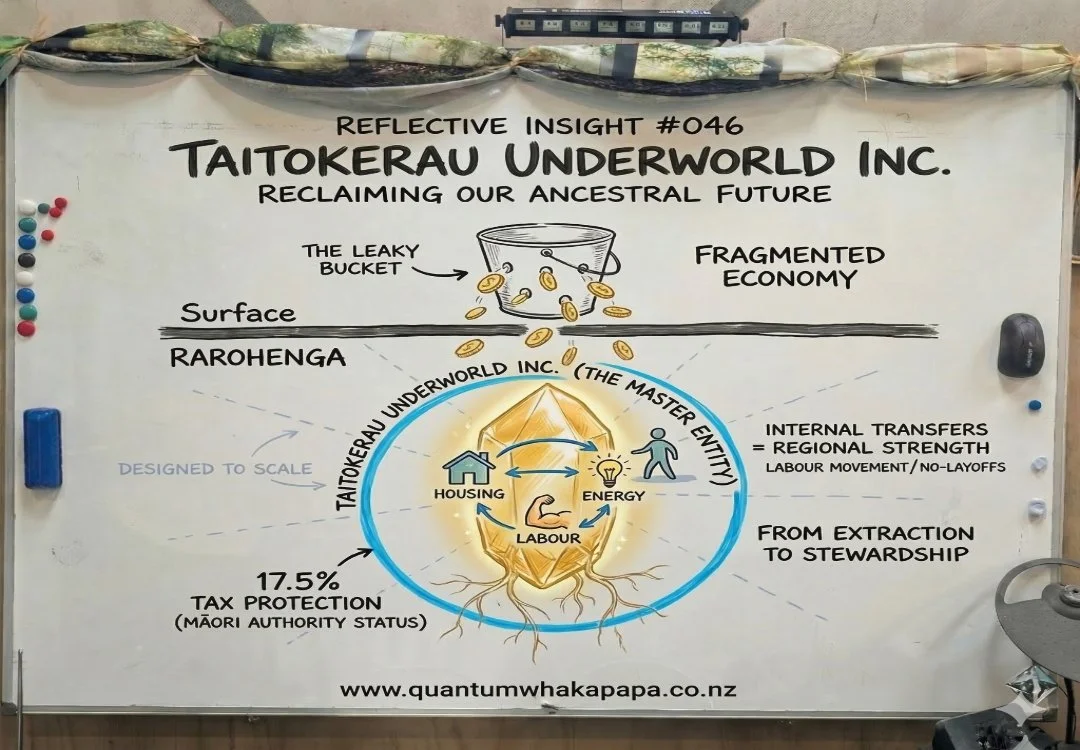
REFLECTIVE INSIGHT #046 - TAITOKERAU UNDERWORLD INCORPORATED: RECLAIMING OUR ANCESTRAL FUTURE
The Architecture of the Deep
For a long time, the economy of Te Tai Tokerau has functioned like a "Leaky Bucket." This is a fragmented system where our regional wealth, talent, and energy are often exported for a currency that immediately drains away to offshore banks and global interests. We see it in our forests, our farms, and our workforce, where the value created here rarely stays here. This happens because the "Software" of our current business environment is designed for extraction rather than stewardship.
Taitokerau Underworld Incorporated is our architectural response to this challenge. It is a single legal master entity designed to be capable of holding an entire communal regional economy. While it is built with that vast potential in mind, it is intended to start as a small, humble seed that can scale naturally over time as trust and resources grow. By shifting our regional business operations into this unified structure, we move from a mindset of survival to a reality of collective abundance.
Why the "Underworld"?
In our Quantum Whakapapa framework, the name "Underworld" draws from the Māori philosophical realm of Rarohenga. Far from being a dark abyss, Rarohenga is traditionally seen as a realm of peace, light, and permanent wisdom. It is where the "permanent moko" or deep structural knowledge resides, standing in contrast to the temporary and often chaotic markings of the surface world. Taitokerau Underworld Inc. is designed to be the "Secure Server" for our regional sovereignty, a place where our assets and our people are protected by a common purpose.
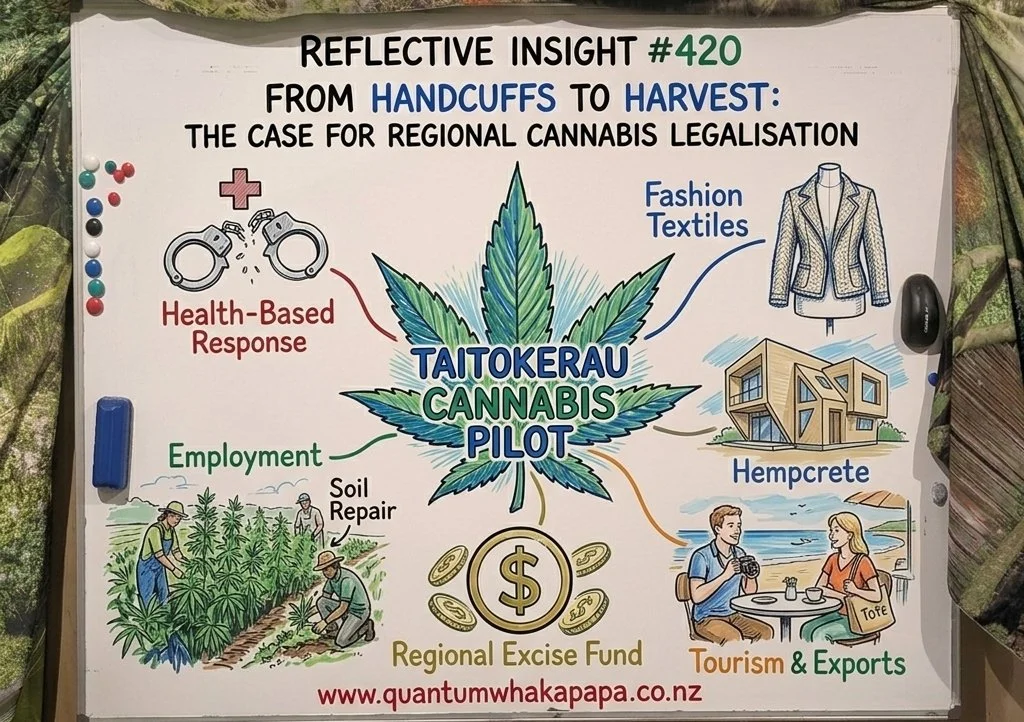
REFLECTIVE INSIGHT #420 - FROM HANDCUFFS TO HARVEST: THE CASE FOR REGIONAL CANNABIS LEGALISATION
A Memory of Unfairness
When I was six years old, a family friend was sent to prison over cannabis. I remember overhearing my mum on the phone saying that the police should be chasing real criminals. That memory has stuck with me for forty years, and she was absolutely right. For five decades, our national drug laws have completely failed to stop drug harm. Instead, they have been used to hurt Māori in Te Tai Tokerau more than anyone else, bringing our communities to a breaking point of social damage.
Turning Our Communities into Criminals
If using cannabis is a crime, then almost our whole region is full of "criminals". A long-term study that followed New Zealand children found that by the time they turned 21, over two-thirds of them had tried cannabis. Arresting or convicting people fails to stop them from using it again in 95% of cases. The law is handed out in an unfair, biased way, creating a bad reputation for our people and forcing our whānau to buy from unsafe, illegal markets. We are running a broken Babylonian system that treats our people as objects to be punished instead of helping them grow.
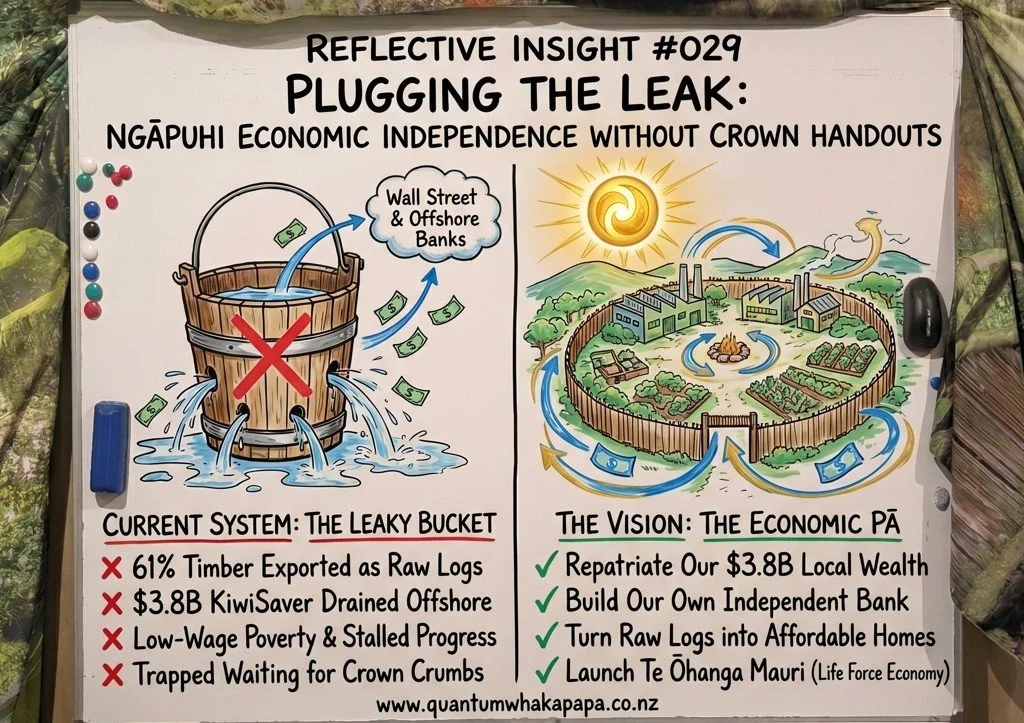
REFLECTIVE INSIGHT #029 - NGĀPUHI CAN RECLAIM OUR ECONOMIC SOVEREIGNTY WITHOUT ACCEPTING A CENT FROM THE GOVERNMENT
Why hasn’t Ngāpuhi settled?
This weekend my whānau travelled down to Tauranga Moana for the burial of our great aunty who passed away at the age of 101 ½, after living a peaceful and simple life and giving most of her money away to the needy overseas. I carpooled with my sister and niece. On the way home as we were coming over the Brynderwyns, enjoying that majestic view that welcomes us home, the conversation turned to the Ngāpuhi settlement. I did my best to explain, from my perspective, why Ngāpuhi hasn’t settled.
One of the things with explaining something to a 9-year-old (even a very smart one) is that simplicity has a way of rising to the surface. In the simplest terms, even though the $500–800 million potentially on offer would be handy for our whānau right now, what the government wants in return isn’t ours to give away. It belongs to our mokopuna and their mokopuna and their mokopuna.
So what’s the alternative? Find the money somewhere else.
Taitokerau’s “Leaky Bucket” Economy
For too long, our people in the North have been told to wait at the table for crumbs from the Crown to survive. But the truth is, the current system is a draining machine designed to pull out our timber, our talent, and our time, and export it to offshore funds. This system acts as a leaky bucket where our resources are stripped away, leaving us with the constant struggle of low-wage poverty and split-up communities.
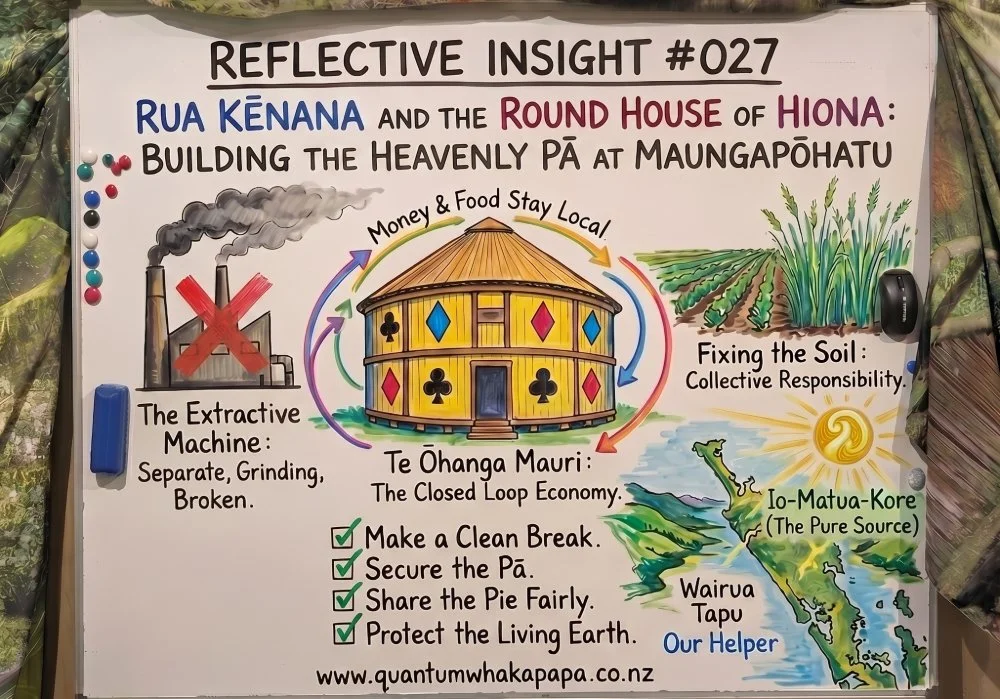
REFLECTIVE INSIGHT #027 - RUA KĒNANA - BUILDING THE HEAVENLY PĀ AT MAUNGAPŌHATU
A Vision of Hope
In the misty, rugged heart of the Urewera forest, there is a powerful story of hope and heartache that every single one of us should hold close to our hearts. It is the story of Rua Kēnana Hepetipa and the beautiful, safe community he built for his people at Maungapōhatu. Following a deep spiritual guidance and the older prophecies of Te Kooti, Rua led his followers, known as the Iharaira, away from the distractions and pressures of the outside world. Together, they cleared the bush to build a dedicated city of God right on the steep slopes of their sacred mountain.
Escaping the Machine Mindset
For Rua, this massive hill community was not just about religion or hiding away, it was a practical way to protect the true standing and well-being of his people. He saw clearly how the colonial system was set up to turn local people into cheap workers on their own ancestral land. Rua decided to make a clean break from that broken path. He imagined a safe home where daily work and deep faith lived together as one, where families looked after each other, and where the future was decided by the community around the table, not by a cold bureaucracy in a distant city.
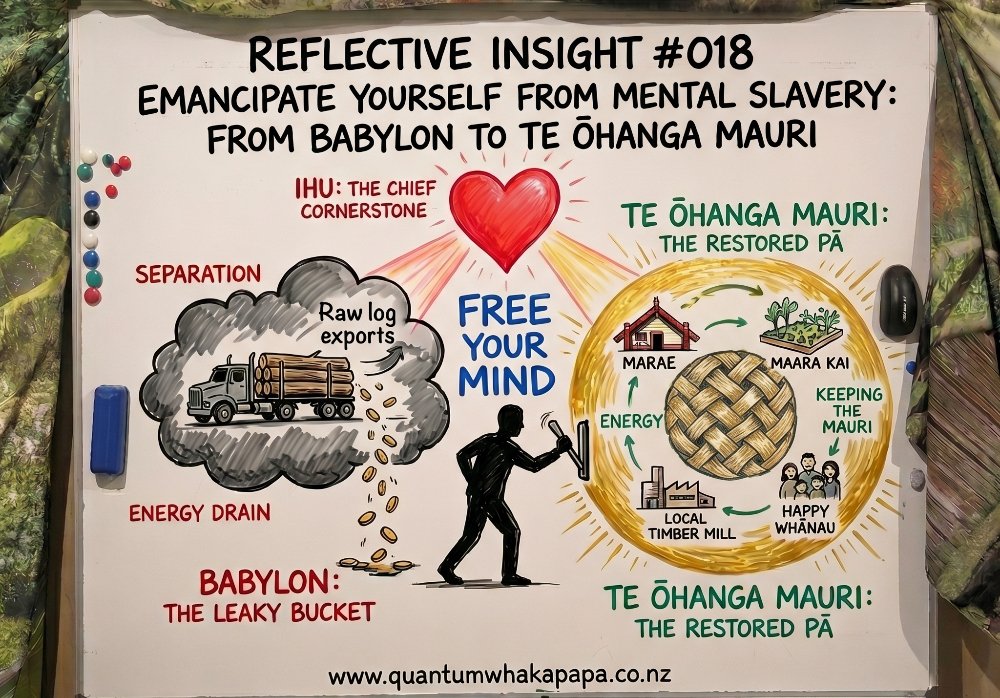
REFLECTIVE INSIGHT #018 - FREE YOUR MIND: THE CHOICE BETWEEN BABYLON AND TE ŌHANGA MAURI
The Choice is Ours
We often talk about "the system" as if it’s a faceless machine we can't control. But our ancestors and the prophets had a much sharper name for it: Babylon. As the song says, we need to free our minds from a way of thinking that keeps us as slaves to a broken system. In Taitokerau, we are at a crossroads. We have to choose: do we stay in the "Leaky Bucket" of Babylon, or do we finally build Te Ōhanga Mauri?
The Babylonian Way: A Leaky Bucket
Babylon is a system built on a big mistake, the idea that we are all separate and should just grab whatever we can for ourselves. In the North, we see this in the way we trade our logs. We send 61% of our raw timber away to the other side of the world. We are sending our "energy" away, and in return, we get paper money that we immediately spend on imported goods. This creates disorder. It leaves our roads broken and our families struggling, while the real wealth is built somewhere else. It is a system that takes our life force and leaves us with the waste.
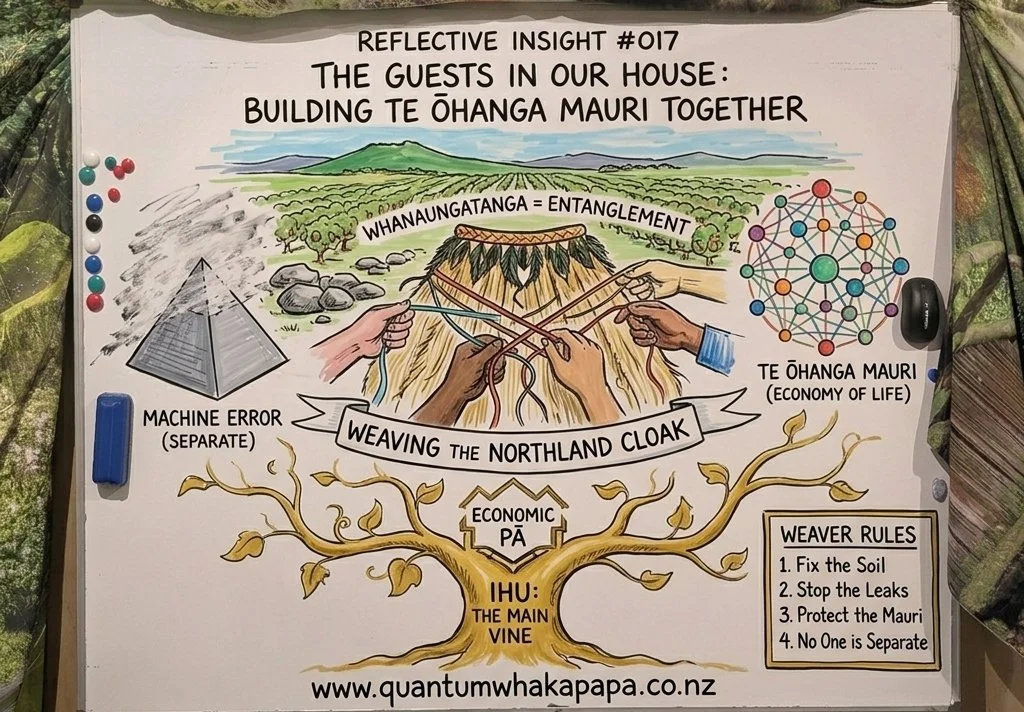
REFLECTIVE INSIGHT #017 - THE GUESTS IN OUR HOUSE: BUILDING TE ŌHANGA MAURI TOGETHER
Sunlight in Maungatapere
The afternoon sun is baking the volcanic stones and warming the kiwifruit orchards here in Maungatapere. Looking out over this land, I am reminded of what Rev. Māori Marsden called the "Woven Universe." This is a reality where everything is a process of connected threads rather than a collection of separate things. If we are to move Te Tai Tokerau away from a system that just takes and toward a place where life flourishes, we must understand how every person living here, whether they are Tāngata Whenua, Tāngata Tiriti, or new immigrants, fits into that fabric.
The Machine Error
For too long, the broken system we live in has relied on a major mistake. It views the universe like a cold machine made of isolated parts that don't really need each other. In our community, this shows up when we think of ourselves as separate individuals only looking out for ourselves. But modern science and ancient wisdom both tell us the same thing: separation is an illusion. We are all part of the same mauri (life force) that flows through this land. When one part of our community suffers, we all feel the leak.
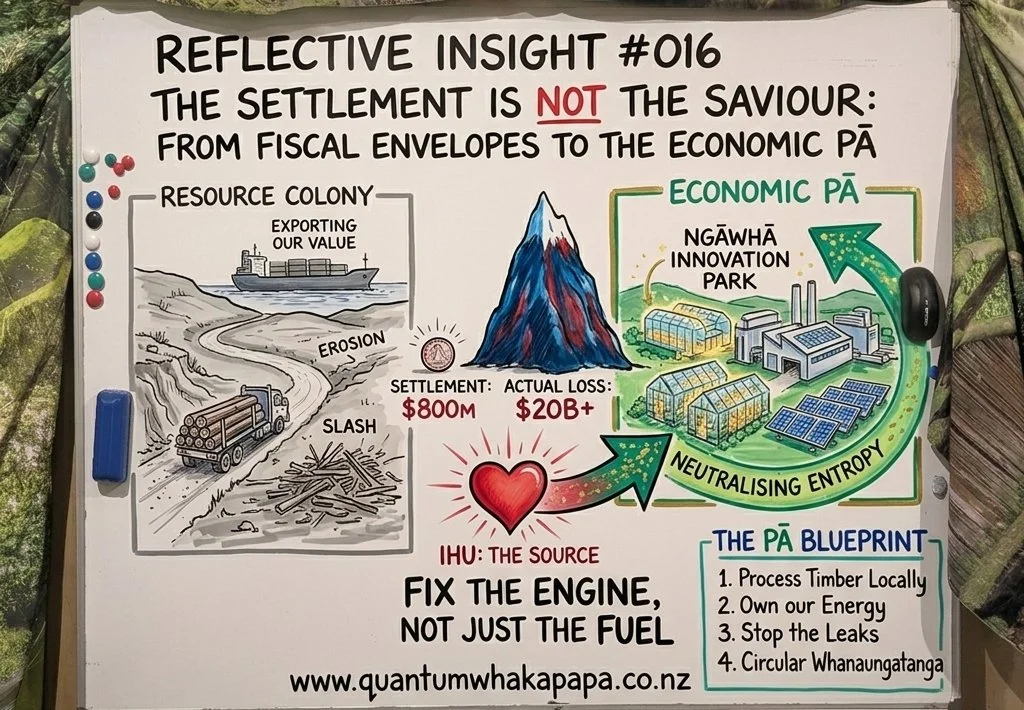
REFLECTIVE INSIGHT #016 - THE SETTLEMENT IS NOT THE SAVIOUR: FROM FISCAL ENVELOPES TO THE ECONOMIC PĀ
The Hard Truth
We need to have a very honest kōrero about the numbers facing us in Te Tai Tokerau. For generations, our whānau have been waiting for the "Big Settlement" to arrive, hoping it will be the answer to our struggles. But the forensic reports are in, and the truth is sobering. The actual value of the land and resources stripped from our tūpuna exceeds $20 billion. That is the real debt. Yet, the Crown is offering a settlement likely between $500 million and $800 million. We have to be candid: this is not a rescue package, it is pennies on the dollar.
The Fiscal Envelope BS
The Crown uses fancy language like "Fiscal Envelopes" and "relativity clauses" to justify these small numbers. In reality, it is a political game designed to keep the status quo. If we think that $800 million, managed by a few centralised boards in the city, is going to fix the deep-rooted poverty in our region, we are falling for a "bad explanation." If we just pour that money into the same broken "Babylonian" system we live in now, it will leak out of the North faster than it arrives.
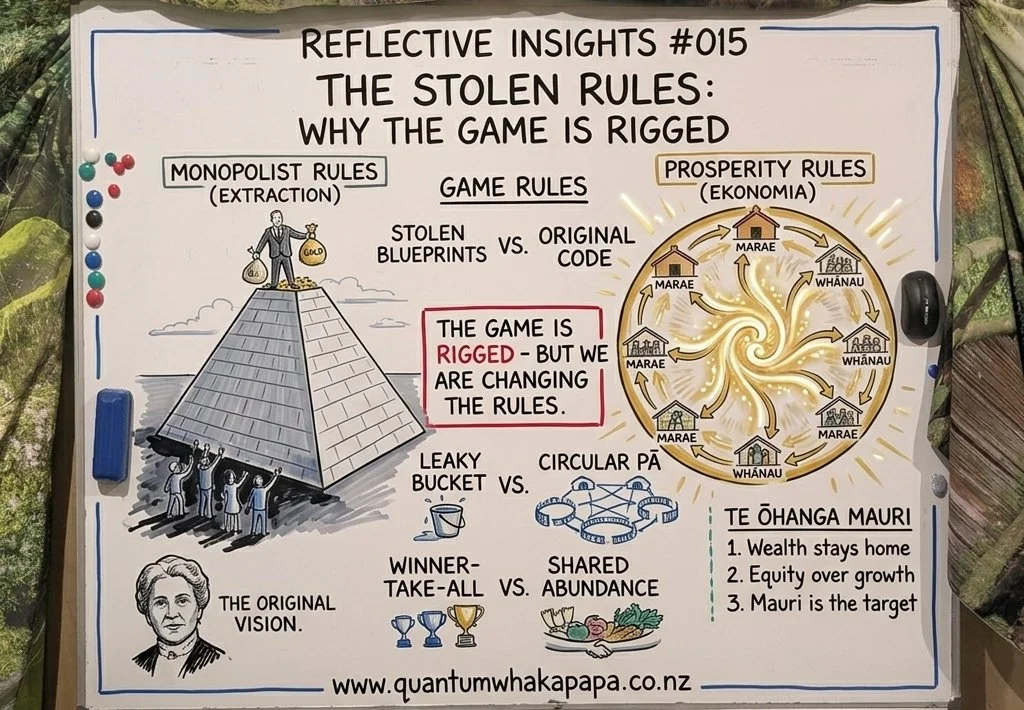
REFLECTIVE INSIGHT #015 - THE STOLEN RULES: WHY THE GAME IS RIGGED
The Game We All Know
We have all been there, sitting around the table on a rainy Taitokerau afternoon, the Northland Edition Monopoly board spread out. The tension rises as one whānau member starts hoarding all the hotels, while the rest of the players slowly go broke. We were taught that this is just "how the game works", that for one person to win, everyone else has to lose. But what if I told you that the game we were given is a stolen explanation? What if I told you the original version had a second set of rules, one designed to prove that we can all prosper together?
The Stolen Blueprint
The game we know as Monopoly was actually patented in 1904 by a woman named Elizabeth Magie. She called it The Landlord’s Game, and she did not design it to celebrate greed. She designed it as a wero to the extractive systems of her time. Her original game featured two distinct sets of rules: "Monopolist" and "Prosperity." She wanted to show that how we organise our society is a choice, not a destiny.
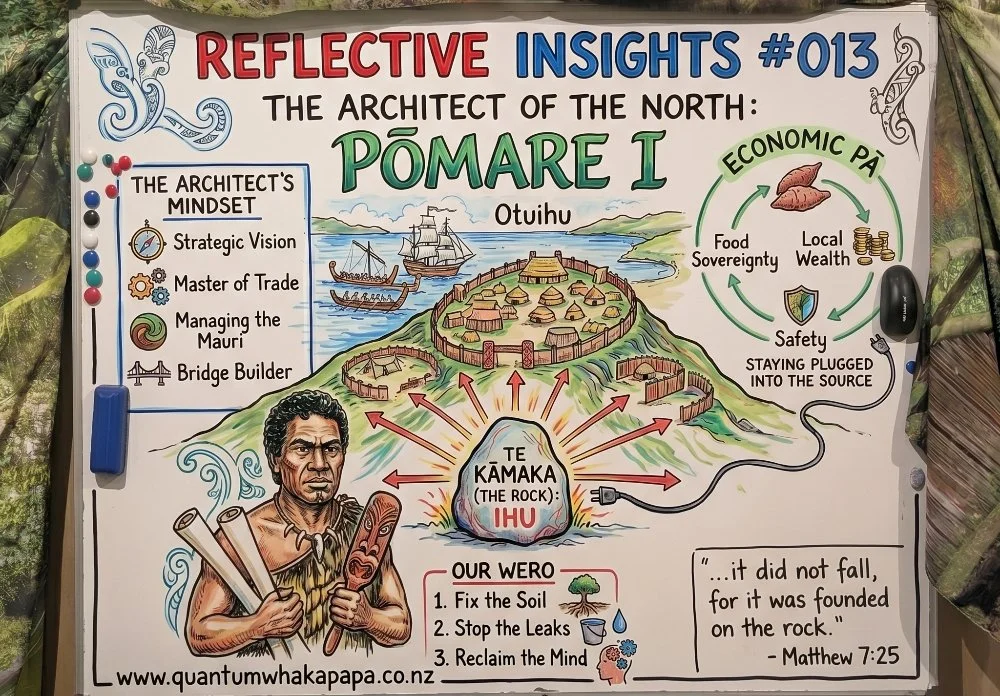
REFLECTIVE INSIGHT #013 - THE ARCHITECT OF THE NORTH - POMARE I
A Legacy of Vision
When we talk about the history of Te Tai Tokerau, the name Pōmare I often brings to mind images of a fierce warrior and a leader of the Ngāti Manu people. But if we only see him as a man of war, we miss the most important part of his story. Pōmare was, in truth, an architect. He wasn't just building a tribe; he was building a future. He was a strategic thinker who understood how to manage the mauri of his people during a time of massive change, showing us what it looks like to be a "Navigator" of two worlds.
The Economic Pā Blueprint
Pōmare lived in a time when the "Babylonian" world was first reaching our shores. Instead of just reacting to the static of colonial influence, he leaned into his own authority. He established the Pā at Otuihu as a thriving center of trade and diplomacy. This was a prototype for what we now call the "Economic Pā", a place where wealth is created, resources are managed, and the community is kept safe and sovereign. He understood that to protect his whānau, he had to be a master of the new "software" of commerce without losing the "hardware" of his whakapapa.
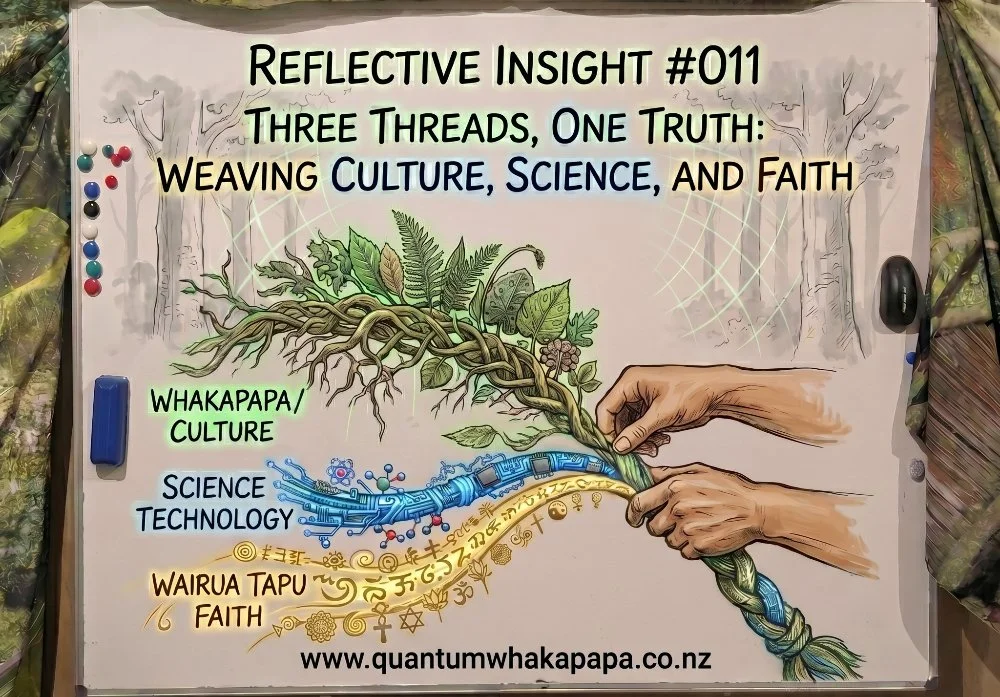
REFLECTIVE INSIGHT #011 - THREE THREADS, ONE TRUTH: WEAVING CULTURE, SCIENCE, AND FAITH
Weaving a New Reality
It’s time to stop living in fragments. For too long, we’ve been told that we have to live in separate boxes, one for our culture, another for the science lab, and a different one for our faith and beliefs. This separation makes us feel like we are missing a piece of ourselves, and it keeps our communities stuck in a cycle of scarcity. But at the Quantum Whakapapa Project, we know these aren't different worlds, they are three threads of the same Kākahu, or cloak. Our authentic, abundant future depends on weaving them back together.
The Heart of the Project: Triangulation
The central theme of everything we do is Triangulation. This is the process of bringing these three powerful realms, Science, Faith, and Culture, back together to find our way home. When we weave them into one strong cord, we stop being victims of a broken system and start becoming the builders of a reality that is authentic, sustainable, and full of life.
Thread 1: Our Culture (Ancestral Wisdom)
The first thread is the Woven Universe. Our ancestors, like Reverend Māori Marsden, understood that reality isn't just a collection of separate things, it is a massive web of energy.
Whanaungatanga as Connection: This isn't just a social value, it is a description of how the universe is connected.
Shared Life Force: When we say, "I am the river and the river is me," we are describing a physical and spiritual connection to the land. If the land is sick, we are sick. If the land thrives, we thrive.
The Roots of the North: Our culture provides the stable ground we stand on, giving us the identity and wisdom needed to navigate the future.
Thread 2: Modern Knowledge (Science & Technology)
The second thread is our role as Life-Builders. We believe we were created to be problem solvers who can transform our reality using every tool available.
Masters of Science, Technology, Engineering & Maths: Our ancestors were master scientists who used the stars and complex maths to navigate the Great Ocean.
The Power of the Observer: Science now proves that the way we observe our world actually changes it. We have the authority to shape a new reality by using the tools of technology and knowledge for the good of our tangata (people) and taiao (environment).
Thread 3: Our Faith (Beliefs & Spirit)
The third thread is Wairua Tapu. Our faith isn't an "added extra," it is the original blueprint for how life is supposed to function.
One Source: Through Wairua Tapu, we see that the Source our ancestors called Io and the God of the Bible are one and the same.
Kotahitanga (Unity): We recognise that, as humankind, we are all God’s diverse Children and that Ihu (Yeshua’s name in the Paipera Tapu) came to unite us through the power of love, leading us together toward a closer connection to God and our common goal of a flourishing world.
The Guiding Pulse: Faith is the energy that turns dead matter into living Mauri.
The Goal: The Economic Pā
When we weave these together, we move away from the "Leaky Bucket" model that drains our region and start building the Economic Pā. This is a safe place where our wealth, our energy, and our talent stay local to nourish our own whānau.
To ensure we are on the right track, we audit our choices:
Does it bring life (+2)? We choose paths that restore the soil, strengthen the family, and build a future for our children.
Does it cause decay (-2)? If it destroys our connection to the land or each other, we reject it.
Let it be fulfilled. It is time to stop living in separate worlds and start weaving the cloak of our future.
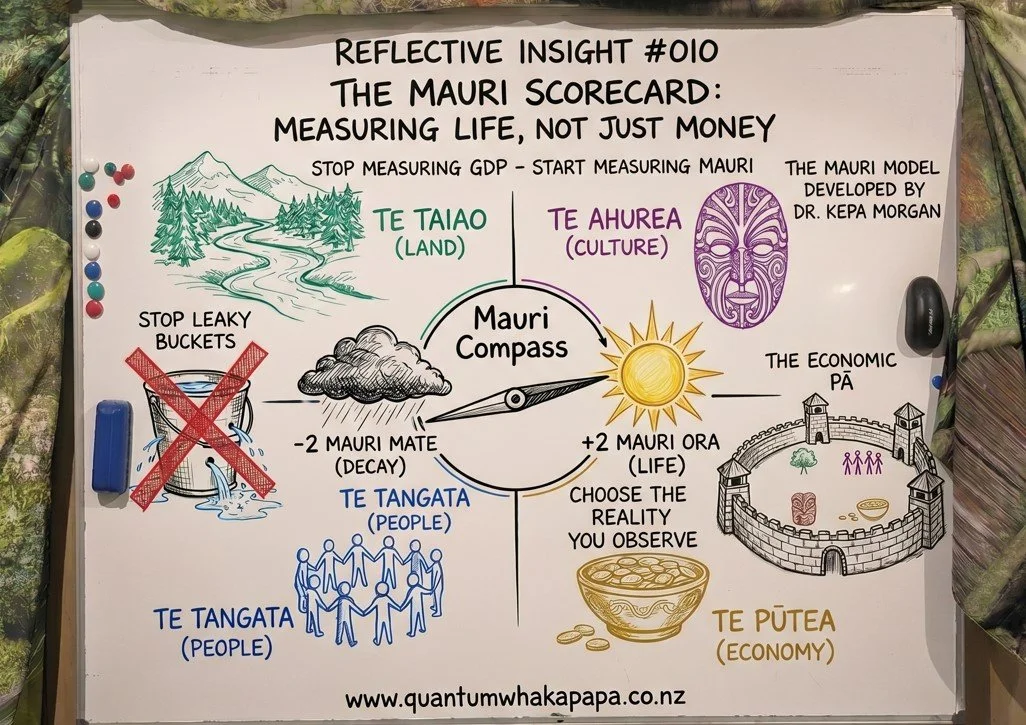
REFLECTIVE INSIGHT #010 - BEYOND THE DOLLAR: MEASURING WHAT REALLY MATTERS
The Problem With the Old Maths
Kia ora. In offices and boardrooms across Whangārei and Kaikohe, success is often measured using spreadsheets and bank balances. This old system, which can be thought of as "Babylonian maths," focuses purely on profit. But if that profit comes at the cost of a polluted river or families who can no longer afford to live in their own hometowns, is it actually success? In the "Woven Universe," we see that everything is connected; we cannot separate the money from the health of the land and the people.
The Hidden Debt
When a business makes money but ignores the damage it does to the environment or the stress it puts on workers, it is creating what is called a "Mauri Debt." The old system treats the land as a dead object to be used, rather than a living ancestor. We might call this profit, but the universe sees it as Mauri Mate, a state of decay and loss.
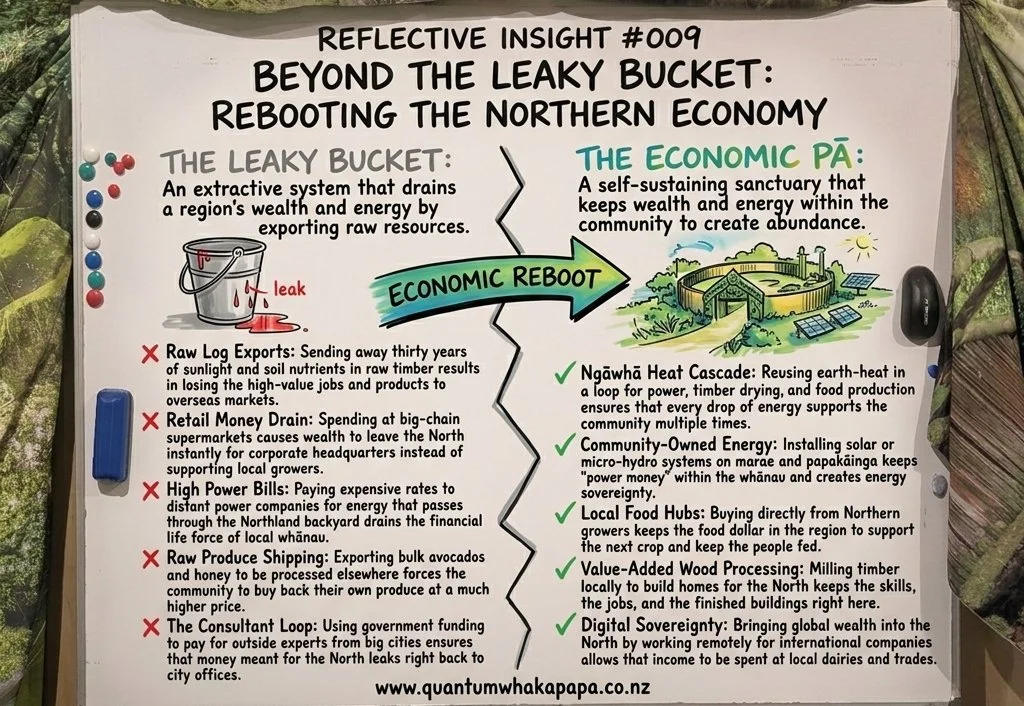
REFLECTIVE INSIGHT #009 – BEYOND THE LEAKY BUCKET: REBOOTING THE NORTHERN ECONOMY
The View from the Roadside
I was standing on the side of the road near Maungatapere recently, watching a long line of trucks hauling raw logs toward the port. We see this every day in Te Tai Tokerau, but this time I looked at those trucks differently. I didn't just see timber; I saw a massive export of our energy.
For decades, people have treated the North like a "Leaky Bucket." We send away the best of our land, thirty years of our sunlight, our rain, and the nutrients from our soil. In return, we get a few low-wage jobs and some paper money that leaves our pockets the moment we pay for petrol or power.
Leaky Bucket: An extractive system that drains a region’s wealth and energy by exporting raw resources.
A Faulty Operating System
This isn't just "bad luck." We are forced to run an outdated way of thinking that treats the world like a dead machine. This old system only knows how to take and mine. But my research in Report #218 proves that a better way to live has been sitting in our own history all along.