
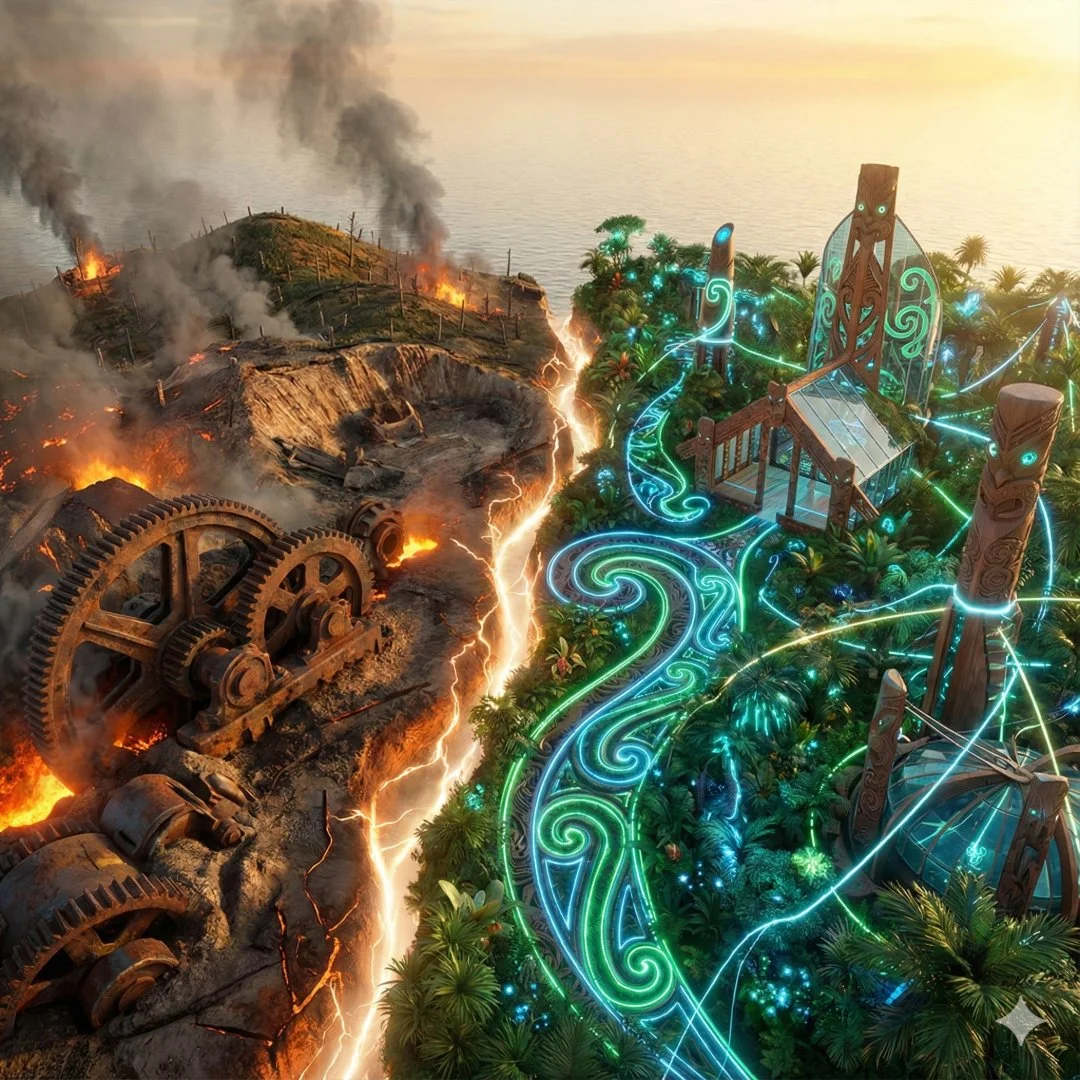
REFLECTIVE INSIGHT #020 - THE FIRE FRONT - WHAT MADEIRA TEACHES US ABOUT BABYLON
Long before the "Leaky Bucket" economy hit our shores in the North, the blueprint for extraction was drawn on a tiny island in the Atlantic called Madeira. In the 15th century, Portuguese settlers looked at a sub-tropical paradise and didn't see an ancestor; they saw a commodity. They named it "Madeira"—literally meaning "wood"—and then they proceeded to burn and fell every tree in sight to fuel the world’s first great sugar boom.
This was the birth of "Babylonian" capitalism. It wasn't just about trade; it was about the "boom-bust-quit" cycle. Using slave labour and "free" natural wealth, they achieved unimaginable productivity. But it was thermodynamically unsound. It took 60kg of wood to refine just 1kg of sugar. Within decades, the forests were gone, the soil was exhausted, and the "embodied energy" of the island had been exported to the banks of Europe. When the Mauri of the island was depleted, the capital simply "quit" and moved to Brazil and the Caribbean, leaving behind a high-entropy residue of social and ecological disorder.

REFLECTIVE INSIGHT #018 - EMANCIPATE OURSELVES FROM MENTAL SLAVERY - THE METAPHORS OF “BABYLON” AND “ZION”
We often talk about "the system" as if it’s a faceless machine, but our tūpuna and the prophets who walked this land before us had a much sharper name for it: Babylon. As Bob Marley famously sang, we need to emancipate ourselves from mental slavery, because while they can’t stop the time, they certainly try to steal our energy. Today, we stand at a crossroads in Taitokerau where we have to choose: do we stay in the "Leaky Bucket" of Babylon, or do we finally build Zion?
In the traditions of the Ringatū and Ratana movements—much like the Rastafarian faith—these names aren't just religious labels; they are descriptions of opposing economic and spiritual operating systems. Babylon represents the "Newtonian Error," the idea that we are all separate, isolated particles just trying to grab what we can. In modern Northland, Babylon looks like the log trade: we export 61% of our raw timber—our "embodied energy"—to the other side of the world, receiving fiat currency that we immediately spend on imported goods. It’s a state of high Entropy (disorder) that leaves our roads broken and our whānau struggling while the "order" is realised offshore.