
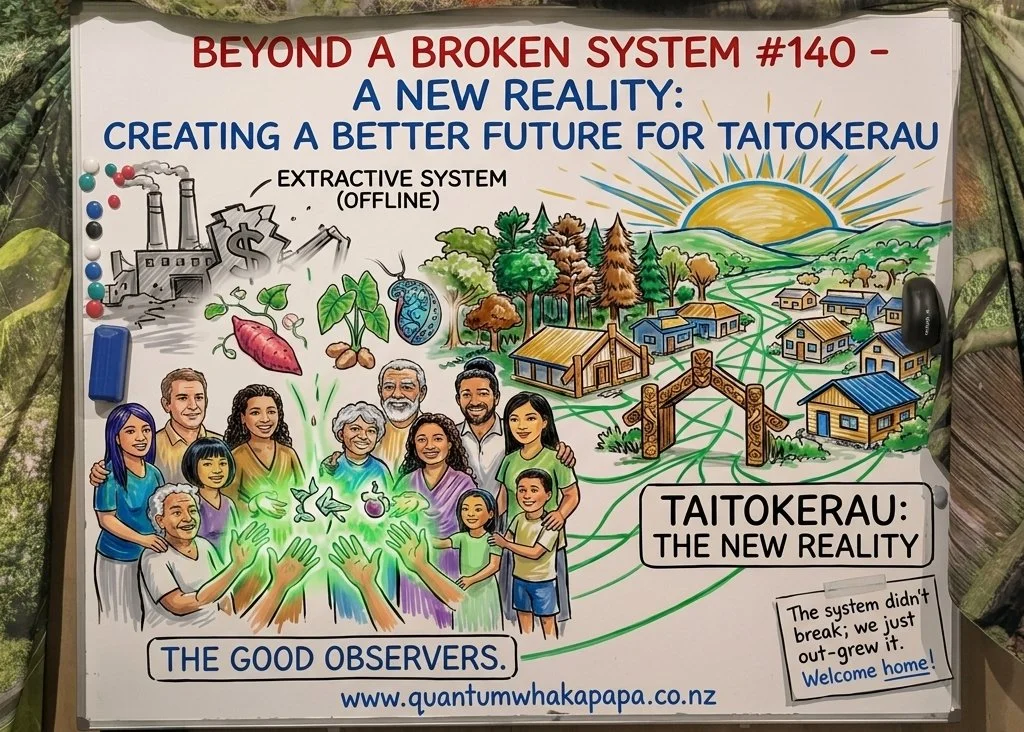
BEYOND A BROKEN SYSTEM #140 - A NEW REALITY: CREATING A BETTER FUTURE FOR TAITOKERAU
Trapped in Manufactured Helplessness
The final and most empowering realisation of this entire journey is that we are not helpless victims trapped inside an unchangeable machine. The Babylonian operating system wants us to believe that its rules are permanent, that its bureaucracies hold all the power, and that places like Taitokerau must accept being poor, struggling regions dependent on state handouts. But both science and our ancestral wisdom tell us otherwise.
When a community accepts negative labels, relies on outside banks, lets its money leak out, isolates its people, and fills out endless paperwork, it remains trapped in high entropy, a continuous state of decay, disorder, and chaos. This artificial breakdown is how imperial systems maintain control, by convincing local whānau that they lack the power to shape their own reality.
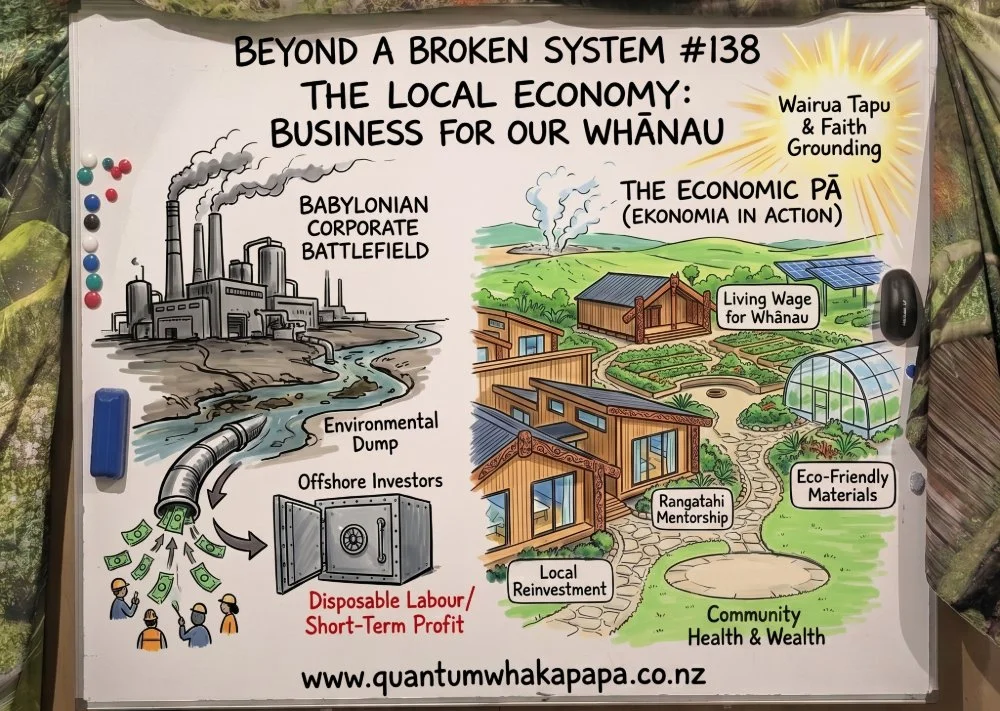
BEYOND A BROKEN SYSTEM #138 - THE LOCAL ECONOMY: BUSINESS FOR OUR WHĀNAU
The Battlefield of Business
Under standard Babylonian economics, business is taught as a ruthless battlefield. Mainstream business courses train owners to believe that the only purpose of an enterprise is to maximise short-term financial profit. To win on this battlefield, businesses are encouraged to pay workers as little as possible, charge customers as much as possible, and ignore the pollution they dump into local rivers, all so that distant owners and investors can extract maximum cash.
In a local community, this corporate business model acts like a predatory pump. It treats local workers like disposable labour units and treats the local environment like a dump. It isolates whānau into competing units, creating social entropy and extracting the natural wealth of our home to feed outside shareholders.
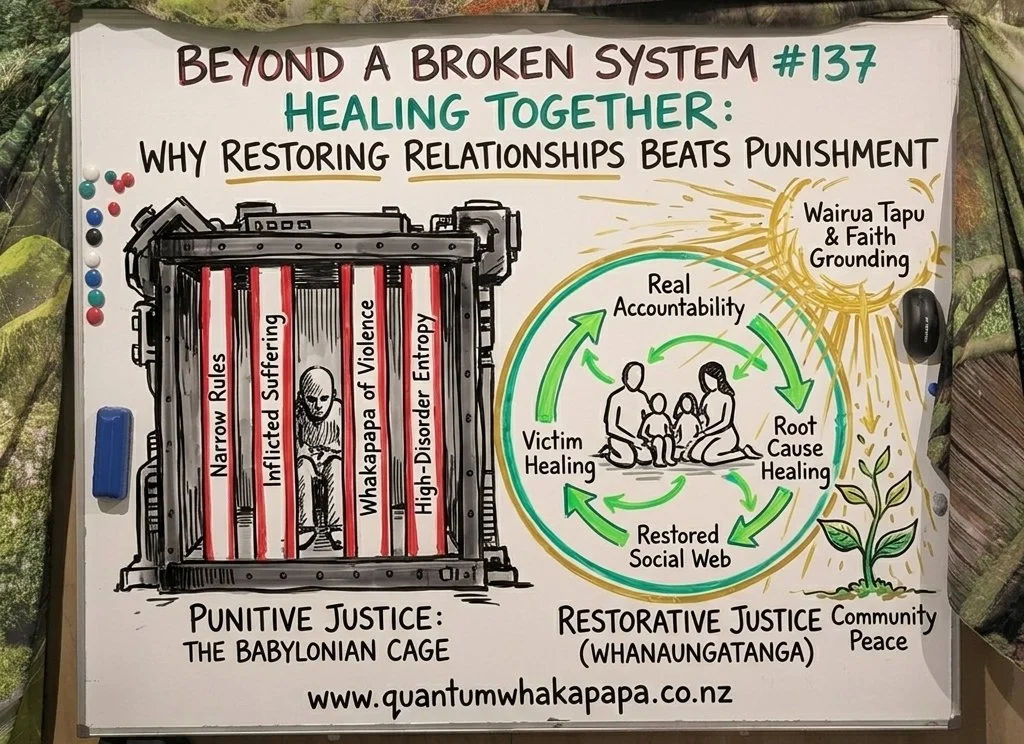
BEYOND A BROKEN SYSTEM #137 - HEALING TOGETHER: WHY RESTORING RELATIONSHIPS BEATS PUNISHMENT
The Trap of Punitive Justice
When harm occurs in a community, whether it is property damage, conflict, or crime, the Babylonian system unleashes its most destructive mechanism: punitive justice. The modern court and prison system is a mechanical, high-disorder machine. When someone commits a wrong, the system immediately isolates them, strips them away from their whānau, and locks them in a metal cage. This legal process asks only two narrow questions: which official rule was broken, and how much suffering should we inflict on this offender?
This mechanical approach fails everyone involved. It fails the victim because it offers no direct apology, emotional healing, or real repair. It fails the offender because locking people in hostile environments doubles down on their isolation, deepens their trauma, and teaches them to be more bitter. And it fails the community because it costs millions of dollars while returning unhealed individuals right back into the same broken environment. In Aotearoa, history proves that taking children into state care and putting people into institutions created a "whakapapa of violence," where system abuse directly drove generations of people into the prison pipeline.
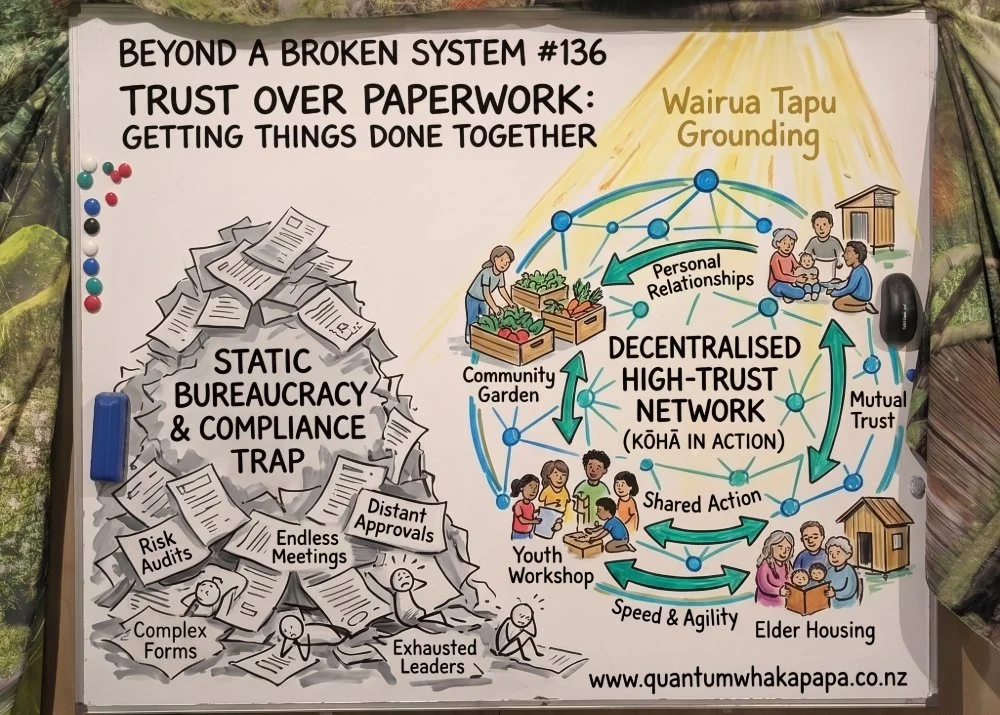
BEYOND A BROKEN SYSTEM #136 - TRUST OVER PAPERWORK: GETTING THINGS DONE TOGETHER
The Trap of Static Bureaucracy
Another way the Babylonian system drains community energy and stops real progress is through static bureaucracy and the compliance trap. Because the entire Babylonian system is built on the false idea that everyone is an isolated, self-interested individual, it cannot function on personal trust. Instead, it assumes that everyone is constantly trying to cheat the system. To manage this deep suspicion, institutions create mountains of administrative red tape, rigid eligibility checks, risk audits, and endless meetings about meetings.
This creates an exhausting weight for local communities. When a local marae group, small business, or volunteer team wants to build something urgently needed, like a community garden, a youth workshop, or housing for elders, they are immediately buried in paperwork. They are forced to spend months or years filling out complex funding applications, proving their worthiness to distant officials, and waiting for permission from people who have never set foot in their town. This bureaucracy exhausts community leaders, consumes precious time, and causes good projects to collapse under administrative weight.
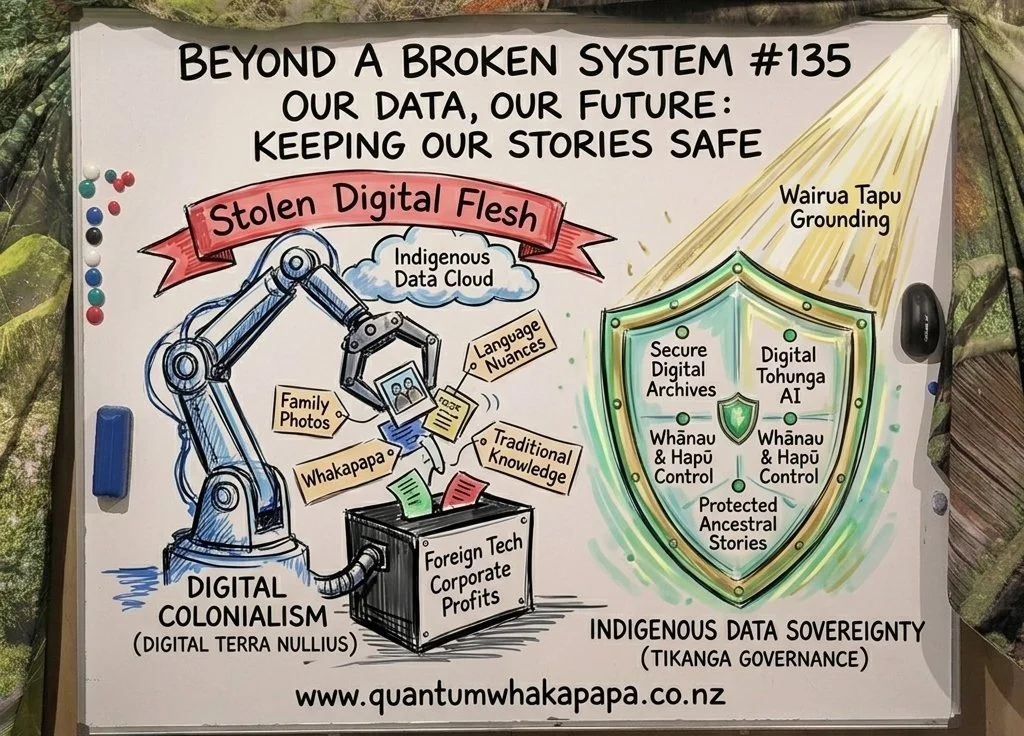
BEYOND A BROKEN SYSTEM #135 - OUR DATA, OUR FUTURE: KEEPING OUR STORIES SAFE
The New Colonial Frontier
In earlier centuries, colonial powers invaded physical land, claimed it was empty territory (Terra Nullius), and extracted natural resources without permission. Today, as physical resources become scarcer, the Babylonian machine has created a new frontier for extraction: Digital Colonialism.
In the modern digital world, large technology and artificial intelligence corporations treat the internet as "Digital Terra Nullius", a wild, empty space where they feel entitled to take whatever they want. Automated software tools constantly scrape public social media posts, recorded community discussions, video interviews, family photographs, and traditional genealogies (whakapapa).
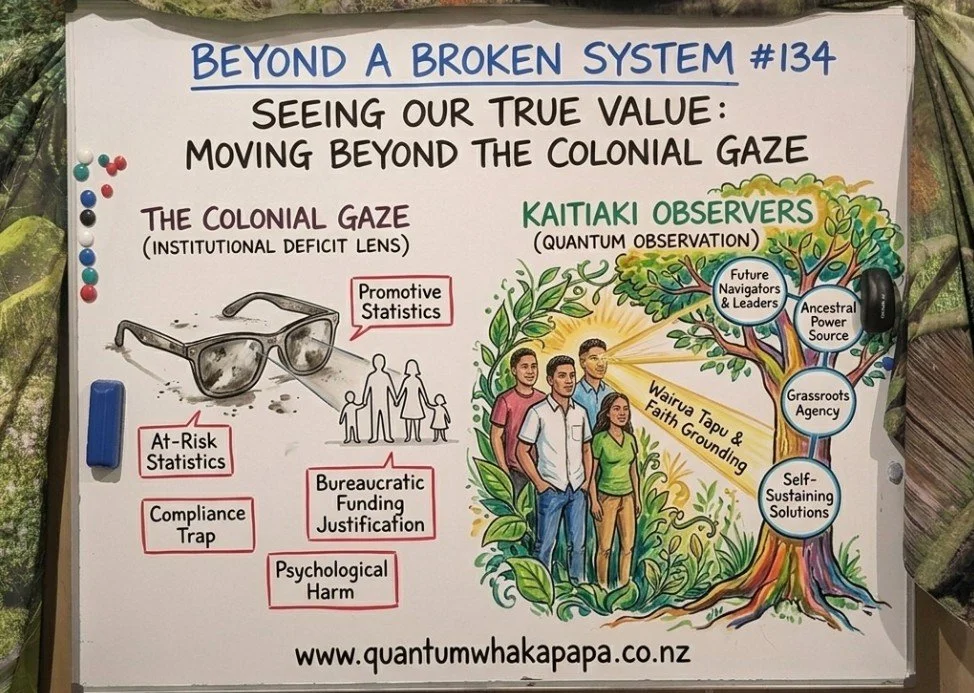
BEYOND A BROKEN SYSTEM #134 - SEEING OUR TRUE VALUE: MOVING BEYOND THE COLONIAL GAZE
Trapped in the Deficit Trap
The Babylonian operating system does not just extract physical resources and money from our communities, it maintains control by conditioning us in how we view ourselves. It accomplishes this through a damaging mental filter often called the "Colonial Gaze".
When government agencies, academic institutions, and media organisations look at regions like Taitokerau, they view our people almost exclusively through deficit narratives. They measure our communities entirely by our problems, fixating on unemployment rates, school statistics, health issues, and crime numbers. They produce endless reports detailing everything that is supposedly broken or lacking in local whānau.
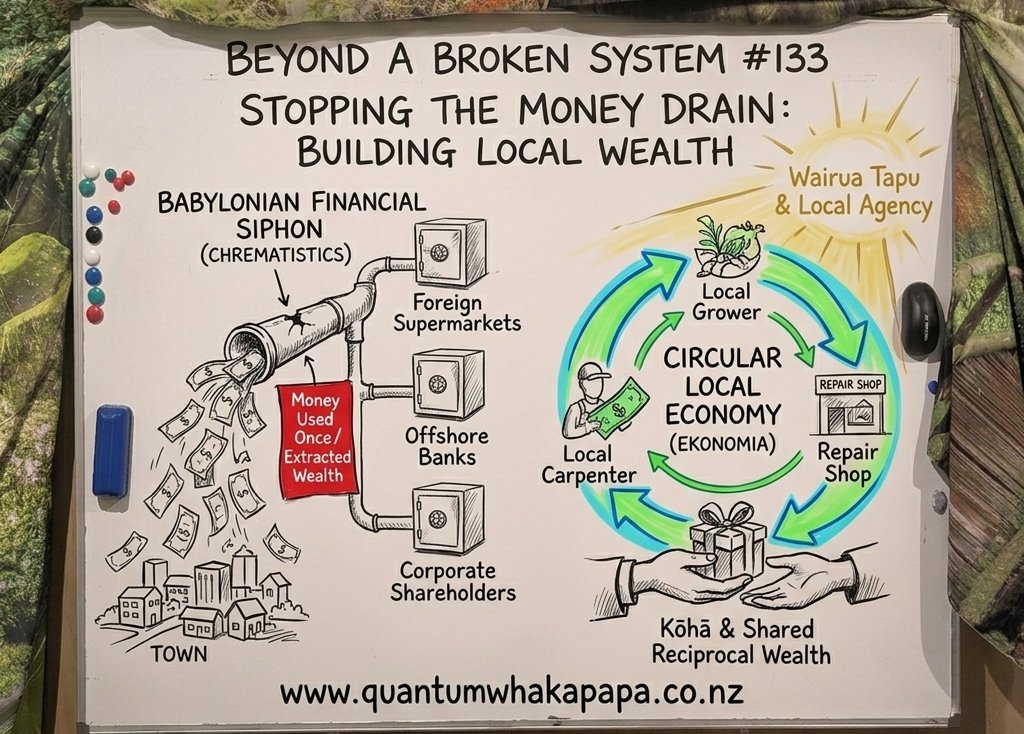
BEYOND A BROKEN SYSTEM #133 - STOPPING THE MONEY DRAIN: BUILDING LOCAL WEALTH
The Siphon in Our Streets
Once the Babylonian system convinces people that they are isolated individuals, it uses financial tricks to continuously drain our hard-earned money out of the community. Most people in small towns across Taitokerau work extremely hard, yet their bank accounts always seem empty, and our local main streets struggle to keep their doors open. This does not happen by accident. It happens because our daily financial systems are deliberately wired like a siphon.
Consider what happens to a dollar earned right here in the North. If a worker takes that dollar and spends it at a massive foreign-owned supermarket, a corporate petrol station, or an offshore bank, that dollar leaves our town within hours. It travels straight into distant corporate vaults and shareholder dividend accounts. Because the money leaves immediately, it only gets used once locally. Our whānau work exhausting hours to generate real income, but the system instantly vacuums that wealth away to distant places.
The Research: The Difference Between Making Money and Making a Home
Research Report #224 highlights a very important distinction that the modern world has forgotten. It is the difference between two ways of thinking about wealth:
Money-First Thinking (Chrematistics): This is the Babylonian way. It is the study of how to accumulate money for its own sake. In this model, people, land, and resources are just tools to be used up to make a bank balance grow. It doesn't matter if the community is left poor or the river is left dirty, as long as the profit is "exported" to the shareholders.
Home-First Thinking (Ekonomia): This is the original meaning of "economy." It is the art of stewardship - looking after the household so that everyone has enough. It is about the health of the family, the garden, and the neighbourhood. Wealth is measured not by how much you take, but by how well everyone is cared for.