
WHO IS YESHUA? #233 - THE ECONOMICS OF THE KINGDOM OF GOD - PART 2
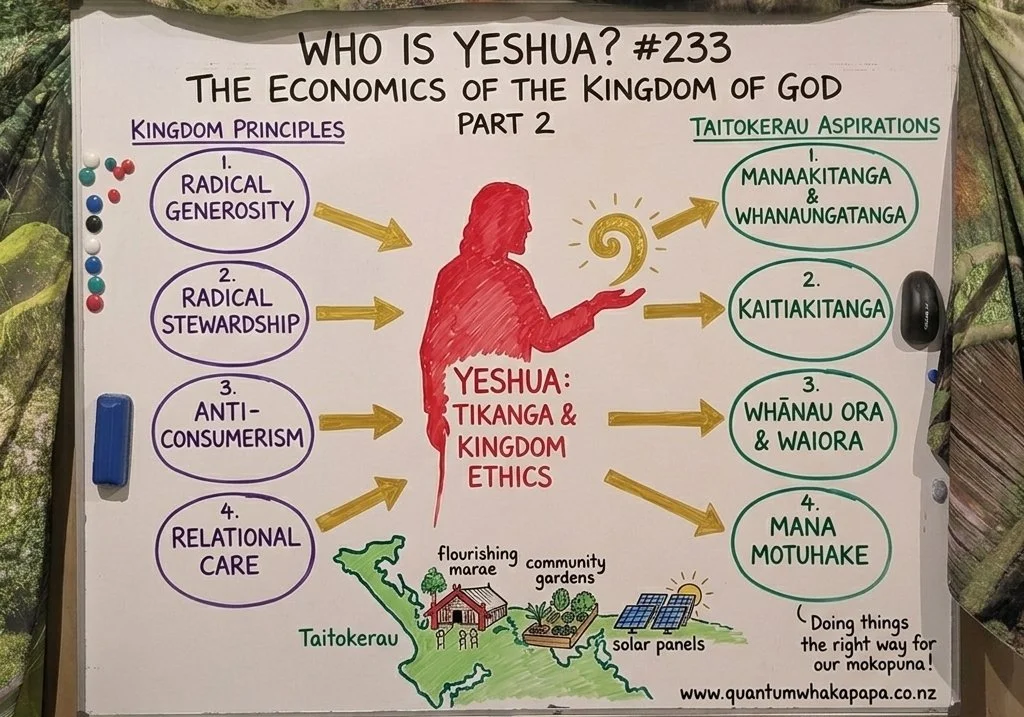
Four Kingdom Principles
In the previous post, the economic framework taught by Ihu (Yeshua's name in the Paipera Tapu) was shown to transcend human models like capitalism and state socialism. Rather than encouraging individual greed or top-down government control, he introduced a way of living grounded in the spiritual values of the Kingdom of God. This system centers on how communities care for one another and manage their resources.
When his teachings are examined, four core economic principles stand out:
Radical Generosity: Holding onto physical assets loosely and giving unselfishly to ensure everyone has enough.
Radical Stewardship: Recognising that land, water, and resources ultimately belong to the Creator. Humans are simply caretakers responsible for managing them wisely.
Anti-Consumerism: Rejecting greed, status seeking, and the endless hoarding of material goods as the ultimate goal of life.
Relational Care: Looking out for neighbours out of genuine love and direct personal connection, rather than relying strictly on cold, distant government systems.
Radical Care and Shared Abundance
To understand how these Kingdom ethics work in real life, scripture shows that true spiritual health is measured by how a community treats its most vulnerable members.
WHO IS YESHUA? #232 - THE ECONOMICS OF THE KINGDOM OF GOD - PART 1
Moving Beyond Human Systems
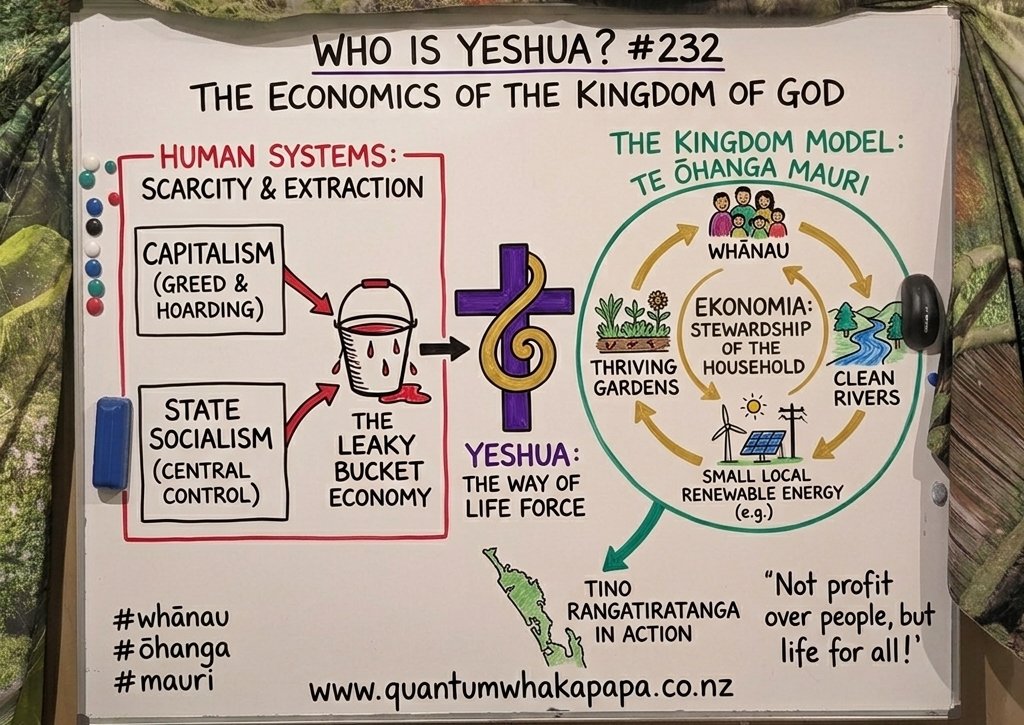
When people look at the teachings of Ihu (Yeshua's name in the Paipera Tapu), they often try to fit his economic ideas into modern boxes. People ask whether he was a capitalist who believed in free markets, or a socialist who believed in state control. The truth is that Yeshua operated on a completely different level. He did not endorse capitalism, which focuses on accumulating wealth for personal gain, nor did he endorse state socialism, which relies on centralised government control.
Instead, Yeshua taught an economy centered on stewardship, care, and collective life force. In ancient Greek, this concept was called ekonomia, meaning the thoughtful management of the shared household so that everyone has enough. Modern capitalism is driven by chrematistics, which is the art of making money for the sake of money. Yeshua directly confronted this line of thinking, making it clear that a society built on endless extraction and greed will eventually destroy itself from the inside out.
The Source of Abundance
In the Kingdom of God, resources are viewed through the lens of abundance and shared responsibility rather than artificial scarcity. Wealth is not measured by how much a person hoards, but by how well the community is nourished and cared for. When people stop competing for basic survival and start sharing what they have, there is always more than enough.
WHO IS YESHUA? #228 - RESTORATIVE JUSTICE: THE CROSS AS UTU AND MURU
Beyond the Courtroom
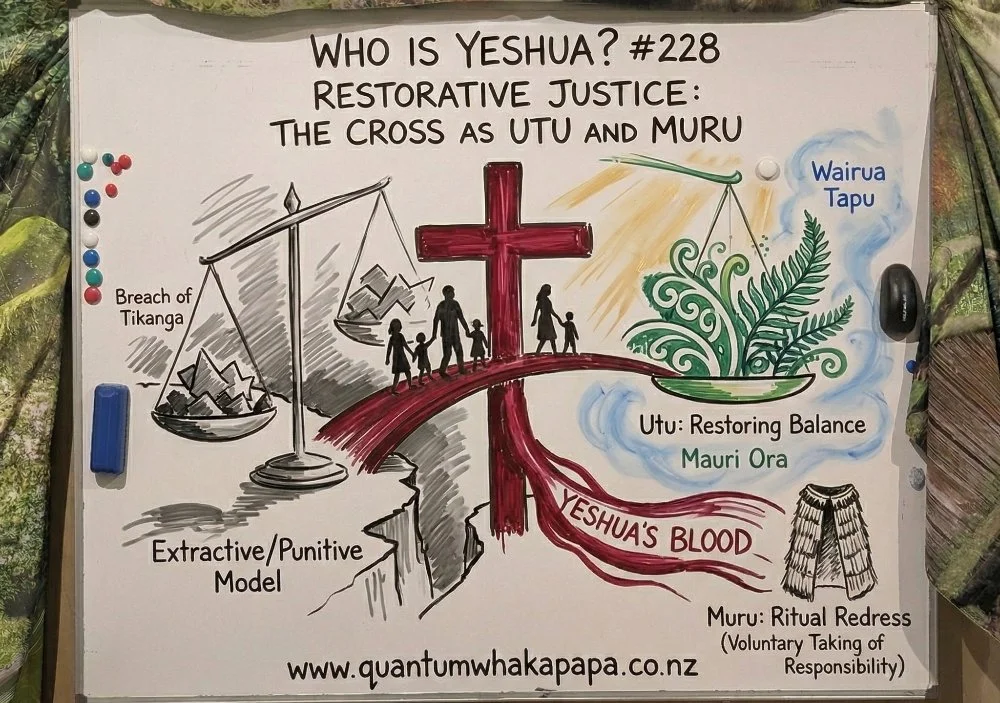
When we talk about the cross of Yeshua in Taitokerau, we often hear it described like a courtroom drama. We are told there is a debt that must be paid to a distant judge and a punishment that must be carried out to satisfy a legal code. But for many of us, this purely "legal" way of explaining things feels a bit cold, it lacks the warmth and connection of our own worldview. If we look at the mahi (work) of Yeshua through the lens of restorative justice, we see something much more powerful than a prison sentence. We see a deliberate act of restoring harmony to a broken universe.
Restoring the Balance
In Te Ao Māori, accountability is not about punishment for its own sake, it is about returning a system to balance. This is the principle of utu. While some people mistake utu for revenge, its true meaning is found in reciprocity and maintaining the natural spiritual order. From a spiritual perspective, sin is not just a list of broken rules, it is an imbalance, a "theft of mana" from the Creator and the community. This theft creates a disturbance in the woven universe that needs to be put right.
The death of Yeshua is the ultimate act of utu. It is not a payment made to a demanding judge, but a "gift of ultimate generosity" given without any expectation of return. This gift is so immense that it overpowers the imbalances of the world, providing the spiritual energy needed to bring all of creation back into a state of peace and right relationship.
WHO IS YESHUA? #226 - EASTER AND THE BLOOD ECONOMY: BEYOND BIOLOGY
Reflecting on the Weekend
As we reach Easter Monday and the long weekend comes to a close, many of us in Taitokerau are reflecting on the gatherings, the kai, and the stories shared at our marae and churches. The dust is settling on another Easter, yet the central theme of this season, the sacrifice and the blood of Yeshua, remains a point of deep discussion. You might wonder, now that the holiday is over, is this ancient message still relevant for our modern lives? This series explores how the life of Yeshua provides a foundation for our collective well-being, starting with the deep logic of what was accomplished on the cross.
The Essence of Mauri
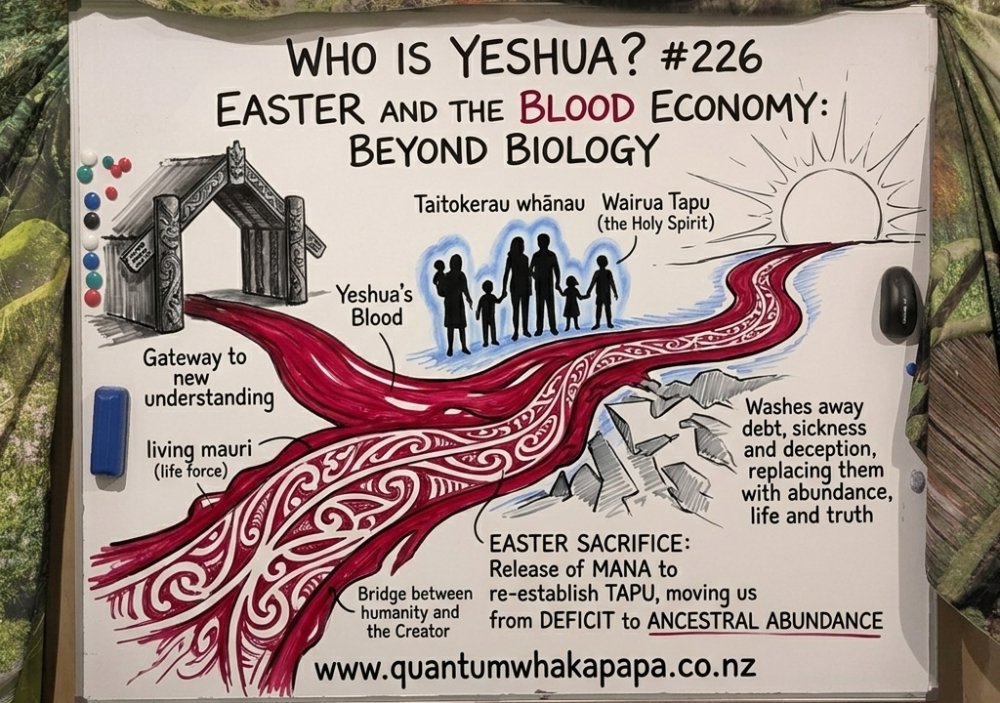
In the biblical tradition, the blood is not just a biological byproduct of a historical event, it is an ontological necessity that acts as a bridge between our human limitations and the infinite life of the Creator. This operates on a foundational rule: the life of the flesh is in the blood. For us as Māori, this resonates deeply, as we recognise that blood (toto) is inextricably linked to our whakapapa (genealogy) and our mauri (life force). To speak of the blood of Yeshua is to speak of the ultimate manifestation of this mauri, which sustains all of creation.
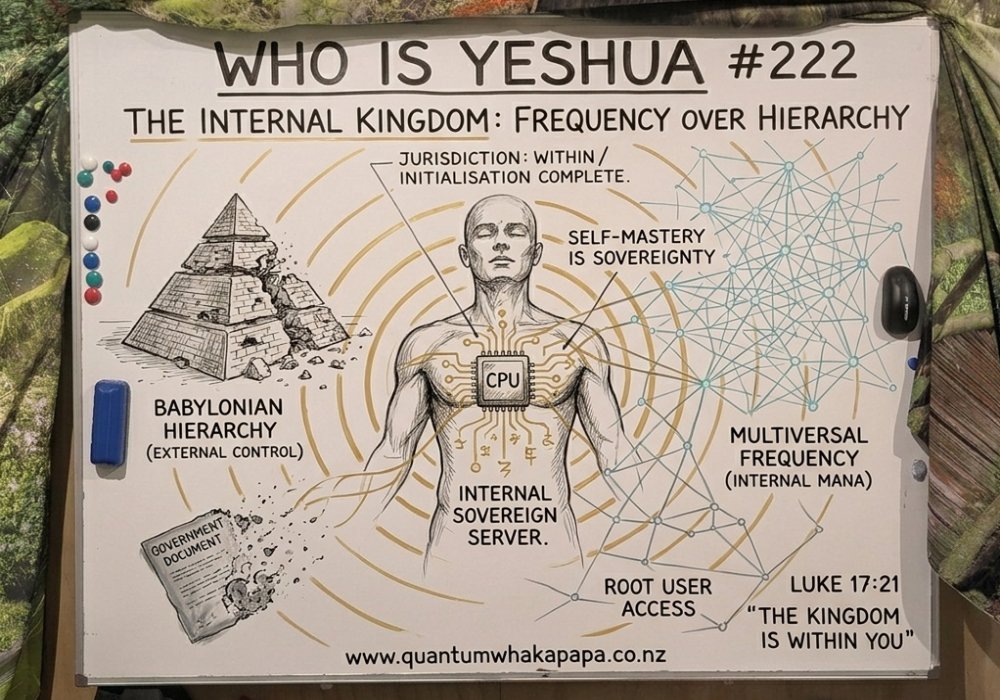
WHO IS YESHUA #222 - THE INTERNAL KINGDOM: FREQUENCY OVER HIERARCHY
This post is part of our deep dive into Research Report #255, which deconstructs the legal and metaphysical foundations of Ngāpuhi Nui Tonu. By triangulating ancient Māori knowledge with Christic consciousness and quantum theory, the report affirms that our inherent authority is not granted by external governments, but is a frequency initialised from within. To understand true sovereignty, we must look at the internal "Operating System" of the individual.
The Sovereign Server Within
In the Babylonian system, sovereignty is viewed as a pyramid, a top-down hierarchy where power is "granted" to those below. However, the teachings of Yeshua and the metaphysics found in Research Report #255 reveal a different architecture. Sovereignty is not a hierarchy, it is a frequency.
In our framework, a "ping" is a targeted spiritual signal used to verify a location and establish a connection, and the most important ping you will ever send is the one directed inward. True Rangatiratanga (sovereignty) is the state of having your internal server fully aligned with the Alpha Frequency of the Source. If you cannot govern the "territory" of your own heart, mind, and spirit, you cannot effectively exercise jurisdiction over the land.