
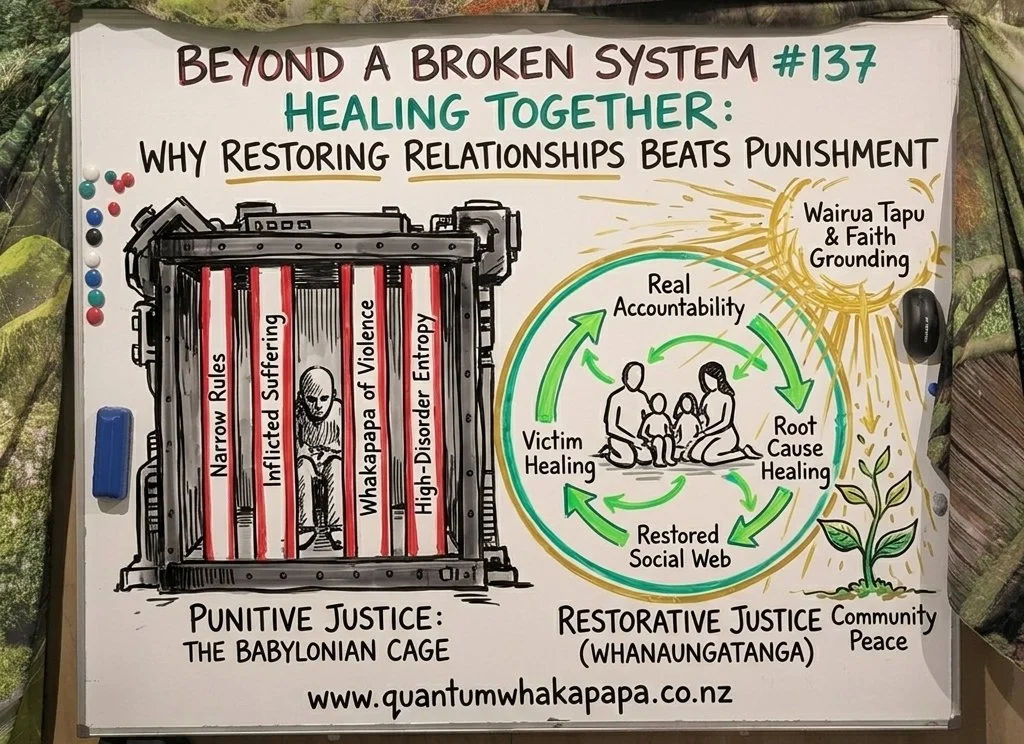
BEYOND A BROKEN SYSTEM #137 - HEALING TOGETHER: WHY RESTORING RELATIONSHIPS BEATS PUNISHMENT
The Trap of Punitive Justice
When harm occurs in a community, whether it is property damage, conflict, or crime, the Babylonian system unleashes its most destructive mechanism: punitive justice. The modern court and prison system is a mechanical, high-disorder machine. When someone commits a wrong, the system immediately isolates them, strips them away from their whānau, and locks them in a metal cage. This legal process asks only two narrow questions: which official rule was broken, and how much suffering should we inflict on this offender?
This mechanical approach fails everyone involved. It fails the victim because it offers no direct apology, emotional healing, or real repair. It fails the offender because locking people in hostile environments doubles down on their isolation, deepens their trauma, and teaches them to be more bitter. And it fails the community because it costs millions of dollars while returning unhealed individuals right back into the same broken environment. In Aotearoa, history proves that taking children into state care and putting people into institutions created a "whakapapa of violence," where system abuse directly drove generations of people into the prison pipeline.
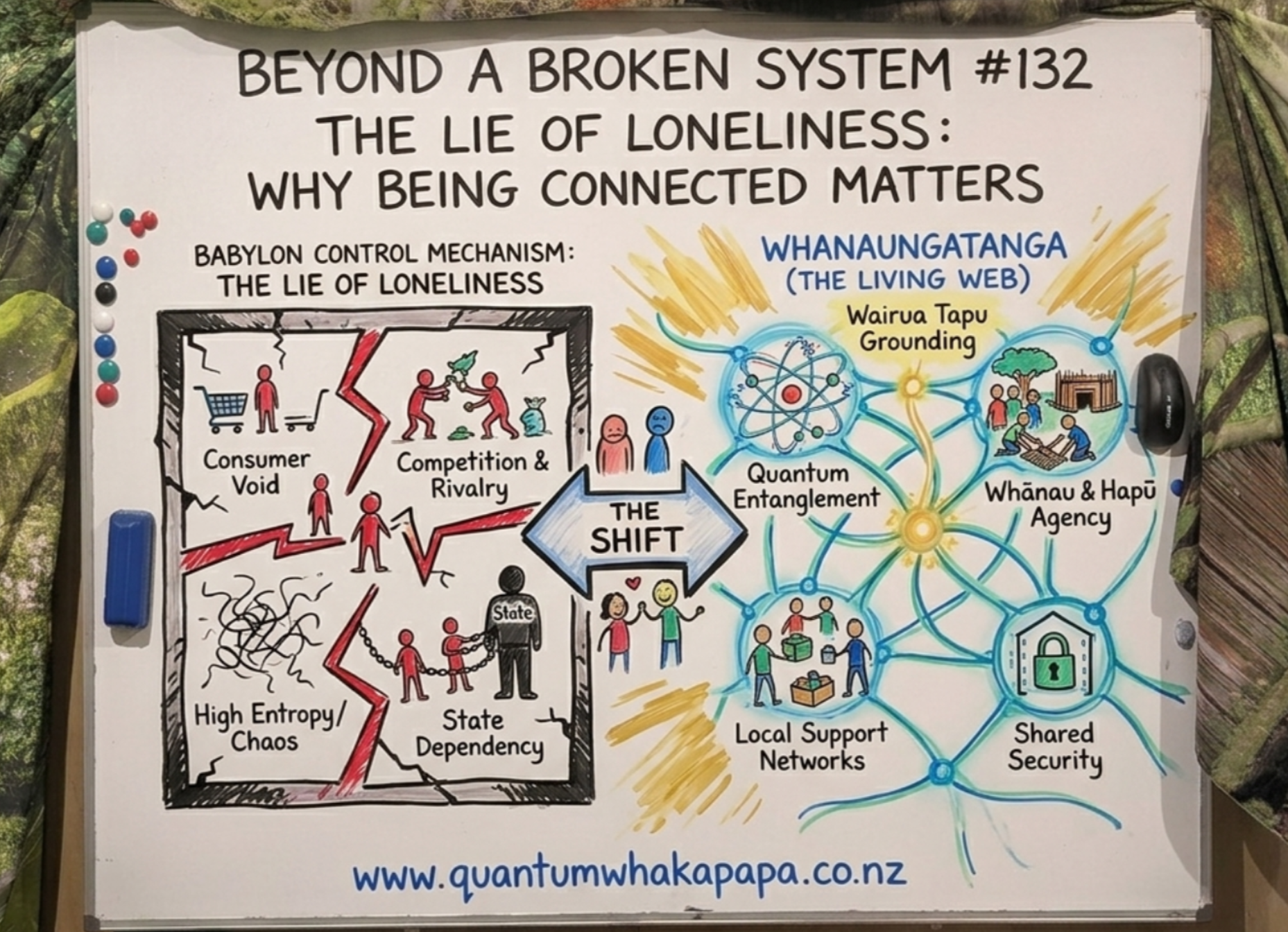
BEYOND A BROKEN SYSTEM #132 - THE LIE OF LONELINESS: WHY BEING CONNECTED MATTERS
In our last post, we looked at how Babylon acts like a giant machine, sucking wealth and talent out of the North. But how does it get away with it? It uses a very old trick: it tries to convince us that we are all alone. It tells us that we are just separate individuals, like little cogs in a machine, who have to compete against each other just to survive. In this post, we are looking at why this "Lie of Loneliness" is the foundation of the system, and how we can break it by simply remembering who we are.
The Research: The Mistake of Separation
Research Report #224 explains that the Babylonian system is built on a massive mistake. It treats people, land, and nature as separate "things" that can be moved around, used, and discarded. Scientists and historians sometimes call this the "Newtonian Error" - the idea that the world is just a big clock made of separate parts that don't really affect each other unless they bump together.
When the system convinces us that we are separate units, we become much easier to manage and far easier to exploit. If you are "just an individual," the system can sell you "privacy" as a luxury, when really it is just isolation. It can tell you that your neighbour is your competitor for a job or a resource, rather than your teammate. This intentional separation creates a huge amount of stress and a deep, underlying sense of loneliness. Babylon then steps in to "fix" that loneliness by selling us products, entertainment, and distractions. It’s a cycle that keeps the machine running on our energy while leaving us feeling empty and exhausted.
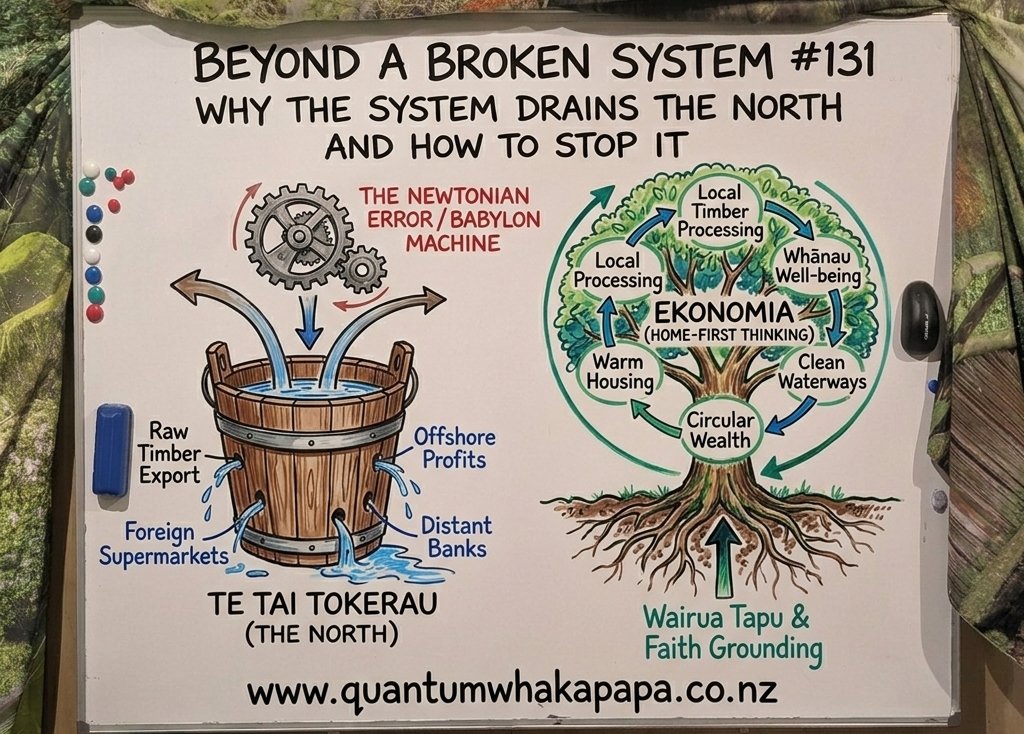
BEYOND A BROKEN SYSTEM #131 - WHY THE SYSTEM DRAINS THE NORTH AND HOW TO STOP IT
Trapped in the Machine
If you look around Taitokerau, it is easy to see the signs of struggle. We see roads that need constant repair, whānau working long hours just to get by, cold housing, and polluted waterways. The outside world often tells us that this happens because local people are failing, making poor choices, or lacking ambition. But that is a complete lie. The North is struggling because it is trapped inside a broken societal operating system that we call "Babylon".
Babylon is not an ancient city in a history book, it is a way of running society like an extraction machine. This machine was built on a massive philosophical mistake called the "Newtonian Error". Centuries ago, Western thinkers started viewing the world like a giant, mechanical clock made of separate, disconnected parts. They decided that human beings were completely separate from nature, separate from the land, and separate from each other. Because of this mistake, the system treats land as mere property to be bought and sold, and treats nature as a raw material to be mined.