DECONSTRUCTING BABYLON #140 - A NEW REALITY: CREATING A BETTER FUTURE FOR TAITOKERAU
We have reached the end of our journey through the tools of Babylon. We have deconstructed the "Lie of Loneliness," exposed the "Money Drain," and learned how to protect our data and our stories. We have seen how the system uses paperwork and punishment to keep us stuck in a cycle of extraction. Now, in this final post, we are looking at the most powerful tool of all: the ability to create a new reality by simply changing how we show up in the world.
The Research: The Power of Observation
Research Report #224 talks about a fascinating idea from the world of physics: that the way we observe something actually changes how it behaves. In our communities, this is a profound truth. For too long, we have been "observing" our people through the eyes of Babylon - seeing only the problems, the gaps, and the brokenness.
When we stop being observers for the machine and start being "Kaitiaki Observers" for our own whānau, the reality of Taitokerau begins to shift. This isn't just "positive thinking"; it is a strategic move. By making small, cumulative decisions to prioritise the Mauri (life force) over the machine, we are literally building a new operating system for the North. We are moving from a world of entropy (chaos and drain) to a world of negentropy (order and growth).
DECONSTRUCTING BABYLON #139 - MEASURING WHAT MATTERS: CHECKING THE HEALTH OF OUR COMMUNITY
In our last few posts, we have looked at building a local economy and running businesses that look after the whānau. But how do we actually know if we are winning? Babylon has a very specific way of measuring "success" - it usually involves a bank balance, a GDP figure, or a pile of ticked boxes on a compliance form. In this post, we are looking at how to stop using the system’s yardstick and start measuring the things that actually matter to our health and our future.
The Research: Money vs. Life Force
Research Report #224 points out that the Babylonian system is obsessed with things that can be counted but often ignores the things that count. It uses "Money-First Thinking" to measure growth. If a forest is cut down and sold, the system says the economy has "grown." It doesn't factor in the loss of the birds, the silt in the river, or the heartbreak of the people who lost their shelter.
To deconstruct this, we use the Mauri Model. This is a simple but powerful way to measure the "life force" or the "health" of a project, a business, or a community. Instead of just looking at a profit and loss statement, we look at whether the life force is being drained or restored. We use a scale that goes from -2 to +2.
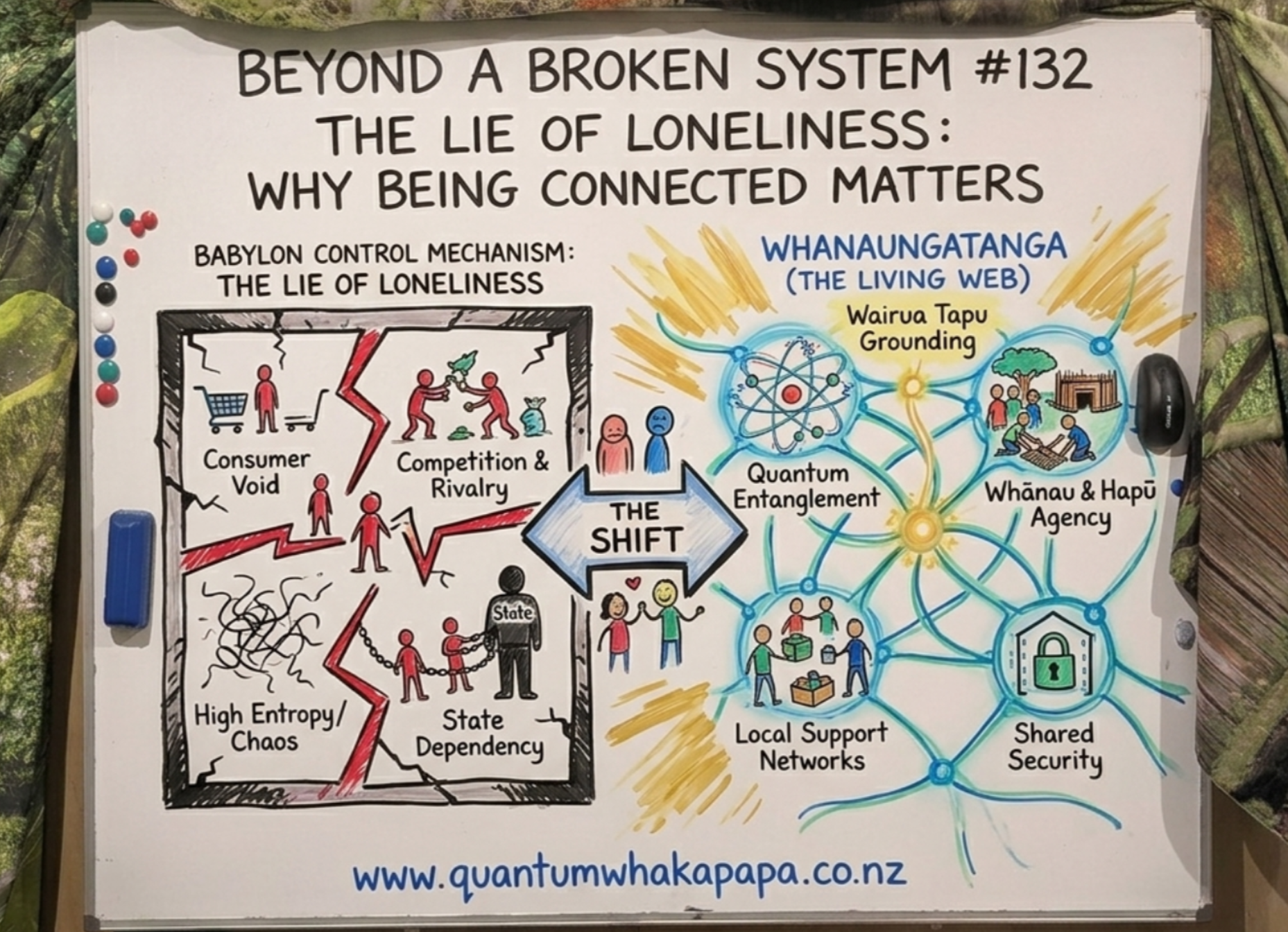
BEYOND A BROKEN SYSTEM #132 - THE LIE OF LONELINESS: WHY BEING CONNECTED MATTERS
In our last post, we looked at how Babylon acts like a giant machine, sucking wealth and talent out of the North. But how does it get away with it? It uses a very old trick: it tries to convince us that we are all alone. It tells us that we are just separate individuals, like little cogs in a machine, who have to compete against each other just to survive. In this post, we are looking at why this "Lie of Loneliness" is the foundation of the system, and how we can break it by simply remembering who we are.
The Research: The Mistake of Separation
Research Report #224 explains that the Babylonian system is built on a massive mistake. It treats people, land, and nature as separate "things" that can be moved around, used, and discarded. Scientists and historians sometimes call this the "Newtonian Error" - the idea that the world is just a big clock made of separate parts that don't really affect each other unless they bump together.
When the system convinces us that we are separate units, we become much easier to manage and far easier to exploit. If you are "just an individual," the system can sell you "privacy" as a luxury, when really it is just isolation. It can tell you that your neighbour is your competitor for a job or a resource, rather than your teammate. This intentional separation creates a huge amount of stress and a deep, underlying sense of loneliness. Babylon then steps in to "fix" that loneliness by selling us products, entertainment, and distractions. It’s a cycle that keeps the machine running on our energy while leaving us feeling empty and exhausted.