
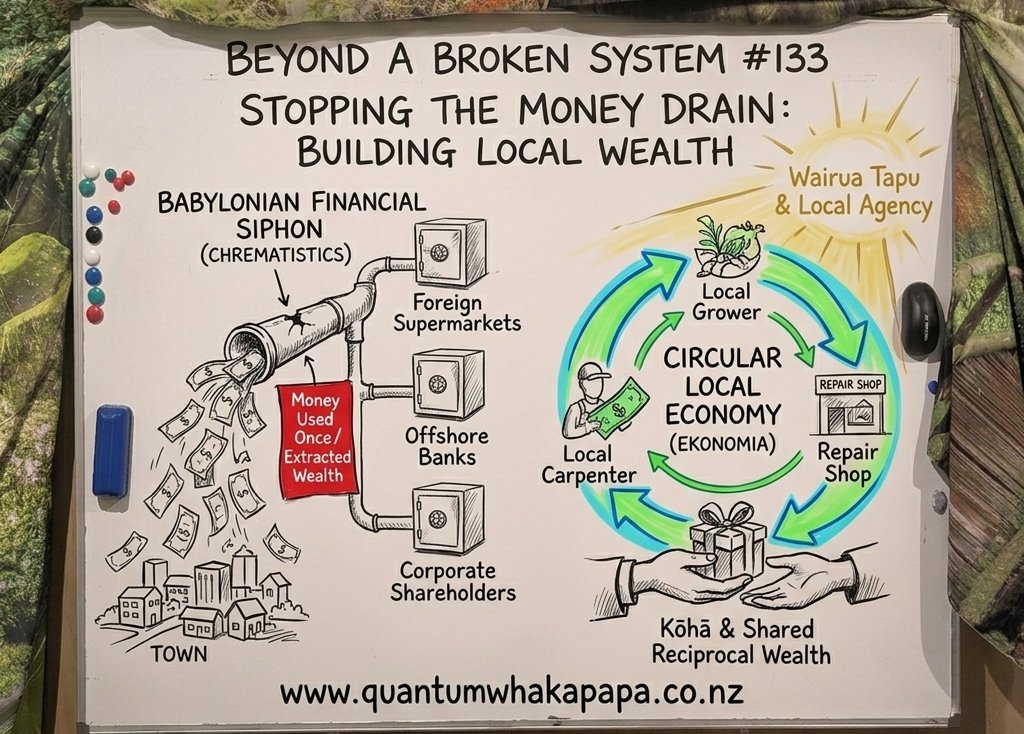
BEYOND A BROKEN SYSTEM #133 - STOPPING THE MONEY DRAIN: BUILDING LOCAL WEALTH
The Siphon in Our Streets
Once the Babylonian system convinces people that they are isolated individuals, it uses financial tricks to continuously drain our hard-earned money out of the community. Most people in small towns across Taitokerau work extremely hard, yet their bank accounts always seem empty, and our local main streets struggle to keep their doors open. This does not happen by accident. It happens because our daily financial systems are deliberately wired like a siphon.
Consider what happens to a dollar earned right here in the North. If a worker takes that dollar and spends it at a massive foreign-owned supermarket, a corporate petrol station, or an offshore bank, that dollar leaves our town within hours. It travels straight into distant corporate vaults and shareholder dividend accounts. Because the money leaves immediately, it only gets used once locally. Our whānau work exhausting hours to generate real income, but the system instantly vacuums that wealth away to distant places.
The Research: The Difference Between Making Money and Making a Home
Research Report #224 highlights a very important distinction that the modern world has forgotten. It is the difference between two ways of thinking about wealth:
Money-First Thinking (Chrematistics): This is the Babylonian way. It is the study of how to accumulate money for its own sake. In this model, people, land, and resources are just tools to be used up to make a bank balance grow. It doesn't matter if the community is left poor or the river is left dirty, as long as the profit is "exported" to the shareholders.
Home-First Thinking (Ekonomia): This is the original meaning of "economy." It is the art of stewardship - looking after the household so that everyone has enough. It is about the health of the family, the garden, and the neighbourhood. Wealth is measured not by how much you take, but by how well everyone is cared for.