
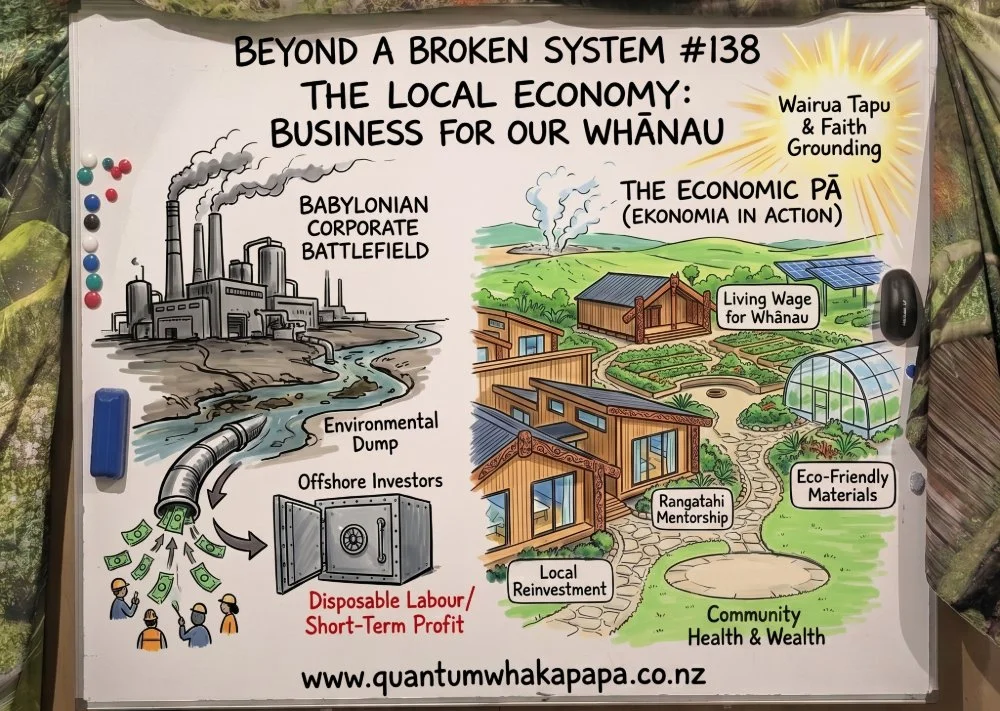
BEYOND A BROKEN SYSTEM #138 - THE LOCAL ECONOMY: BUSINESS FOR OUR WHĀNAU
The Battlefield of Business
Under standard Babylonian economics, business is taught as a ruthless battlefield. Mainstream business courses train owners to believe that the only purpose of an enterprise is to maximise short-term financial profit. To win on this battlefield, businesses are encouraged to pay workers as little as possible, charge customers as much as possible, and ignore the pollution they dump into local rivers, all so that distant owners and investors can extract maximum cash.
In a local community, this corporate business model acts like a predatory pump. It treats local workers like disposable labour units and treats the local environment like a dump. It isolates whānau into competing units, creating social entropy and extracting the natural wealth of our home to feed outside shareholders.
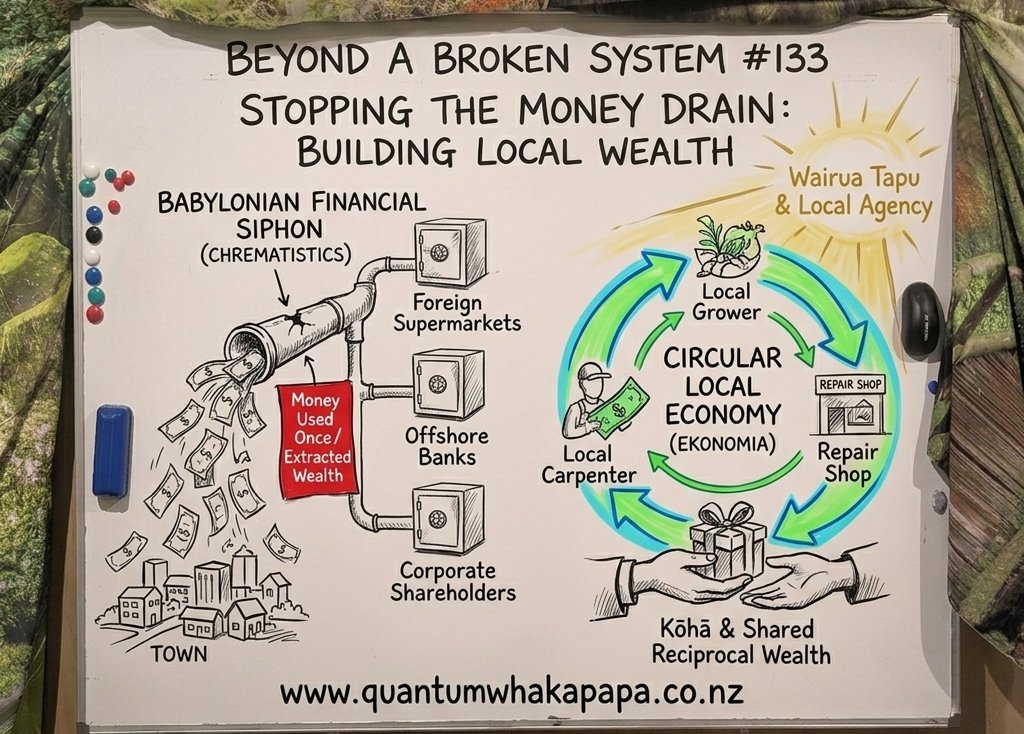
BEYOND A BROKEN SYSTEM #133 - STOPPING THE MONEY DRAIN: BUILDING LOCAL WEALTH
The Siphon in Our Streets
Once the Babylonian system convinces people that they are isolated individuals, it uses financial tricks to continuously drain our hard-earned money out of the community. Most people in small towns across Taitokerau work extremely hard, yet their bank accounts always seem empty, and our local main streets struggle to keep their doors open. This does not happen by accident. It happens because our daily financial systems are deliberately wired like a siphon.
Consider what happens to a dollar earned right here in the North. If a worker takes that dollar and spends it at a massive foreign-owned supermarket, a corporate petrol station, or an offshore bank, that dollar leaves our town within hours. It travels straight into distant corporate vaults and shareholder dividend accounts. Because the money leaves immediately, it only gets used once locally. Our whānau work exhausting hours to generate real income, but the system instantly vacuums that wealth away to distant places.
The Research: The Difference Between Making Money and Making a Home
Research Report #224 highlights a very important distinction that the modern world has forgotten. It is the difference between two ways of thinking about wealth:
Money-First Thinking (Chrematistics): This is the Babylonian way. It is the study of how to accumulate money for its own sake. In this model, people, land, and resources are just tools to be used up to make a bank balance grow. It doesn't matter if the community is left poor or the river is left dirty, as long as the profit is "exported" to the shareholders.
Home-First Thinking (Ekonomia): This is the original meaning of "economy." It is the art of stewardship - looking after the household so that everyone has enough. It is about the health of the family, the garden, and the neighbourhood. Wealth is measured not by how much you take, but by how well everyone is cared for.
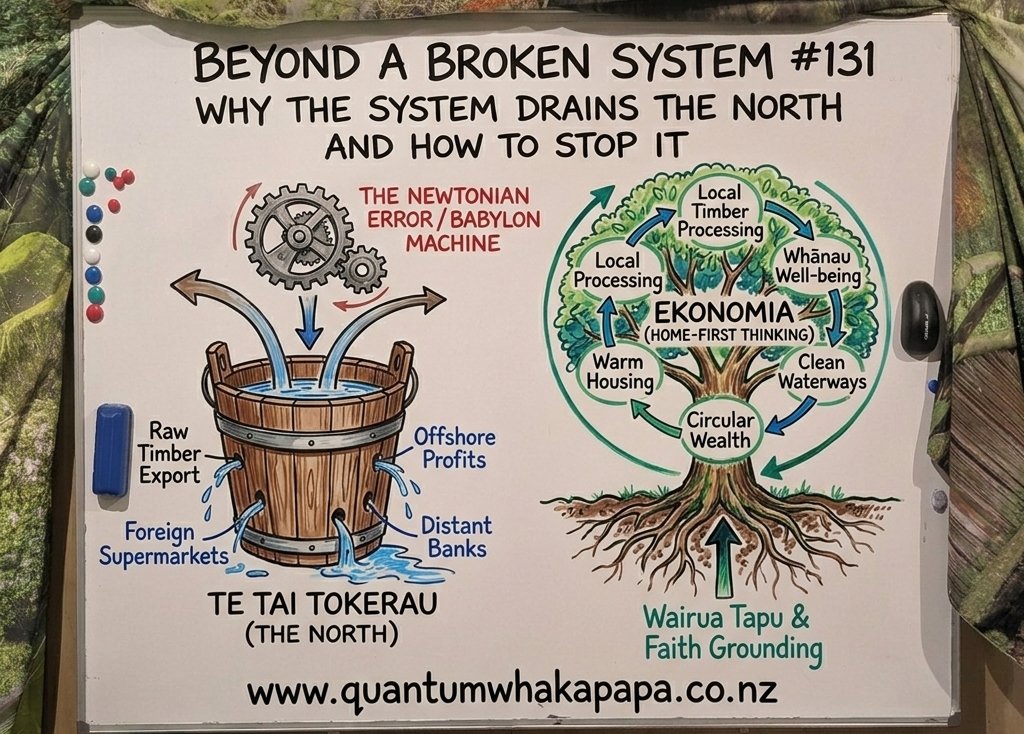
BEYOND A BROKEN SYSTEM #131 - WHY THE SYSTEM DRAINS THE NORTH AND HOW TO STOP IT
Trapped in the Machine
If you look around Taitokerau, it is easy to see the signs of struggle. We see roads that need constant repair, whānau working long hours just to get by, cold housing, and polluted waterways. The outside world often tells us that this happens because local people are failing, making poor choices, or lacking ambition. But that is a complete lie. The North is struggling because it is trapped inside a broken societal operating system that we call "Babylon".
Babylon is not an ancient city in a history book, it is a way of running society like an extraction machine. This machine was built on a massive philosophical mistake called the "Newtonian Error". Centuries ago, Western thinkers started viewing the world like a giant, mechanical clock made of separate, disconnected parts. They decided that human beings were completely separate from nature, separate from the land, and separate from each other. Because of this mistake, the system treats land as mere property to be bought and sold, and treats nature as a raw material to be mined.